
What Home Equity Actually Means
Home equity is the share of your home's value that you own free of debt. The formula is straightforward: current market value minus your remaining mortgage balance. If your home is appraised at $400,000 and you still owe $280,000, your equity stands at $120,000.
That figure is not static. It moves whenever your property's market value changes or whenever your loan balance changes - sometimes both at once. Understanding this dual nature is the starting point for making informed decisions about your home as a financial asset.
Home equity
The portion of your home's current market value that you own outright - calculated by subtracting your remaining mortgage balance from the home's market value.
Amortization
The gradual process of paying off a loan through scheduled payments. Early payments are weighted toward interest; later payments shift more toward reducing principal.
Principal
The original loan amount borrowed, or the remaining balance still owed - not counting interest.
Appreciation
An increase in your home's market value over time, driven by local market conditions and economic factors.
Loan-to-value ratio (LTV)
A percentage that compares your remaining mortgage balance to your home's current appraised value. A lower LTV means more equity.
Negative equity
A situation where you owe more on your mortgage than your home is currently worth, often called being 'underwater' on your loan.
How Mortgage Payments Build Equity Over Time
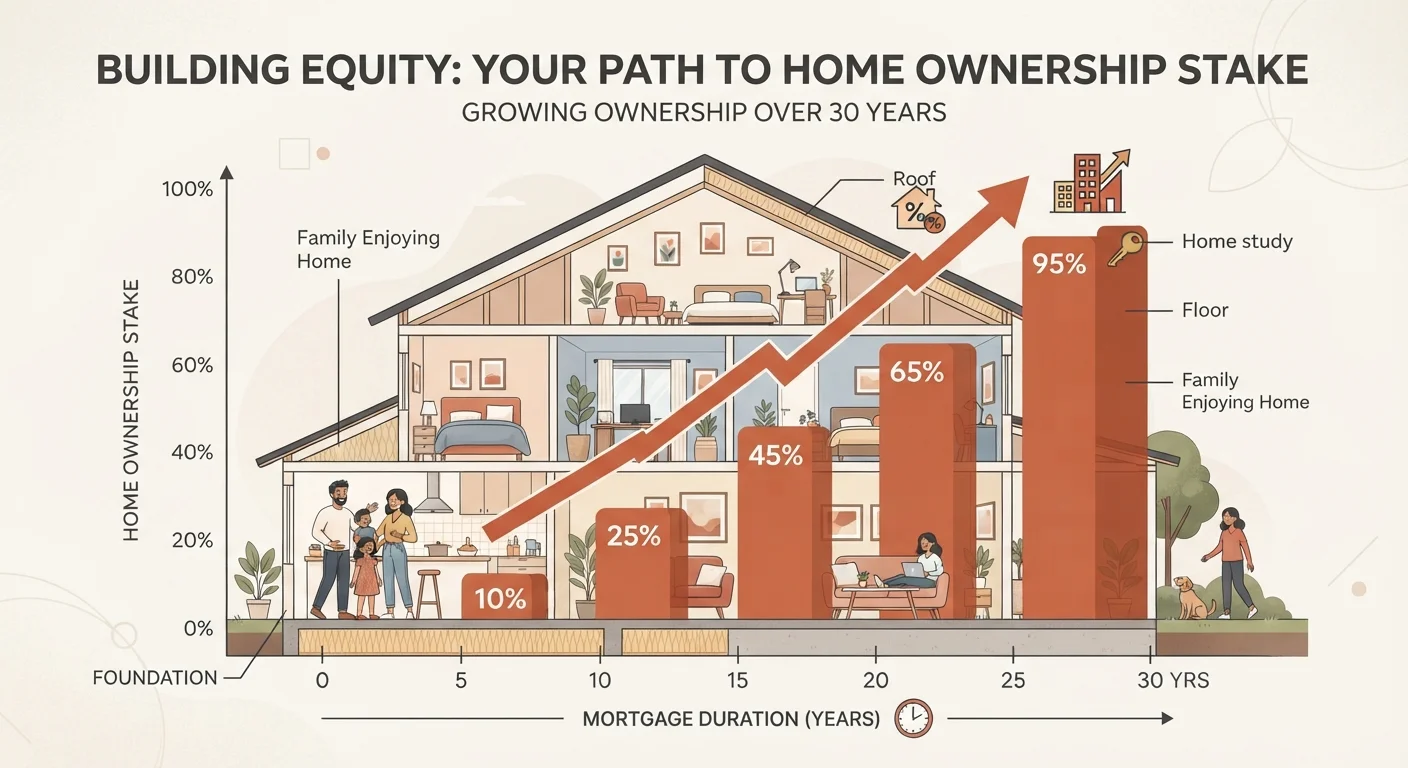
Every mortgage payment is split between interest and principal. In the early years of a standard amortizing loan, the vast majority of each payment covers interest owed to the lender. Only a smaller slice reduces the actual loan balance - and therefore builds equity.
This is called amortization. As the loan balance shrinks over time, the interest portion of each payment decreases while the principal portion grows. By the final years of a 30-year mortgage, almost the entire payment goes toward principal.
The practical implication: equity builds slowly at first and accelerates later. A larger down payment at purchase gives you an immediate equity head start and means less interest accrues over the life of the loan. Making voluntary extra payments directly toward principal can also speed the process - consult your servicer about how to ensure extra payments are applied correctly.
Make Extra Payments Count
If you want to accelerate equity through extra payments, confirm with your loan servicer that the additional amount is applied to principal - not simply credited as an early payment toward next month's bill. Even modest, consistent extra payments can shorten your loan term and increase your equity stake meaningfully over the years.
The Role of Property Appreciation
The second engine of equity growth is appreciation - an increase in your home's market value. Unlike loan repayment, appreciation happens regardless of whether you make any payments. A home purchased for $300,000 that rises to $360,000 in value has added $60,000 in equity without the owner doing anything beyond maintaining ownership.
Appreciation is driven by factors largely outside any individual homeowner's control: local job growth, housing supply and demand, neighborhood development, and broader economic conditions. Historically, residential real estate in the US has appreciated over long time horizons on average, though individual markets and individual properties vary considerably. Past trends do not guarantee future outcomes.
Home improvements can also contribute to value - though not all renovations return their full cost at resale. Projects that address structural issues or align with buyer preferences in your local market tend to hold up better than highly personalized upgrades.
What Can Slow or Reverse Equity Growth
Equity is not a one-way street. Several factors can stall or reverse its growth:
- Market downturns: A decline in local or national property values directly reduces equity, even if your loan balance is shrinking on schedule.
- Cash-out refinancing: Replacing your mortgage with a larger loan to access cash increases your balance and reduces equity accordingly.
- Home equity loans and lines of credit: Borrowing against your equity adds new debt secured by the property, lowering your net ownership stake.
- Deferred maintenance: A home in poor condition may appraise below market comparables, limiting equity even in a strong market.
- Interest-only loans: During an interest-only payment period, no principal is being repaid, so loan repayment contributes zero equity growth.
Equity Is Not the Same as Cash
Many homeowners treat equity as savings they can access freely, but it is illiquid by nature. Converting equity to cash always requires a transaction - a sale, a refinance, or a secured loan - each of which comes with costs and qualification hurdles. Factor in those friction costs before including equity in short-term financial plans.
How Homeowners Typically Use Built-Up Equity
Equity is a financial resource, but accessing it always involves trade-offs. Common options include:
- Selling the home
- The most direct route. Net proceeds after paying off the mortgage and transaction costs represent your realized equity.
- Home equity loan
- A lump-sum loan secured by your equity, repaid at a fixed rate over a set term. Adds new debt and monthly payment obligations.
- Home equity line of credit (HELOC)
- A revolving credit line tied to your equity with a variable interest rate. Flexible but carries rate risk.
- Cash-out refinance
- Replaces your existing mortgage with a larger one, delivering the difference in cash. Resets your amortization clock.
Each option comes with qualification requirements, closing costs, and interest charges. Because your home serves as collateral in all borrowing scenarios, failure to repay puts the property at risk. This is general educational information - consult a licensed financial professional before making decisions about accessing your home's equity.
Mortgage Amortization Calculator
An amortization calculator shows you exactly how each scheduled payment is split between principal and interest over the life of your loan, making equity growth patterns easy to visualize.
Consumer Financial Protection Bureau (CFPB) - Home Equity Guide
The CFPB publishes free, unbiased educational resources explaining how home equity products work, what rights borrowers have, and what to watch out for when borrowing against your home.