
What Home Equity Actually Means
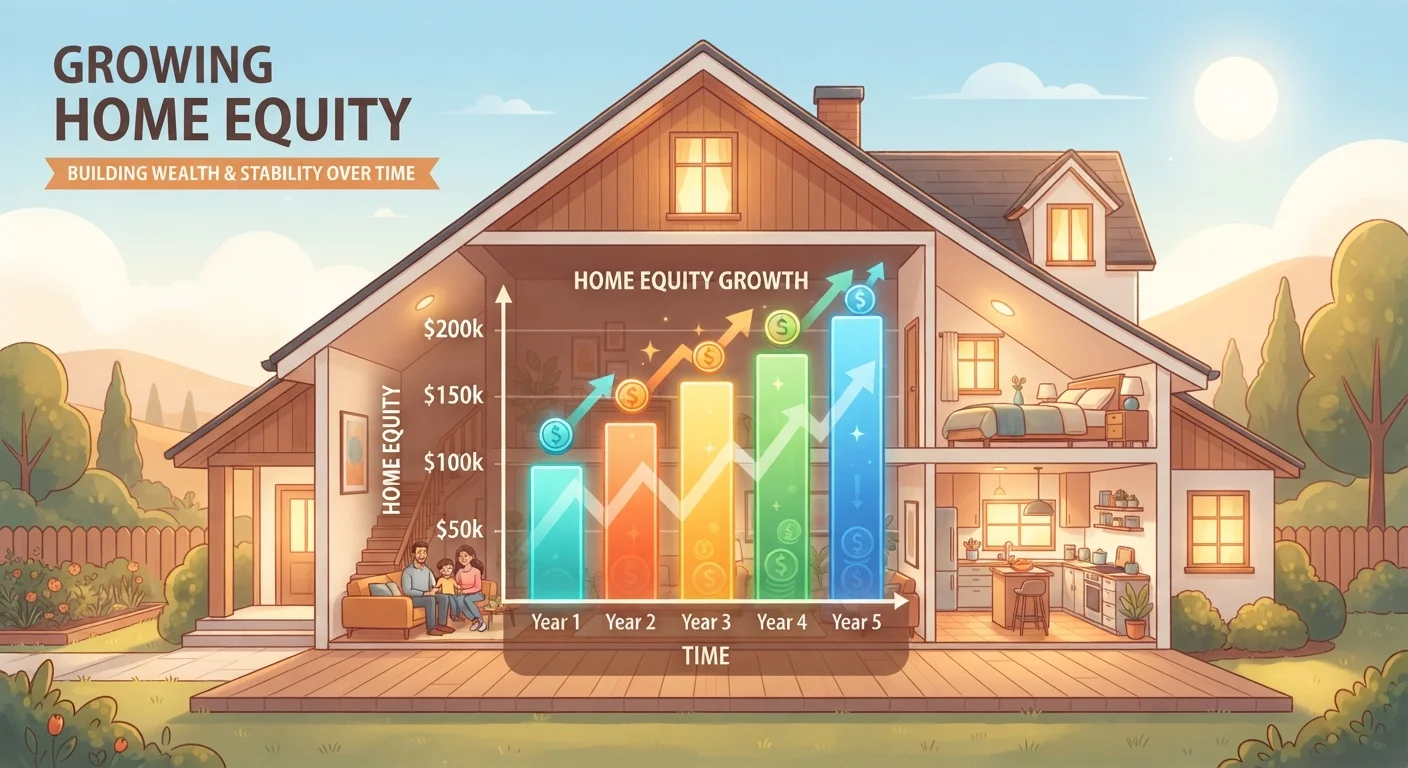
At its core, home equity is simple math: your home's current market value minus what you still owe. If your home is appraised at $400,000 and your mortgage balance is $260,000, you have $140,000 in equity. That amount represents your ownership stake - the share of the property that is unencumbered by debt.
It's worth being precise about "market value." This isn't the price you paid for the home - it's what a willing buyer would pay today, based on current conditions, comparable sales, and property condition. Values shift with the market, which means your equity can go up or down even when your mortgage balance is steadily declining.
For a comprehensive look at how all these pieces fit together, the Homeowner's Guide to Home Equity covers the full landscape in one place.
Equity and Market Value Are Not Fixed
Your home's market value - and therefore your equity - changes with local real estate conditions, interest rate environments, and economic trends. The equity you have today may be higher or lower in a year, independent of your mortgage payments. Treat any equity figure as a point-in-time estimate rather than a guaranteed balance.
How Equity Builds Over Time
Equity grows through three primary mechanisms, and most homeowners experience some combination of all three:
- Mortgage payments: Each payment you make includes a portion that reduces your principal balance. Early in a standard amortized loan, most of your payment goes toward interest - but over time, more goes to principal, accelerating equity growth.
- Property appreciation: When market values rise, your home is worth more while your debt stays the same. This can significantly increase equity without any action on your part - but it can also reverse if values fall.
- Home improvements: Some renovations increase a home's appraised value, adding equity. The gain depends heavily on the type of project and local market demand.
A larger down payment also gives you a head start. Putting 20% down on a $350,000 home means you enter with $70,000 in equity from day one.
~$300,000
Median homeowner equity in the U.S.
According to data from the Federal Reserve's Survey of Consumer Finances, homeowner equity has grown substantially as property values rose over the past decade.
20%
Typical minimum equity to avoid PMI
Most conventional mortgage lenders require at least 20% equity (an LTV of 80% or below) before removing private mortgage insurance requirements.
15-20%
Equity most lenders require you to retain after borrowing
Lenders generally cap home equity borrowing so that the homeowner retains a cushion, reducing risk for both parties if property values shift.
Why Your Equity Position Matters
Equity isn't just a number - it has real practical consequences for your financial options as a homeowner.
Refinancing: Lenders typically offer better interest rates when your loan-to-value ratio is lower, meaning more equity in your home can reduce your borrowing costs.
Selling: Your equity determines how much cash you walk away with after paying off your mortgage and covering closing costs. Low equity - especially in a flat market - can mean little to nothing at the closing table.
Borrowing against the home: Homeowners with substantial equity may qualify to borrow against it for major expenses. Common options include home equity loans and HELOCs. However, these instruments convert equity back into debt and carry real risk - including the possibility of foreclosure if you can't repay. See how homeowners typically use equity for a realistic look at trade-offs.
Private Mortgage Insurance (PMI): If your equity drops below 20% of your home's value - often calculated as an LTV above 80% - most conventional lenders require PMI, which adds to your monthly cost.
Know Your Numbers Before Making Decisions
Before refinancing, selling, or borrowing against your home, get a realistic estimate of your current market value - not just what you paid. A licensed appraiser or a comparative market analysis from a local real estate professional can give you a defensible number to work with. Decisions based on outdated or assumed values can lead to costly miscalculations.
Common Misunderstandings Worth Clearing Up
A few misconceptions trip up homeowners regularly. First, equity is not free money - accessing it means borrowing, and that borrowing has costs. Second, equity tied to rising property values can disappear: the 2008 housing crisis erased trillions of dollars in homeowner equity in just a few years. Third, owning more home doesn't automatically mean more usable equity - lenders cap how much you can borrow against your equity, typically requiring you to retain 15-20% after any withdrawal.
These distinctions matter for good decision-making. For a deeper look at where homeowners get tripped up, common home equity myths covers the most costly misconceptions in plain terms.
If the terminology around equity - terms like LTV, draw period, or subordinate lien - feels unfamiliar, the Home Equity Glossary is a straightforward reference to bookmark.
This article is for general informational purposes only and does not constitute personalized financial or legal advice. Consult a licensed financial professional for guidance specific to your situation.