
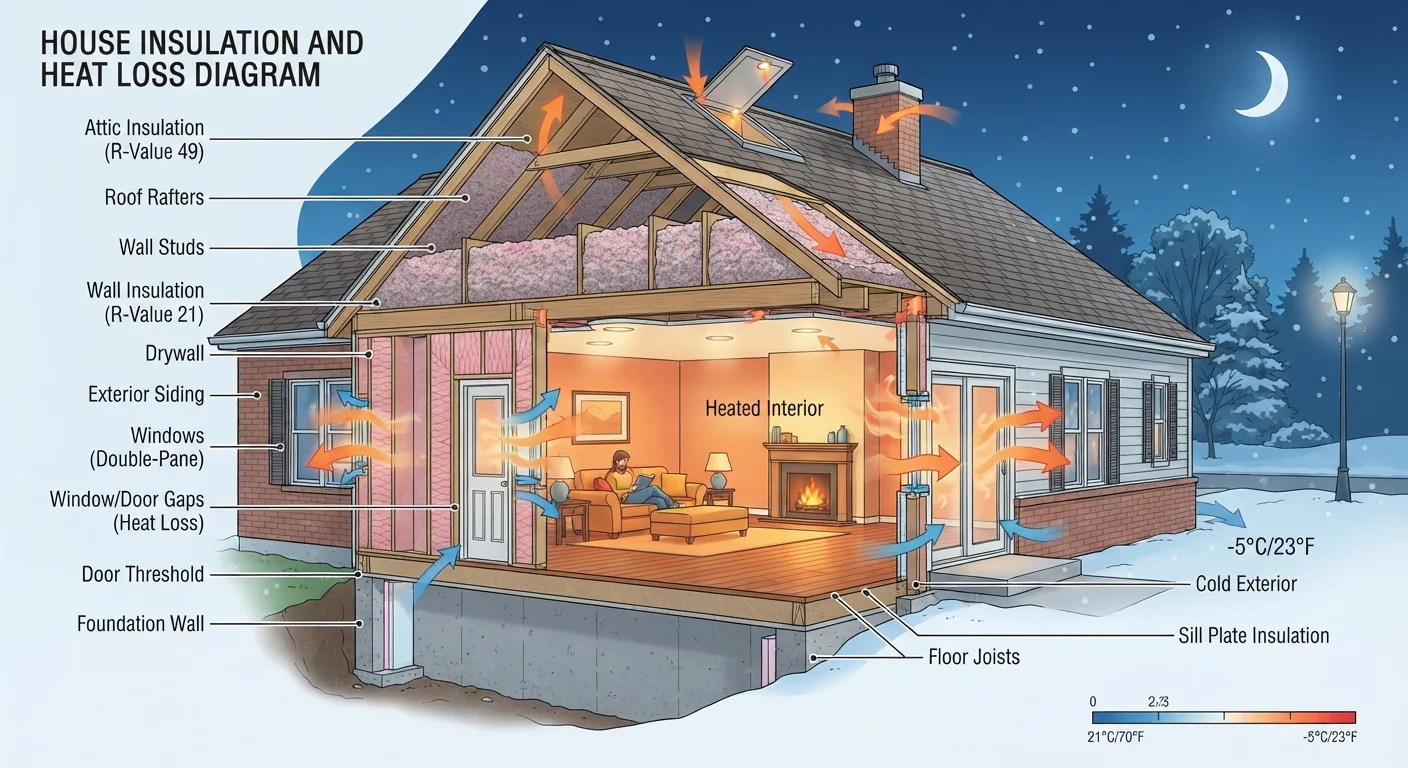
Why Your Envelope Is the Root Cause of High Bills
Heating and cooling typically represent 40-50% of a US household's total energy use, according to the US Energy Information Administration. Most homeowners assume their HVAC equipment is the primary driver of those costs. In reality, the bigger culprit is usually the building itself - specifically, how well its envelope holds conditioned air in place.
Think of your home like a cooler. A high-quality cooler keeps ice frozen for days; a cheap one with a warped lid loses temperature by the hour. Your furnace or air conditioner is the ice - but if the lid doesn't seal, no amount of ice solves the problem. Every gap, thin wall, and uninsulated attic floor is a point where energy bought and paid for simply escapes.
25-40%
Heating and cooling energy lost through air leaks
The US Department of Energy estimates that air leaks account for roughly 25-40% of the energy used to heat and cool a typical home.
10-20%
Potential savings from insulating and air sealing
According to the US Department of Energy, homeowners who properly insulate and air seal can typically cut total heating and cooling costs by 10-20%.
40-50%
Share of household energy used for heating and cooling
The US Energy Information Administration reports that heating and cooling consistently account for the largest share of residential energy consumption.
The practical implication: improving your envelope reduces the total workload on your HVAC system. Less workload means lower fuel or electricity consumption, smaller monthly bills, and less wear on equipment that costs thousands of dollars to replace.
Where Heat Actually Goes: The Main Leak Points
Not all envelope weaknesses are equal. Understanding where energy loss concentrates helps you prioritize fixes by impact rather than visibility.
- Attic floor and roof deck: Heat rises, so attic losses are almost always the largest single category. Inadequate insulation depth and unsealed penetrations - where pipes, wires, and recessed light cans pass through - are common culprits.
- Windows and exterior doors: Older single-pane windows have very low thermal resistance. Even newer double-pane windows lose heat rapidly at their frames and through failed seals. Door weatherstripping degrades over time and is often overlooked.
- Wall cavities: Homes built before the 1980s frequently have little or no wall insulation. Blown-in insulation can be added without full renovation, but it's a more involved project than attic work.
- Rim joists and basement walls: The rim joist - where your home's framing meets the foundation - is a common cold-air entry point that's easy to miss and relatively straightforward to seal and insulate.
- Electrical outlets and switches on exterior walls: These small penetrations are individually minor but collectively significant. Foam gaskets installed behind outlet covers take seconds to add and cost almost nothing.
Start With the Attic Before Anything Else
If you can only tackle one improvement, prioritize your attic. Adding insulation and sealing bypasses overhead delivers the highest energy return per dollar in most US climates. It's also one of the less disruptive projects - work is contained to the attic space and doesn't require disturbing finished living areas.
Getting an Energy Audit: The Diagnostic First Step
Before spending money on improvements, understanding your specific home's weaknesses makes every dollar go further. A professional home energy audit - conducted by a certified energy auditor - uses diagnostic equipment to measure actual performance rather than guessing.
The core tool is a blower door test: a large fan mounted in an exterior door frame that depressurizes the house, making air leaks detectable with smoke pencils or infrared cameras. Infrared thermography can also reveal insulation voids inside walls that are invisible from the surface.
Air Sealing Must Come Before Insulation
A common and costly mistake is adding attic insulation without first sealing air bypasses - gaps where wires, pipes, and framing penetrations allow air to flow freely between conditioned and unconditioned space. Insulation slows conductive heat transfer but does little to stop airflow. Seal first, then insulate, for the best combined result.
Many state and local utility programs offer subsidized or free energy audits for qualifying homeowners. Check with your utility provider or your state's energy office for available programs in your area. The findings from an audit typically include a prioritized list of improvements ranked by estimated payback period - which turns an overwhelming set of choices into a clear action plan.
Practical Fixes Ranked by Impact and Effort
Envelope improvements span a wide range of complexity and cost. Here's a general framework for thinking about them:
- Immediate, low-cost actions
- Weatherstripping on exterior doors; caulking around window frames, pipe penetrations, and electrical boxes; outlet gaskets on exterior walls; door sweeps. These typically cost under $100 total and can be completed in a weekend.
- Mid-range projects with strong payback
- Adding blown-in or batt insulation to an underinsulated attic; sealing attic bypasses before adding insulation; insulating and air-sealing the rim joist. These generally require a contractor or confident DIYer and run from a few hundred to a couple thousand dollars depending on home size.
- Larger investments to evaluate carefully
- Window replacement, exterior wall insulation, and full HVAC upgrades should be evaluated with payback period in mind. These projects can absolutely improve comfort and efficiency, but their financial return over a reasonable time horizon is less certain and depends heavily on your climate, energy prices, and how long you plan to stay in the home. Consulting a qualified contractor and possibly a financial adviser before committing to large expenditures is worthwhile.
This article is for general informational and educational purposes only and does not constitute financial, tax, or professional home improvement advice. Costs, savings estimates, and project outcomes vary by home, location, and contractor. Always verify requirements with local authorities and consult qualified professionals before undertaking significant home improvement work.