Why Water Bill Myths Are Costly to Believe
Household water bills are easy to overlook - they tend to be lower than energy bills and arrive less frequently. But the assumptions most homeowners carry about water use are often significantly off-base, and acting on those assumptions means paying more than necessary month after month. The good news: most of the corrections are cheap or free to implement.
The myths below aren't obscure. They show up in home forums, are repeated in casual conversation, and feel intuitively reasonable. That's exactly what makes them worth examining carefully. As with popular budgeting advice, the water-saving tips that sound most convincing aren't always the ones that actually move the needle.
Myth
Hand-washing dishes uses less water than running the dishwasher.
Fact
A fully loaded, modern dishwasher typically uses significantly less water than hand-washing an equivalent load.
Many homeowners assume the dishwasher is a water hog, but the math says otherwise. According to the U.S. Environmental Protection Agency, an ENERGY STAR-certified dishwasher uses roughly 3-4 gallons per cycle. Continuous hand-washing under a running tap can use 15-27 gallons for the same number of dishes. The key qualifier: the dishwasher should be full. Running a half-empty machine narrows or eliminates the advantage. Scraping rather than pre-rinsing dishes before loading also keeps water consumption low.
Myth
Indoor water use - showers, laundry, cooking - drives most of the household water bill.
Fact
For homeowners with lawns or gardens, outdoor irrigation routinely accounts for the majority of residential water use.
The EPA estimates that landscape irrigation accounts for nearly one-third of all residential water use in the U.S. on average - and in drier western states, that share climbs considerably higher. If your irrigation system runs on a set schedule regardless of recent rainfall, you may be watering at double the rate your lawn actually needs. Auditing and adjusting your sprinkler schedule seasonally, and adding a rain sensor or smart controller, are among the highest-leverage changes a homeowner can make. For a deeper look at efficient watering principles, see watering your garden more efficiently.
Myth
A slow drip from a faucet or toilet is too minor to affect the water bill.
Fact
A continuously dripping faucet or running toilet can waste thousands of gallons per year and noticeably increase your bill.
A faucet dripping at just one drip per second wastes approximately 3,000 gallons annually, according to the EPA's WaterSense program. A running toilet - where the flapper fails to seal - can waste far more, sometimes 200 gallons or more per day. Because leaks are constant, their cost compounds silently. Homeowners can check for toilet leaks with a simple dye-tablet test (drop a tablet in the tank; color appearing in the bowl without flushing indicates a leak). Fixing a worn flapper typically costs only a few dollars in parts.
Myth
Watering the lawn in the evening is better because it's cooler and water won't evaporate.
Fact
Evening watering can promote lawn disease; early morning is the recommended window for efficient irrigation.
While it's true that cooler temperatures reduce evaporation, watering at night leaves grass blades wet for many hours, creating conditions where fungal diseases can take hold. Turfgrass extension specialists generally recommend watering between 4 a.m. and 10 a.m. - cool enough to limit evaporation, but with enough daylight ahead for blades to dry. This timing can reduce water loss without the disease risk of evening irrigation. The choice of irrigation system also influences how timing interacts with water efficiency.
Myth
Low-flow showerheads and faucets will noticeably reduce water pressure and comfort.
Fact
Modern WaterSense-labeled fixtures are engineered to maintain effective pressure while using less water.
Early water-saving fixtures from the 1990s had a reputation for weak, unsatisfying flow. Contemporary low-flow designs use aerators and pressure-compensating technology to maintain the sensation of strong flow while reducing consumption. A standard showerhead uses about 2.5 gallons per minute (gpm); WaterSense-certified models use 2.0 gpm or less. For a household of three people each showering eight minutes daily, that difference adds up to roughly 4,000 gallons saved per year. The upfront cost of a fixture swap is modest and typically recouped quickly through bill savings, though individual results will vary.
Myth
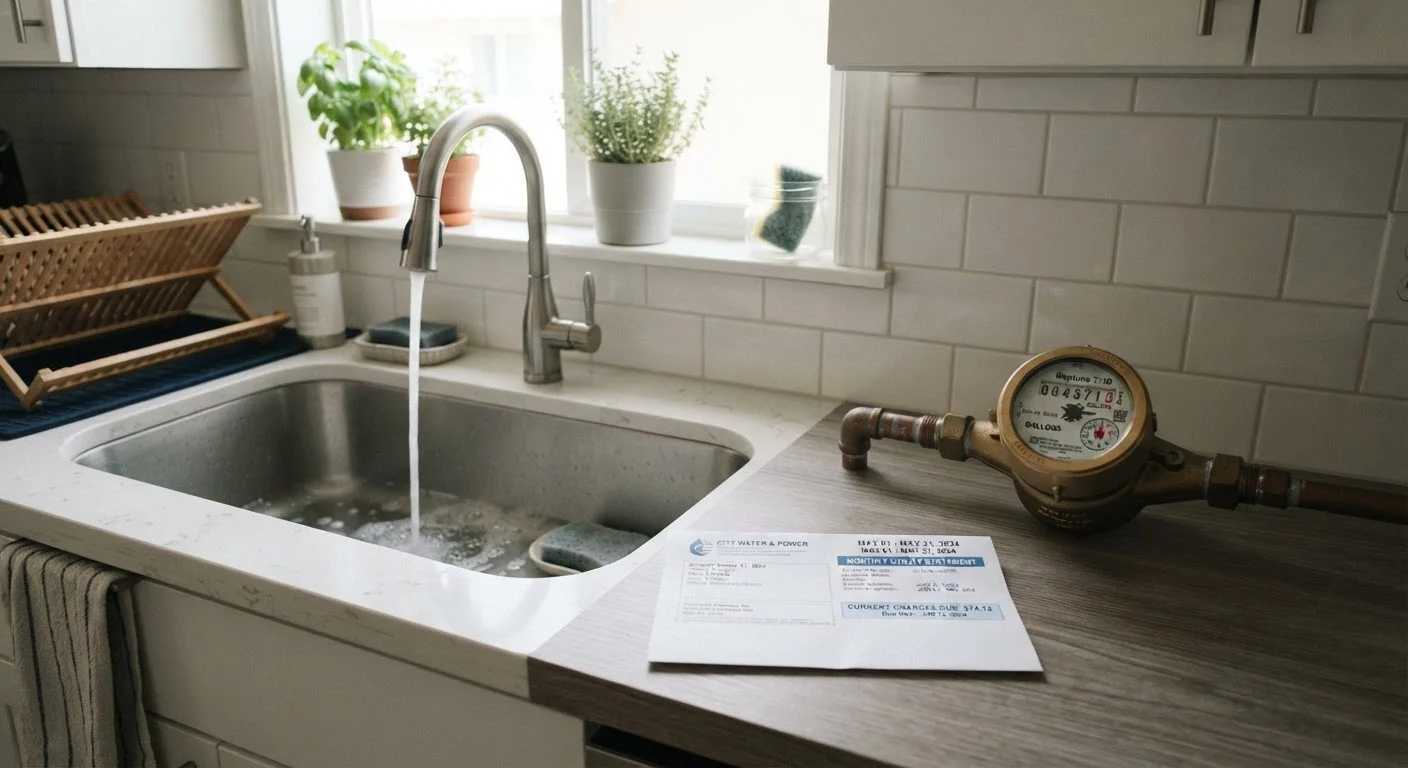
If your water bill hasn't changed, you don't have a leak.
Fact
Water bills are often averaged or estimated, and slow leaks can persist for months before appearing as a noticeable change.
Many utilities bill monthly or bi-monthly and may use estimated readings between meter reads. A steady slow leak can remain below the threshold that would trigger a visible bill spike, particularly in a household with variable usage patterns. A reliable DIY check: record your water meter reading, avoid using any water for two hours, then re-read the meter. Any movement indicates a leak somewhere in the system. Checking your meter is free and takes minutes - it's a simple habit worth building into a twice-yearly home maintenance routine.
Where to Focus Your Water-Saving Effort
Once the myths are cleared away, a clearer picture emerges: outdoor irrigation and hidden leaks are where most households have the greatest opportunity to reduce consumption, not minor behavioral changes indoors.
~30%
Share of home water use from outdoor irrigation
The EPA estimates landscape irrigation accounts for roughly one-third of all residential water use nationally, rising higher in arid regions.
3,000 gal
Annual waste from a single dripping faucet
The EPA's WaterSense program estimates a faucet dripping once per second wastes approximately 3,000 gallons of water each year.
~4 gal
Water used per certified dishwasher cycle
ENERGY STAR-certified dishwashers use approximately 3-4 gallons per cycle, compared to 15-27 gallons for hand-washing under a running tap.
That said, indoor fixtures - particularly toilets, showerheads, and faucet aerators - are worth auditing if they're older than 15 years. Pre-1994 toilets can use 3.5 to 7 gallons per flush, compared to 1.28 gallons or less for current high-efficiency models. The savings from a single toilet upgrade can be substantial in a high-use household.
Understanding what actually drives your bill is also useful when comparing it to neighbors or regional benchmarks. Water pricing varies widely across U.S. municipalities - some use tiered pricing that penalizes higher consumption at escalating rates - so the same behavioral change can produce different savings depending on where you live. Checking your utility's rate structure takes five minutes and can reveal whether you're in a tier where conservation pays off disproportionately.
For a broader look at which commonly believed home finance assumptions are worth revisiting, home equity myths follow a similar pattern - confident assumptions that quietly cost money over time.
Irrigation Timers Set and Forgotten
Automatic irrigation systems are a common source of chronic overwatering. A schedule set in spring may deliver the same amount of water in a wet October that worked in July. Review your controller settings at least once per season, and consider a rain sensor or smart controller that adjusts based on local weather data. Overwatering doesn't just raise your bill - it can damage roots and contribute to lawn disease, as covered in garden myths that harm plants.
This article is for general informational purposes only. Water rates, local regulations, and household conditions vary. Consult a licensed plumber for diagnosis of suspected leaks or plumbing issues specific to your home.