
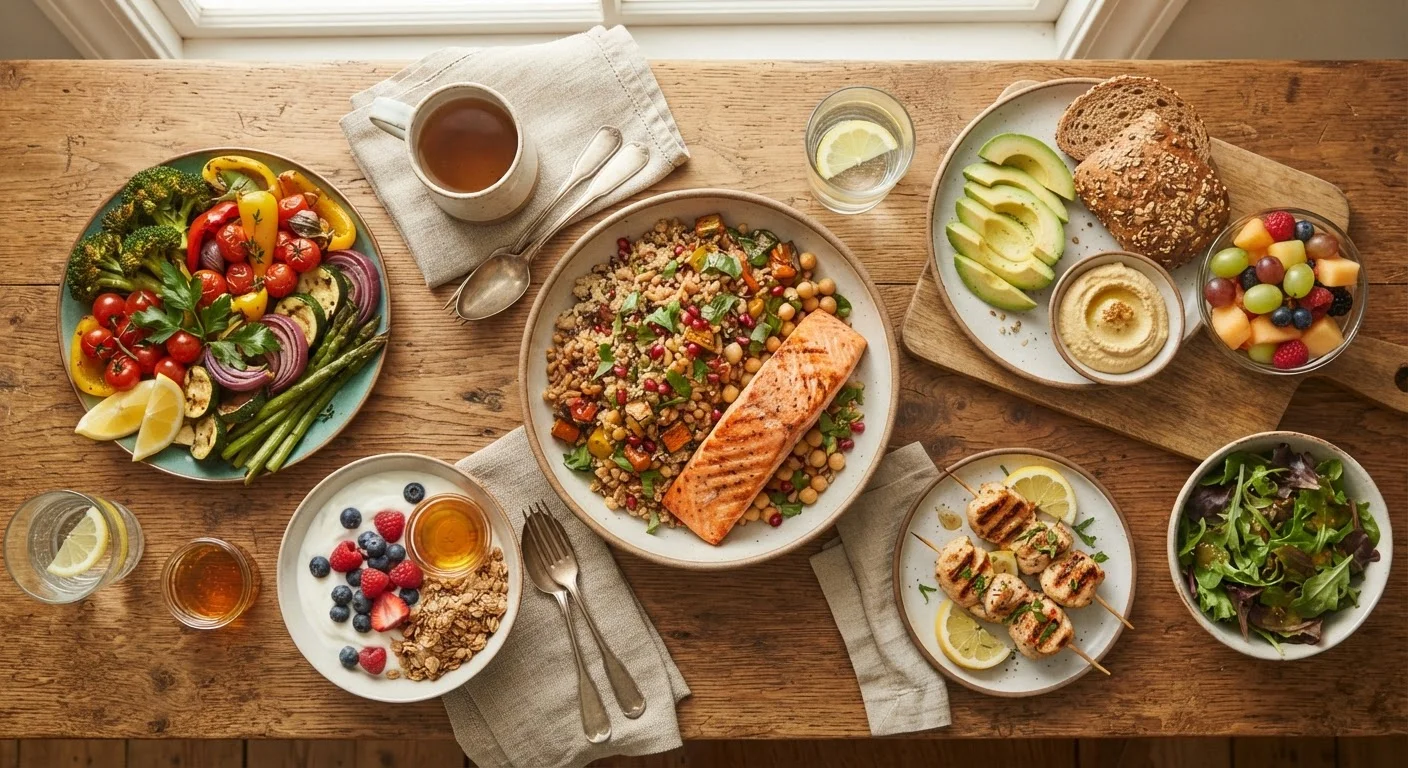
The Phrase Is Everywhere - The Definition Is Rare
"Eat a balanced diet" appears on packaging, in public health campaigns, and in doctors' waiting rooms. Yet the phrase almost never comes with a plain explanation. That vagueness leaves most people filling in the gaps with rules that may be oversimplified - or simply wrong.
Balance in nutrition refers to a pattern of eating that reliably provides what your body needs without consistently over-supplying what it doesn't need as much of. The key word is pattern. A single meal, a single day, or even a single week is rarely enough context to call an eating style balanced or not. What researchers and dietitians look at is the overall dietary picture across weeks and months.
For households trying to eat well without obsessing over every plate, this framing is actually good news. The pressure of achieving perfection at every meal is misplaced. What matters is the direction of your habits over time. Visit the Nutrition Basics hub for a broader foundation on everyday food decisions.
What Nutritional Balance Actually Involves
At its core, a balanced diet is built around three ideas: variety, proportion, and adequacy.
- Variety means rotating through different food groups and within those groups. Eating only chicken and broccoli every day misses nutrients that other proteins and vegetables would supply.
- Proportion means that no single category dominates to the point of crowding out others. Vegetables, whole grains, lean proteins, and healthy fats each serve distinct functions.
- Adequacy means you're getting enough - enough fiber, enough micronutrients, enough energy - to support your activity level and life stage.
The U.S. Dietary Guidelines for Americans describe a balanced eating pattern as one that emphasizes vegetables, fruits, whole grains, low-fat dairy or fortified alternatives, varied protein sources (including legumes, seafood, and nuts), and limited added sugars, saturated fats, and sodium. These aren't arbitrary rules - they reflect decades of nutritional epidemiology linking these patterns to reduced risk of chronic disease.
90%
Americans not meeting vegetable intake recommendations
According to the U.S. Centers for Disease Control and Prevention (CDC), roughly 90% of Americans do not eat the recommended amount of vegetables each day.
57%
Share of calories from ultra-processed foods
Research published in the journal BMJ Open estimated that ultra-processed foods account for more than half of daily calorie intake for many U.S. adults.
5+
Distinct nutrient functions in a varied diet
Carbohydrates, proteins, fats, vitamins, minerals, and water each serve distinct biological roles - no single food group covers all of them, underscoring the importance of variety.
What a Balanced Diet Doesn't Mean
Several common assumptions about balanced eating are worth correcting directly.
It doesn't mean equal portions of everything
Balance is not symmetry. Vegetables and whole grains typically make up a larger share of a well-nourished diet than, say, added fats or sweets. Proportion is calibrated to nutritional function, not visual equality on a plate.
It doesn't mean eliminating any food entirely
The idea that certain foods are inherently off-limits isn't supported by mainstream nutrition science. What matters is frequency and quantity. A diet that regularly includes moderate amounts of less-nutrient-dense foods isn't automatically unbalanced - especially if those foods are accompanied by a strong overall pattern of variety.
It doesn't look the same for everyone
Age, activity level, pregnancy status, chronic conditions, cultural food traditions, and food access all shape what balance looks like in practice. A framework useful for a 35-year-old active adult differs from one appropriate for a school-age child or a person managing a metabolic condition. Always consult a qualified healthcare provider or registered dietitian for guidance specific to your situation.
Start With One Structural Change
If your current eating pattern feels far from balanced, pick one structural shift rather than overhauling everything at once. Adding a serving of vegetables to dinner or swapping refined bread for whole grain are small changes that compound over time. Research on habit formation consistently suggests that incremental changes are more durable than dramatic overhauls.
When evaluating packaged foods, remember that marketing terms like "multigrain" or "natural" don't guarantee nutritional value. Understanding food label claims can help you cut through the noise.
Practical Patterns Worth Building
Rather than tracking every gram, most nutrition experts suggest focusing on structural habits that tend to produce balance naturally over time.
- Make half your plate vegetables or fruit at most meals - this one shift tends to improve fiber, micronutrient, and water intake simultaneously.
- Choose whole grains more often than refined ones. Oats, brown rice, whole wheat bread, and quinoa retain fiber and nutrients stripped from refined versions.
- Include a protein source at each meal - alternating between animal and plant-based options (eggs, beans, fish, tofu, chicken) broadens your nutrient range.
- Limit ultra-processed foods not because they're forbidden but because they tend to displace more nutrient-dense choices when consumed frequently.
These habits are sustainable because they're additive rather than restrictive. Instead of removing things, you're crowding out less nutritious options by building more of the useful ones in. That shift in framing makes balance achievable without constant restriction.
This article provides general nutrition information and is not a substitute for personalized dietary advice. Speak with a registered dietitian or your healthcare provider for guidance tailored to your health needs and circumstances.