
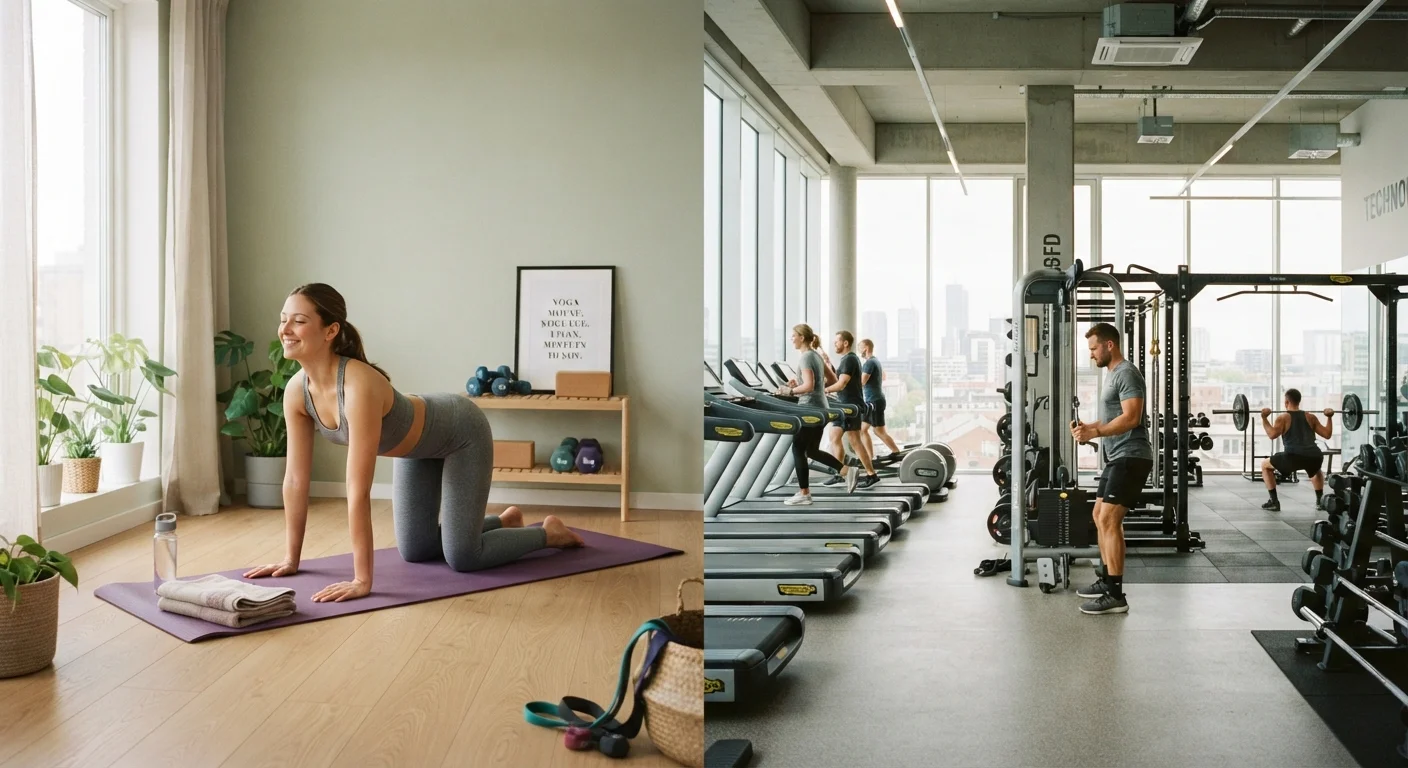
Why This Choice Matters More Than Most People Realize
Where you work out influences not just your budget but your long-term consistency - arguably the single most important factor in achieving fitness results. For busy homeowners, the friction of getting to a gym can quietly erode good intentions, while an under-equipped home setup can stall progress just as effectively. Understanding the real trade-offs helps you build a routine you'll actually sustain.
This article is for general informational purposes only and is not a substitute for guidance from a qualified fitness or healthcare professional. Individual needs vary, and consulting a professional before starting a new exercise program is always a sound step - especially if you have existing health conditions.
~$500-$800
Estimated average annual gym membership cost in the US
Industry surveys consistently place annual US gym membership costs in this range, though prices vary significantly by location and facility type.
67%
Gym members who rarely or never use their membership
Research on fitness industry behavior suggests a substantial share of gym members attend infrequently, meaning access alone does not guarantee consistent exercise.
The Case for Working Out at Home
Home fitness has grown significantly in popularity, and the reasons are practical. No commute, no membership fees, and no waiting for equipment create an environment where the barrier to getting started is genuinely low.
No monthly fees after initial setup costs
Once you own basic equipment like resistance bands or a set of dumbbells, ongoing costs are minimal. Over a year or two, home fitness typically undercuts gym membership spending significantly.
Available 24 hours a day, seven days a week
You set the schedule - early morning, late evening, or a quick lunchtime session. There are no operating hours, holiday closures, or travel time to factor in.
Private, low-pressure environment
For those who feel self-conscious in public fitness spaces, training at home removes that social anxiety entirely, making it easier to focus and stay consistent.
Space-efficient routines are genuinely effective
Bodyweight training, yoga, and resistance band workouts require minimal floor space and can deliver meaningful strength and mobility gains without large equipment.
One often-overlooked benefit is scheduling flexibility. Parents juggling school drop-offs or remote workers fitting in a midday session can exercise in windows that a gym's operating hours would never accommodate. That flexibility also makes it easier to stay consistent through seasonal changes or unpredictable schedules.
Don't forget: even a short home session benefits from a proper warm-up and cool-down. See our guide to warming up and cooling down to understand why skipping either step is a mistake, even at home.
Where Home Workouts Fall Short
Despite the convenience, home training has real limitations that affect certain fitness goals more than others.
Limited equipment restricts certain fitness goals
Heavy strength training, sport-specific conditioning, and some rehabilitation exercises rely on equipment that is expensive or impractical to keep at home.
Self-motivation is entirely on you
Without external accountability - a class time, a trainer, or fellow gym-goers - it is easy to skip sessions or reduce intensity, which gradually erodes results.
Space and household distractions are real barriers
Shared living spaces, children, pets, and domestic interruptions can make it difficult to complete focused, uninterrupted workouts, particularly during peak household hours.
No professional supervision for form or safety
Performing exercises with poor technique over time increases injury risk. At home, there is no trained eye to catch problems early, which matters especially for beginners.
Motivation is perhaps the most underrated challenge. Without the social cues of other exercisers around you, it's easy to cut sessions short or skip them entirely. A dedicated workout space - even a cleared corner of a room - helps create a psychological boundary between exercise time and rest time.
Small Spaces Can Still Support Effective Workouts
You don't need a dedicated home gym room to train effectively at home. A 6-by-6-foot area is enough for most bodyweight, yoga, and resistance band routines. Foldable equipment like collapsible yoga mats and adjustable dumbbells can be stored under a bed or in a closet, making home fitness viable even in apartments or smaller houses.
What a Gym Environment Genuinely Offers
A gym's core advantage is access to equipment diversity that would cost thousands of dollars to replicate at home - cable machines, barbells with full weight stacks, cardio equipment, and more. For anyone pursuing specific strength or athletic goals, this variety is difficult to work around.
Beyond hardware, many people find that training alongside others - even strangers - raises their effort level. This social accountability effect is well-documented in behavioral research on exercise adherence. Group fitness classes, personal trainers on the floor, and a dedicated environment all reinforce the habit of showing up.
For beginners especially, having access to staff who can demonstrate proper form reduces injury risk in a way that online tutorials alone may not fully replicate.
Making the Decision That Fits Your Life
Rather than treating this as an either-or decision, many homeowners find success blending both. A basic home setup - resistance bands, a set of adjustable dumbbells, a mat - handles daily maintenance work, while occasional gym visits address heavier lifting or classes that require specific equipment.
Ask yourself three practical questions before deciding: How much space can you realistically dedicate at home? What is your monthly budget for fitness, including equipment purchases? And honestly, does an external environment motivate you, or does it feel like an obstacle? Your answers will point toward the right balance more reliably than any universal rule.
This article is for informational purposes only and does not constitute medical or fitness advice. Consult a qualified healthcare or fitness professional before beginning any new exercise program, particularly if you have an existing health condition.