Why These Three Basics Matter More Than Most Drivers Realize
Tyres are the only part of your vehicle that actually touches the road. Everything else - steering, braking, acceleration - depends on four contact patches roughly the size of a hand. Yet tyre pressure, tread depth, and rotation schedules are among the most consistently neglected items in routine car care.
Neglect has a real cost. Under-inflated tyres can reduce fuel economy by 0.2% for every 1 PSI drop below the recommended level, according to the U.S. Department of Energy. Worn tread dramatically extends stopping distances, especially in wet conditions. And uneven wear from skipped rotations can shorten tyre life by tens of thousands of miles. None of these problems announce themselves loudly - they accumulate quietly until safety or your budget takes a hit.
This reference covers each fundamental in plain terms: what the numbers mean, how to check them, and when to act.
Tyre Pressure: Reading the Numbers Right
Tyre pressure is measured in PSI (pounds per square inch). The correct pressure for your vehicle is printed on a sticker inside the driver's door jamb - not on the tyre sidewall. The sidewall number is the tyre's maximum rated pressure, which is higher than what you should actually run.
Pressure should be checked when the tyre is cold - meaning the car has been parked for at least three hours or driven fewer than a mile. Heat from driving expands air and artificially raises the reading.
- Under-inflation causes increased rolling resistance, heat buildup, and accelerated edge wear. It also degrades handling responsiveness.
- Over-inflation reduces the tyre's contact patch, leading to center-tread wear and a harsher ride. Braking distances can increase.
A quality digital gauge is more reliable than the analog gauges built into gas-station air pumps, which are frequently inaccurate. Check pressure at least once a month and before any long trip. Tyres naturally lose about 1 PSI per month and an additional 1 PSI for every 10°F drop in ambient temperature.
PSI
Pounds per square inch - the unit used to measure tyre air pressure in the United States. Your vehicle's recommended PSI is found on the door jamb sticker.
Tread depth
The measurement from the top of the tread rubber to the bottom of the deepest groove, expressed in 32nds of an inch. It indicates how much grip remains.
Cold inflation pressure
The tyre pressure measured after the vehicle has been parked for at least three hours. Driving raises tyre temperature and artificially increases pressure readings.
Hydroplaning
A condition where a tyre rides on a film of water rather than the road surface, causing sudden loss of steering and braking control. Worn tread significantly increases this risk.
Rotation pattern
The specific sequence in which tyres are moved to different wheel positions during a rotation service. The correct pattern depends on drivetrain type and tyre design.
Rolling resistance
The energy a tyre expends as it rolls. Under-inflated tyres increase rolling resistance, which reduces fuel efficiency and generates excess heat.
Tread Depth: Knowing When You're Running Out of Grip
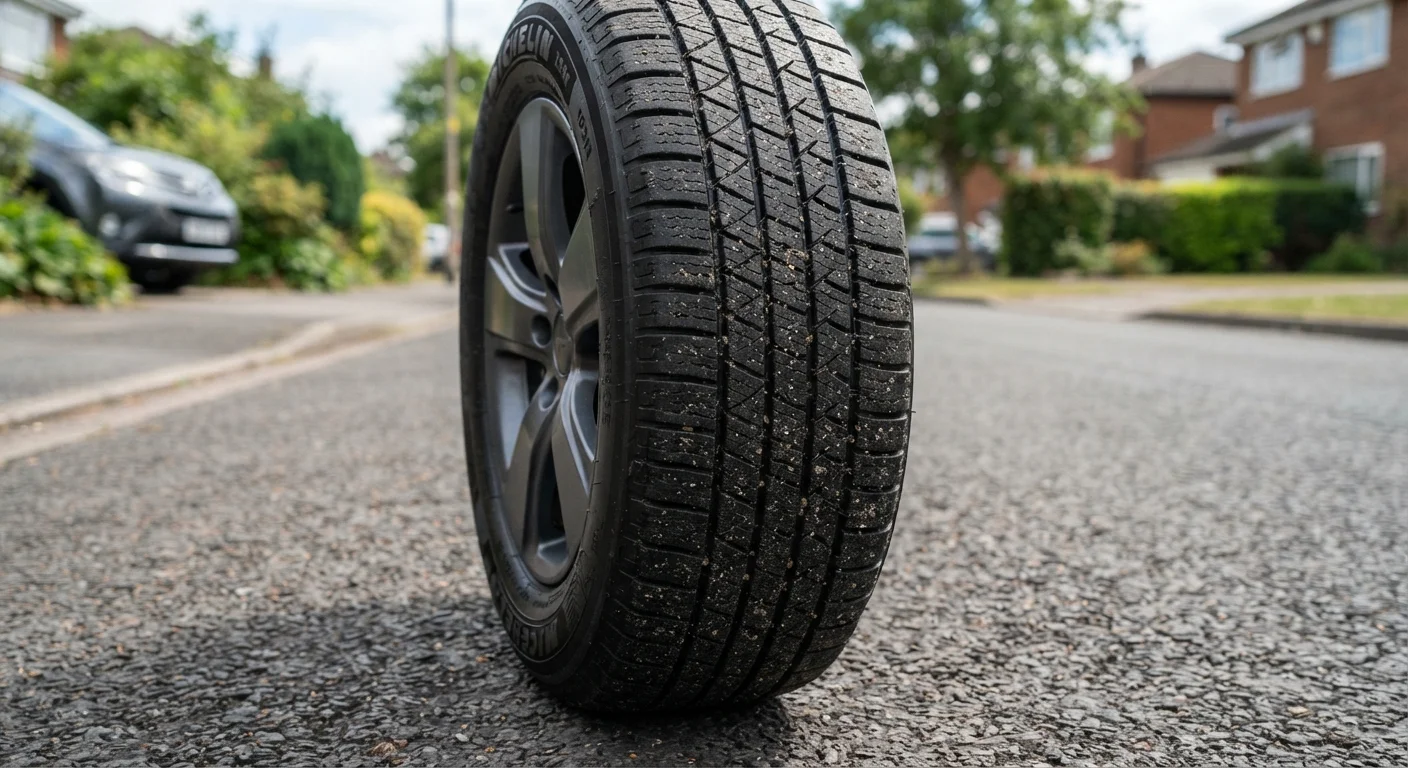
Tread depth is measured in 32nds of an inch. New passenger tyres typically start at 10/32" to 11/32". The legal minimum in most U.S. states is 2/32", but many safety organizations - including the National Highway Traffic Safety Administration (NHTSA) - recommend replacing tyres at 4/32" for improved wet-weather performance.
A tyre worn to 4/32" can take significantly longer to stop on wet pavement compared to a new tyre. By 2/32", hydroplaning risk rises considerably.
The penny test and the quarter test are quick field checks:
- Insert a penny into the tread groove with Lincoln's head pointing down. If you can see all of Lincoln's head, tread is at or below 2/32" - replace immediately.
- Insert a quarter the same way. If you can see the top of Washington's head, tread is at or below 4/32" - start planning for replacement.
Check multiple points across the tyre width and around the circumference. Uneven wear (more on one edge, or in patches) often signals an alignment, inflation, or suspension issue that should be addressed alongside any tyre replacement.
Uneven Wear Is a Diagnostic Signal
If one edge of the tyre is significantly more worn than the other, or if you notice cupping or scalloping across the tread, this often indicates a wheel alignment problem, suspension wear, or chronic under- or over-inflation - not just normal use. Replacing tyres without addressing the underlying cause means new tyres will wear out just as unevenly. A qualified mechanic or tyre shop can inspect alignment and suspension as part of a tyre service.
Rotation: The Habit That Extends Tyre Life
Tyres wear unevenly because each wheel position carries different loads and performs different tasks. Front tyres on front-wheel-drive vehicles typically wear faster, especially at the edges, because they handle both steering and power delivery.
Rotating tyres - moving them to different positions on the vehicle - evens out that wear so all four tyres wear at a similar rate and last longer overall.
0.2%
Fuel economy loss per 1 PSI under-inflation
According to the U.S. Department of Energy, fuel economy can decrease by roughly 0.2% for each PSI drop below the recommended level.
5,000-7,500 mi
Typical tyre rotation interval
Most vehicle manufacturers recommend this range; aligning rotations with oil changes is a common and practical approach.
4/32"
Tread depth threshold for wet-weather safety
NHTSA and many safety organizations recommend replacement at this depth, well before the legal minimum, to maintain adequate wet-road braking performance.
General rotation intervals: Most vehicle manufacturers recommend rotating tyres every 5,000 to 7,500 miles, which often lines up conveniently with oil change schedules. Check your owner's manual for the specification that applies to your vehicle.
Common rotation patterns:
- Forward cross: Rear tyres move straight to the front; front tyres cross to the rear. Common for front-wheel-drive vehicles.
- Rearward cross: Front tyres move straight to the rear; rear tyres cross to the front. Common for rear- and all-wheel-drive vehicles.
- X-pattern: All four tyres cross to the opposite axle and opposite side. Used in specific wear situations.
If your vehicle has a full-size spare that matches the other four tyres, some manufacturers include the spare in a five-tyre rotation - consult your owner's manual. Directional or staggered tyres have rotation limitations; a qualified mechanic can advise on the correct pattern for your setup.
This article is for general informational purposes. For tyre choices, repairs, or concerns about vehicle handling, consult a qualified tyre professional or mechanic.