What Eco Mode Actually Changes
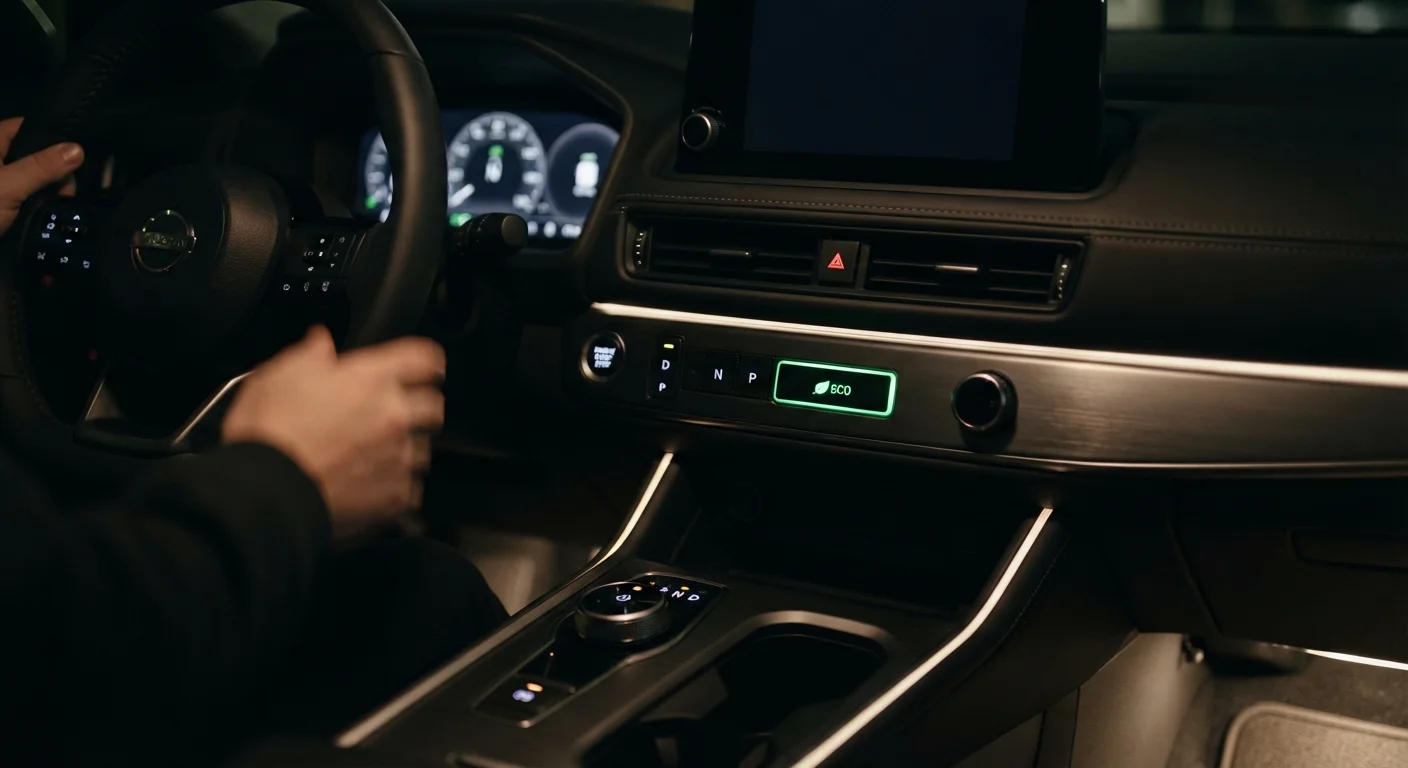
Press the Eco button and you've triggered a coordinated set of ECU recalibrations - not a single switch. Here's what typically shifts:
- Throttle mapping: The most noticeable change. The accelerator pedal's input-to-output ratio is softened, so pressing it halfway no longer commands a surge of torque. This nudges drivers toward gentler acceleration naturally.
- Transmission shift points: Automatic transmissions upshift earlier (at lower RPMs) and hold higher gears longer. Running at lower RPMs reduces fuel consumption during steady cruising.
- Climate control output: The air conditioning compressor cycles less aggressively. Some systems also reduce fan speed defaults. On a mild day this is barely perceptible; on a 95°F afternoon the cabin takes longer to cool.
- Idle behavior and accessory loads: Some vehicles reduce alternator output demands and adjust idle speed to cut unnecessary fuel burn at stoplights.
These changes work together rather than independently - that's what makes Eco mode meaningfully different from simply driving more gently on your own.
5-10%
Estimated urban fuel economy improvement
The U.S. Department of Energy notes that aggressive acceleration and braking can lower fuel economy by 15-30% in city driving; Eco mode helps moderate these behaviors.
~3%
Fuel saved by A/C load reduction
According to the U.S. Department of Energy, air conditioning can reduce fuel economy by as much as 25% in short city trips; cutting compressor aggressiveness provides measurable savings.
1-2 MPG
Typical real-world gain in mixed driving
Automotive testing organizations generally report modest single-digit MPG improvements from Eco mode in mixed-cycle testing, with results varying by vehicle and driver behavior.
When Eco Mode Earns Its Keep
Eco mode's benefits are not uniform. The driving scenario matters a great deal.
Urban stop-and-go: This is where Eco mode shines. The throttle softening directly counters the instinct to accelerate hard between red lights - the single biggest drain on city fuel economy. Paired with a smooth driving style, meaningful consumption reductions are achievable.
Steady highway cruising: At a stable 65 mph, throttle response is largely irrelevant and you're already in a high gear. Eco mode contributes modestly here - mostly through minor accessory-load reductions. Don't expect dramatic differences on a long highway run.
Hilly or variable terrain: Mixed. Earlier upshifts can cause the transmission to hunt (repeatedly shift up and down) on rolling hills, which can actually hurt efficiency. Drivers who know a route's terrain sometimes disengage Eco on hilly stretches.
Pair Eco Mode With Anticipatory Driving
Eco mode's throttle softening helps most when you're already looking ahead - scanning for stoplights turning red, slowing gradually rather than braking hard, and maintaining buffer distance from the vehicle ahead. If you coast to a stop instead of braking sharply, Eco mode amplifies those habits rather than doing the work for you.
The Trade-Offs Worth Knowing
Eco mode is not cost-free, and being honest about the trade-offs helps you use it smarter.
Throttle lag in demanding situations: The softened pedal response can feel genuinely insufficient during freeway merges or when overtaking slow vehicles. This is the most common driver complaint - and a legitimate safety consideration. Switching to Normal mode before situations requiring quick acceleration is a practical habit worth developing.
Reduced towing capacity response: Towing even moderate loads in Eco mode can cause the transmission to lug the engine in too-high a gear. Most owner's manuals recommend Normal or Sport mode when towing.
The psychology effect: Some drivers unconsciously compensate for Eco mode's softness by pressing the pedal further than they normally would. This can negate fuel savings. Eco mode works best when you're actively aware of your driving inputs - not treating it as a passive fix.
Eco Mode in Hybrids and EVs
The same label does more nuanced work in electrified vehicles. In a hybrid, Eco mode typically prioritizes the electric motor over the combustion engine for a wider range of speeds, delays the point at which the gas engine kicks in, and can increase regenerative braking intensity - converting more deceleration energy back into usable electricity.
In a fully electric vehicle, Eco mode's primary job is range extension. It does this by capping maximum power draw, smoothing out torque delivery, and maximizing regenerative braking. There's no fuel to save, but the underlying logic - discouraging energy waste during acceleration - translates directly.
If you drive an electrified vehicle, Eco mode is generally worth keeping engaged during daily commutes. The regenerative braking boost alone makes city driving noticeably more efficient, and the power cap is rarely a constraint in normal traffic.