
Space and Storage: A Practical Reality Check
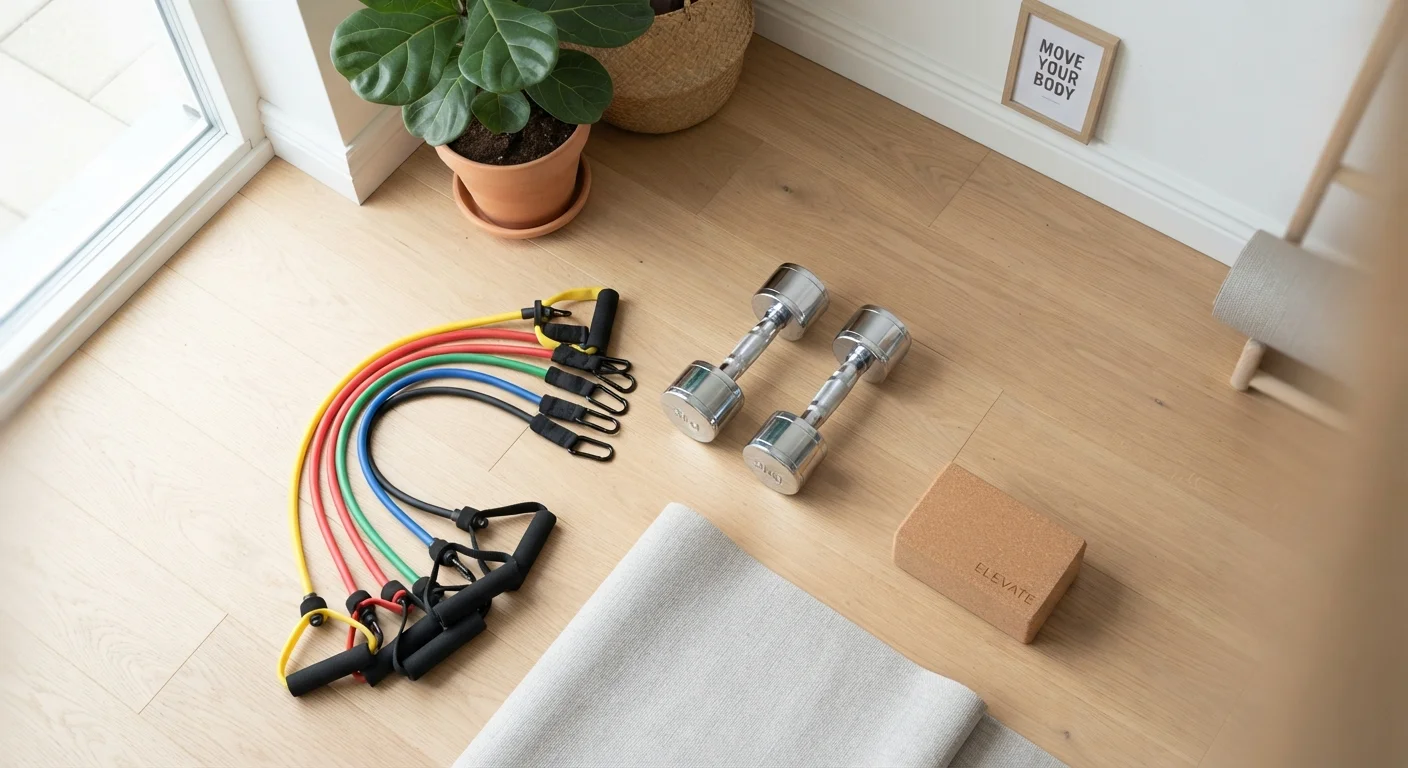
For most homeowners, available workout space is the deciding factor - and the two tools couldn't be more different here. A complete set of resistance bands, including light, medium, and heavy options, easily stores in a zip pouch smaller than a lunchbox. A set of dumbbells, even a modest range from 5 to 25 lbs, occupies significant floor area and ideally needs a rack to stay organized safely.
If you're working out in a spare bedroom, living room corner, or studio apartment, bands remove almost every spatial barrier. See our guide to training in small spaces for a broader look at what equipment formats genuinely work in compact environments.
That said, dumbbells don't require much floor space during a workout - only for storage. A small rack in a closet or under a bed frame can keep them accessible without dominating the room.
| Criterion | Resistance Bands | Dumbbells |
|---|---|---|
| Storage space needed | Minimal - fits in a small pouch | Moderate - requires floor or rack space |
| Typical starting cost | Low (often under $40 for a set) | Higher; varies by weight range |
| Long-term durability | Moderate - may degrade over time | High - rarely needs replacement |
| Progressive overload clarity | Less precise - tension varies | Clear weight increments available |
| Portability for travel | Excellent - packs in luggage | Poor - heavy and bulky |
| Lower-body compound training | Limited at higher resistance | Strong - squats, deadlifts, lunges |
| Joint stress during use | Generally lower at end ranges | Consistent load throughout motion |
Cost Considerations Over Time
Resistance bands typically carry a lower upfront cost. A multi-resistance loop or tube set generally runs well under $40 and covers a surprising range of exercises. Dumbbells vary widely: a pair of adjustable dumbbells may cost considerably more, while fixed-weight pairs can add up quickly if you purchase multiple weights to build a range.
However, durability is worth factoring in. Bands can degrade with regular use - particularly if exposed to sunlight or sharp edges - and may need replacement every one to three years depending on quality and frequency of use. Quality dumbbells, by contrast, are extremely durable and rarely need replacing, making the total cost of ownership more comparable over several years.
~$15-$35
Typical cost of a resistance band set
Multi-pack band sets (loops or tubes) are widely available in this range, making them one of the most accessible home fitness investments.
3-5 years
Average dumbbell lifespan at home
Cast iron and rubber-coated dumbbells used in home settings typically last many years with minimal maintenance, per general fitness equipment guidance.
2-5 lbs
Typical resistance band weight equivalent range
Depending on length and stretch, a single band can replicate a range of resistance levels, though exact equivalency varies by brand and user mechanics.
If you're managing a household budget and want to start moving without a large investment, bands offer an accessible entry point. For a no-equipment alternative to consider alongside either tool, progressive overload with bodyweight is also worth exploring.
Exercise Variety and Effectiveness
Both tools support a wide range of movements, but they have different strengths. Resistance bands shine in upper-body pulling exercises (rows, pull-aparts, face pulls), mobility drills, and rehabilitation-style movements. The variable resistance they provide - increasing tension as the band stretches - can challenge muscles differently than fixed loads and may reduce joint stress at vulnerable points in a movement arc.
Dumbbells, however, tend to be more effective for loaded lower-body work. Goblet squats, Romanian deadlifts, and single-leg exercises are difficult to replicate with bands at meaningful resistance. Dumbbells also allow unilateral (single-limb) training with consistent resistance, which helps identify and correct strength imbalances over time.
For busy households trying to get efficient workouts into a packed day, both tools can be used in short, focused sessions. Our guide to making short workouts count covers how to structure effective sessions regardless of equipment choice.
This article is for general informational purposes only and does not constitute medical or fitness advice. Consult a qualified health or fitness professional before beginning any new exercise program, particularly if you have existing injuries or health conditions.