
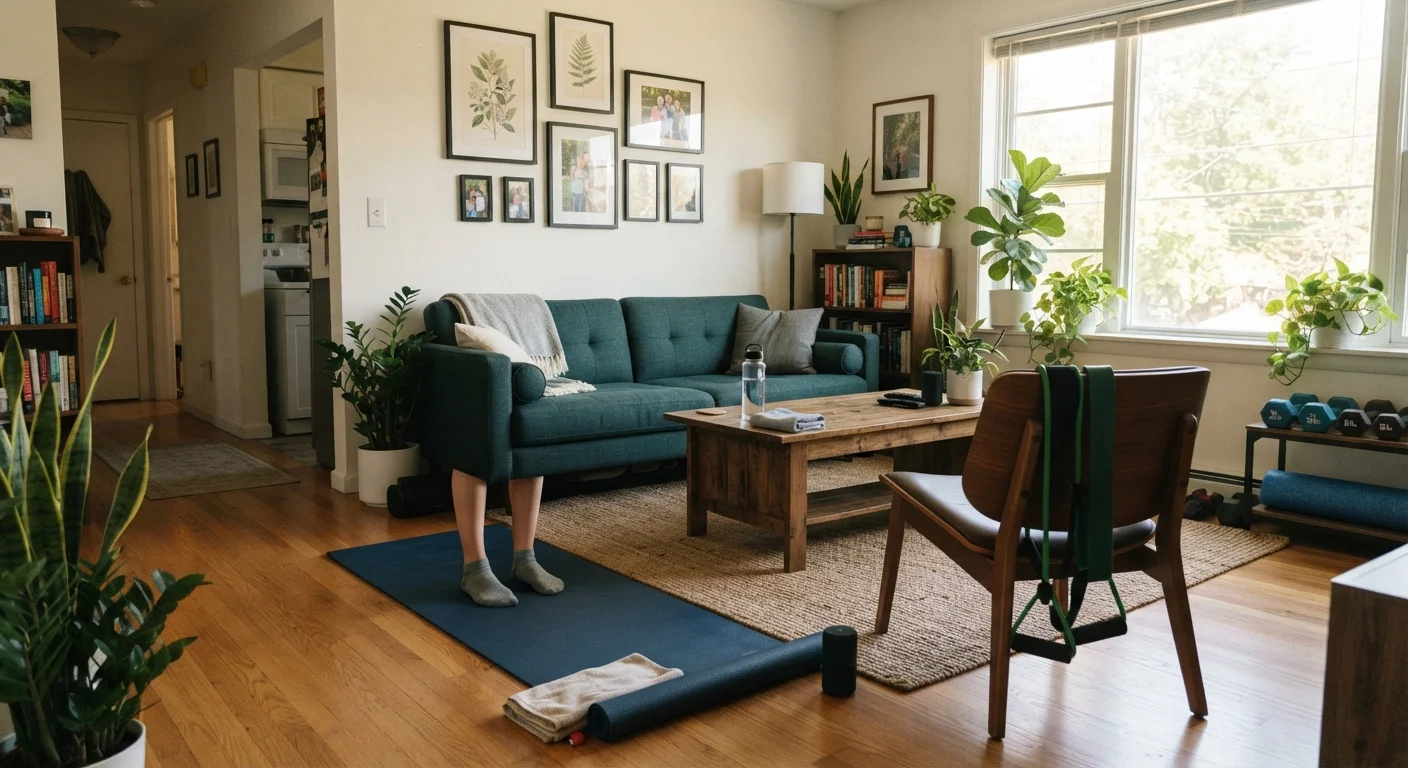
The Space Problem Is Mostly a Perception Problem
Ask most people why they haven't started exercising at home, and limited space is near the top of the list - often alongside cost and time. But the space threshold for a genuinely effective workout is lower than most people assume. The real planning challenge isn't square footage; it's identifying what actually works within your footprint and letting go of formats designed for larger environments.
Small-space fitness succeeds when you match the exercise format to the environment rather than trying to replicate a commercial gym in a hallway. That distinction shapes everything in this article.
Myth
You need at least a full room dedicated to exercise before home workouts are worth attempting.
Fact
A cleared space approximately the dimensions of a yoga mat (roughly 6 by 2 feet) is sufficient for dozens of effective exercises.
Many people postpone home workouts indefinitely, waiting until they have a spare bedroom or finished basement to convert. Research on bodyweight training consistently shows that a large proportion of compound movements - squats, lunges, push-up variations, planks, glute bridges - require no more floor space than a single mat. The key constraint is not room size but obstacle clearance. If you can lie flat and extend your arms, you have enough room. Our guide The Floor Is Your Gym shows how this approach works across every room in a typical home.
Myth
Small-space workouts can only ever be light stretching or yoga - real strength training requires a proper gym setup.
Fact
Meaningful strength and muscle endurance gains are achievable in compact spaces using bodyweight progressions, resistance bands, or a single pair of adjustable dumbbells.
Progressive overload - the principle of gradually increasing challenge over time - doesn't require a rack of barbells. Bodyweight exercises can be made progressively harder by changing leverage (elevating feet in push-ups), adding pauses, slowing the tempo, or moving to single-limb variations. Resistance bands are particularly well-suited to small spaces: they fold flat, store in a drawer, and provide variable resistance across dozens of movements. For a detailed comparison of compact equipment options, see Resistance Bands vs. Dumbbells for Home Workouts.
Myth
Running in place is the best cardio option when you can't go outside or use a treadmill.
Fact
Running in place is one of the least efficient cardio formats available for small spaces - structured alternatives deliver more return per minute.
Jogging on the spot feels intuitive but produces relatively low heart-rate elevation for most people compared to other options. Formats like jump squats, mountain climbers, burpee variations, step-ups onto a sturdy chair, and high-knee drills generate greater cardiovascular demand in the same footprint - and are easier to scale for different fitness levels. If joint impact is a concern, low-impact circuits (controlled step touches, standing core moves, slow squat pulses) can elevate heart rate without jarring force. See Low-Impact Exercise: What It Means and Who Benefits Most for a plain-language breakdown of low-impact alternatives.
Myth
Home workouts stop being effective after a few weeks because you quickly run out of variety in a small space.
Fact
Plateaus in small-space training are almost always caused by insufficient progression or planning, not by a genuine lack of exercise variety.
The human body adapts to any stimulus that is no longer novel or challenging enough - regardless of where the workout happens. The solution is structured progression: rotating movement patterns, increasing repetitions or time under tension, and incorporating tools like resistance bands or household objects to add variety. Everyday items around the home - chairs, towels, walls, filled backpacks - can expand exercise options considerably. For practical ideas, Household Objects That Double as Workout Tools offers a room-by-room look. If your routine has stalled, Why Home Workouts Stop Working addresses the most common reasons and remedies.
Myth
You need long workout sessions to get results - short sessions in a small space aren't worth the effort.
Fact
Exercise science supports shorter, consistent sessions as genuinely effective - especially when structured around quality movement rather than duration.
Session length is far less predictive of outcomes than consistency and intensity. A well-structured 20-minute circuit performed three to four times per week can produce measurable improvements in cardiovascular fitness, muscular endurance, and mobility for most healthy adults. The practical advantage for homeowners is that short sessions fit around work, children, and household demands in ways that 60-minute blocks rarely do. For guidance on building this kind of routine, Fitness for Busy Homeowners: Making Short Workouts Count provides a beginner-friendly starting framework.
Setting Up Realistically Without Wasting Space or Money
One of the most practical steps is creating a consistent, clutter-free zone - even temporarily - rather than assuming you need a permanent dedicated room. Moving a coffee table or folding back a rug takes minutes and signals mentally that it's time to train. For households where space is genuinely at a premium, Setting Up a Dedicated Workout Corner Without Wasting Space walks through low-investment ways to carve out a functional area without a renovation.
Watch for Ceiling Height and Clearance
Before performing any overhead movements - such as jumping jacks, overhead presses, or skipping - check that your ceiling height and surrounding space are adequate. Striking a ceiling fan, light fixture, or low beam is a genuine injury risk. When in doubt, substitute a lower-impact alternative.
Equipment choices matter too. A resistance band set, a jump rope (used outdoors or in a hallway with adequate ceiling height), and a yoga mat represent a low-cost, nearly zero-footprint kit that covers cardio, strength, and flexibility work. Bulky machines and full weight racks are simply the wrong tools for a small home - not because they're inferior in a gym context, but because they impose a space cost that rarely pays off for most homeowners.
This Is General Information, Not Medical Advice
The content in this article is intended for general educational purposes only. It is not a substitute for personalized guidance from a qualified healthcare or fitness professional. If you have an injury, chronic condition, or are new to exercise, consult a healthcare provider before starting any new fitness routine.
Finally, keep in mind that the best workout routine is one you'll actually repeat. Choosing an approach that fits naturally into your space and schedule - rather than one that demands ideal conditions - is the most evidence-aligned decision you can make. For ideas on structuring that routine sustainably, see Fitness for Busy Homeowners: Making Short Workouts Count.
This article provides general health and fitness information for educational purposes only. It is not a substitute for advice from a qualified healthcare or fitness professional. Consult a professional before beginning any new exercise program, particularly if you have existing health conditions or injuries.