
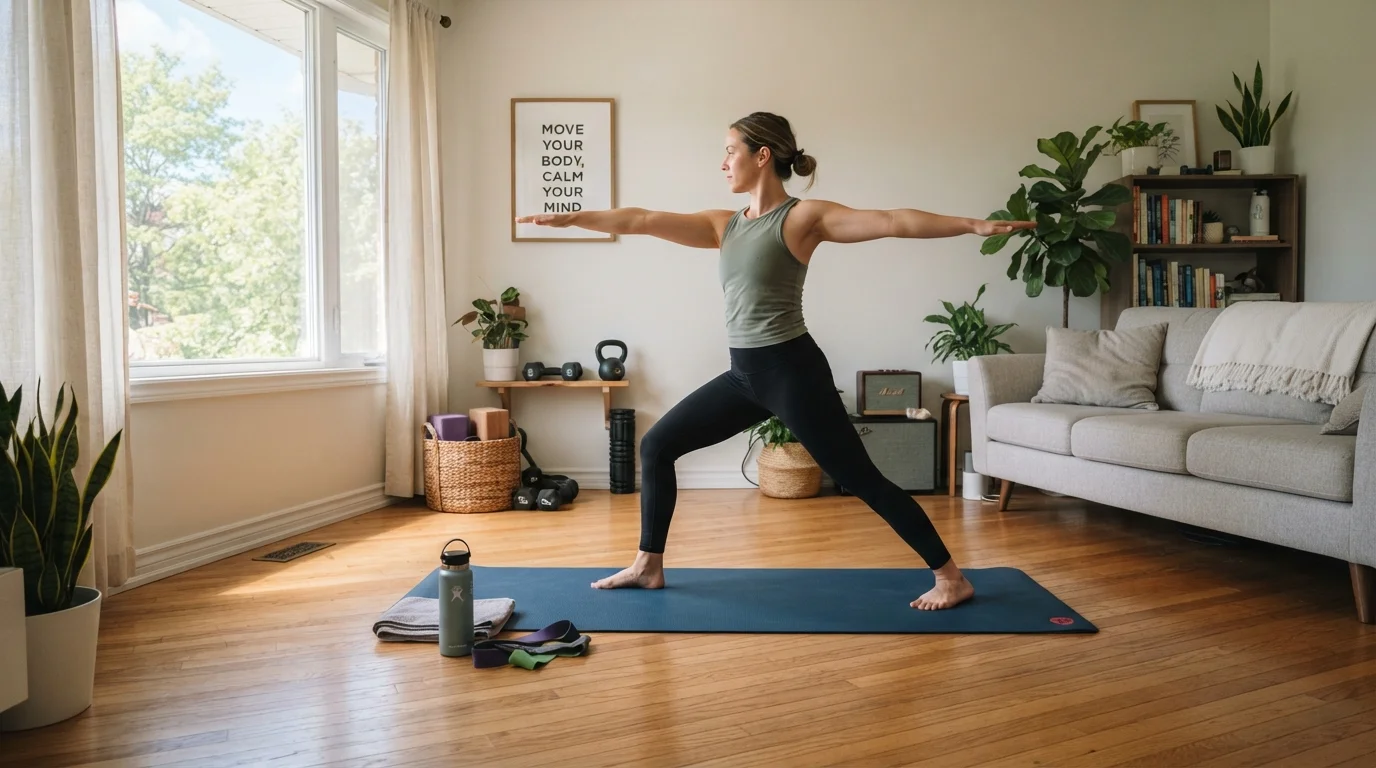
Why Home Routines Lose Their Edge
Home workouts offer genuine advantages - zero commute, no membership fees, flexible timing. Yet a surprisingly large number of people find their routines quietly stalling within weeks or months of starting. Results slow down, motivation fades, and sessions get skipped. The frustrating part is that the workout itself is rarely the only problem.
Most plateaus come from a handful of predictable patterns: insufficient progression, poor recovery habits, environmental friction, and a lack of measurable goals. Understanding which of these is affecting your routine is the first step toward fixing it. The section below outlines the most common mistakes and, crucially, what to do about each one.
This Is General Information, Not Medical Advice
The guidance in this article is intended for general educational purposes only. It is not a substitute for professional medical or fitness advice. If you have an existing health condition, injury, or are returning to exercise after a long break, consult a qualified healthcare professional before making changes to your routine.
The Most Common Home Workout Mistakes - and How to Fix Them
The following mistakes are drawn from widely recognized principles in exercise science and behavior change. They apply whether you work out in a studio apartment or a dedicated garage gym.
Repeating the same workout week after week without increasing challenge.
Why it happens: When a routine feels manageable and familiar, it's tempting to stick with it. Many people equate comfort with consistency, not realizing the body adapts quickly to repeated stimuli.
Skipping rest days or, conversely, resting so often that momentum disappears.
Why it happens: Without a coach or gym schedule, the boundaries between training and recovery blur. Some people overtrain out of guilt; others skip sessions because no one is watching.
Ignoring sleep and nutrition while expecting exercise alone to deliver results.
Why it happens: It's easy to focus on what's visible - the workout - and underestimate the role of recovery inputs that happen off the mat.
Working out in a cluttered or impractical space that creates friction every session.
Why it happens: Home environments weren't designed for exercise, so setup barriers - moving furniture, finding equipment, noise concerns - quietly erode motivation.
Setting vague goals like 'get fitter' with no way to measure progress.
Why it happens: Without a gym's built-in metrics - weight on the bar, machine readouts - home exercisers often lack a feedback loop, making it hard to know whether effort is paying off.
Abandoning a routine entirely after missing a few sessions.
Why it happens: All-or-nothing thinking is common: one missed week feels like failure, which makes restarting feel harder than it actually is.
If you're short on time but want your sessions to count, the principles in making short workouts count can help you build structure even around a packed schedule.
Getting Back on Track - Practical First Steps
Restarting after a stall doesn't require a complete overhaul. Begin with an honest audit: look at your last two or three weeks of exercise and ask whether your sessions have become easier, shorter, or less frequent than you intended. That pattern usually reveals the core issue.
From there, choose one change to make this week - not five. Adding one new challenge, clearing your workout space, or committing to a fixed time slot is more effective than a sweeping reset that's hard to sustain. Consistency across imperfect sessions outperforms occasional perfect ones every time.
~50%
Adults who quit new exercise routines within 6 months
Research consistently shows that roughly half of people who begin a new exercise program discontinue it within the first six months, according to exercise adherence literature reviewed by public health bodies.
2-4 weeks
Time for the body to adapt to a new exercise stimulus
Exercise physiologists generally note that the body begins adapting to a new movement pattern within two to four weeks, making periodic progression essential for continued improvement.
For a broader look at how the home environment shapes fitness outcomes compared to a gym, understanding the real trade-offs can help you set realistic expectations.
This article is for general informational and educational purposes only and does not constitute medical or fitness advice. Consult a qualified healthcare professional before beginning or significantly modifying any exercise program, particularly if you have any health conditions or concerns.