Why Cat Affection Looks So Different From a Dog's
Cats have a reputation for being aloof, but animal behavior research suggests that reputation is largely unfair. Cats form strong attachments to their owners - they simply express those attachments on their own terms, in ways shaped by feline social instincts rather than human expectations.
Unlike dogs, which evolved as pack animals wired for overt social signaling, cats are semi-solitary by nature. Their affection tends to be quieter, more deliberate, and more context-dependent. That doesn't make it less real - it just means owners need a different vocabulary to understand it. For a broader look at feline communication beyond affection, see our guide on reading cat body language.
Below are seven affectionate behaviors that cats display regularly, along with what each one actually signals.
Head Bunting
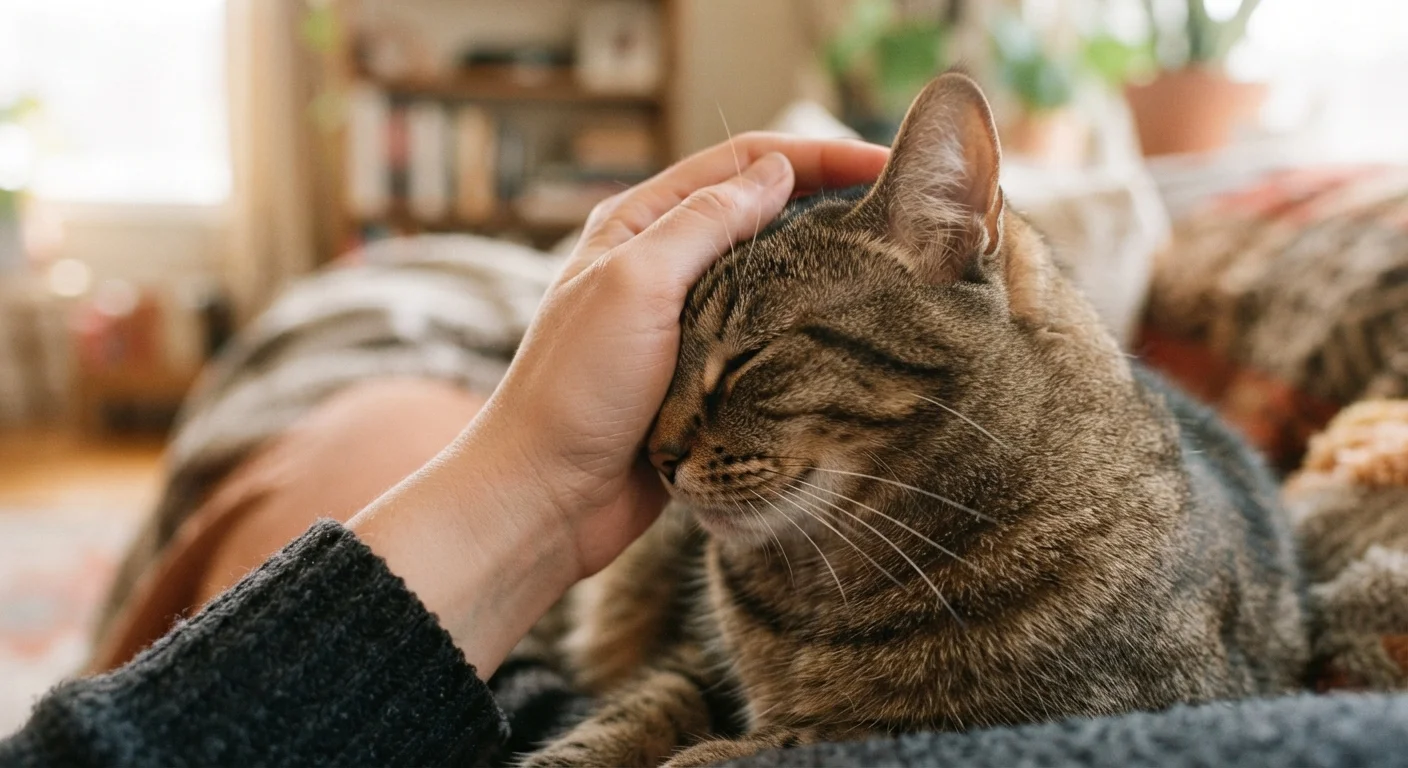
Head bunting - when a cat presses its forehead or cheek against you - is one of the most intentional displays of affection in a cat's repertoire. Cats have scent glands concentrated around the face, and bunting deposits their scent on you, marking you as part of their social group. It's a behavior cats direct almost exclusively at individuals they feel safe with and bonded to. If your cat bumps its head against your hand or face, consider it a genuine compliment.
Head bunting deposits scent on you, marking you as part of a cat's trusted inner circle.
Slow Blinking
A slow, deliberate blink from a cat in a relaxed setting is widely recognized by animal behaviorists as a signal of trust and contentment. When a cat narrows its eyes and blinks slowly at you - rather than maintaining a tense, wide stare - it's communicating that it feels safe and at ease in your presence. Many owners find that returning a slow blink is met with a reciprocal response, though results vary by individual cat. It's a subtle exchange, but a meaningful one.
A slow blink is a cat's way of signaling it feels completely safe around you.
Kneading
Kneading - the rhythmic pushing of paws into a soft surface, sometimes called "making biscuits" - originates in kittenhood, when nursing cats knead their mother's belly to stimulate milk flow. When adult cats knead on their owners, blankets, or furniture, it typically indicates a deep state of relaxation and positive association. It's a comfort behavior carried into adulthood, and when directed at you, it usually means your cat associates you with security and warmth.
When a cat kneads on you as an adult, it's drawing on a deeply comforting early memory.
Tail Wrapping and Tail Position
A cat that wraps its tail around your leg or ankle while walking past you is performing the feline equivalent of a hug. Similarly, a tail held upright with a slight curl at the tip - sometimes called a "question mark" tail - is generally a greeting signal associated with friendly, confident social interaction. These are easy gestures to overlook, but they're worth paying attention to: tail contact is a form of physical closeness that cats reserve for those they're comfortable with.
A tail wrapped around your leg is a quiet but deliberate feline gesture of closeness.
Proximity Without Contact
Not every cat is a lap cat, and some cats express affection primarily through proximity rather than touch. A cat that consistently positions itself in the same room as you - on a nearby chair, at your feet, or just within eyeline - is making a social choice. It's choosing to be near you rather than somewhere else in the home. For more independent cats, this kind of companionable presence may be their primary love language, and it deserves recognition as such.
Choosing to stay near you, even without touching, is a deliberate expression of feline preference.
Bringing You "Gifts"
A cat that deposits a toy - or, outdoors, a small prey animal - at your feet is engaging in a behavior rooted in feline social instinct. Cats that bring gifts to humans may be acting on a nurturing impulse, similar to how they would provide food for kittens. While the gift itself might not feel like a compliment, the behavior reflects a cat that views you as part of its social unit. Indoor cats that present toy mice or hair ties are expressing the same underlying impulse in a domesticated context.
Gift-giving behavior reflects a cat's instinct to provide for members of its social group.
Purring During Calm Interaction
Purring is commonly associated with happiness, but it's worth knowing that cats also purr when stressed or unwell - context matters. Purring that occurs during relaxed petting or quiet time with you is a reliable indicator of contentment and positive social bonding. Research into feline purring suggests it can also serve a self-soothing function, but the purr that accompanies slow blinking and a relaxed body posture is almost universally a positive signal. If you want to learn more about when purring means something different, common cat health myths addresses this and similar misconceptions.
Purring during calm, relaxed moments with you is a reliable signal of feline contentment and trust.
Putting It All Together
No single behavior tells the whole story. The most reliable way to understand your cat's affection is to observe patterns over time. A cat that consistently chooses to sit near you, slow-blinks in relaxed moments, and greets you at the door is expressing a coherent emotional bond - even if it never climbs into your lap.
Respond in kind to build the bond
When your cat slow-blinks at you, try returning the gesture by softly blinking back. Allow your cat to initiate head bunting rather than leaning in first - letting the cat control the contact reinforces its sense of safety. Small, consistent responses to your cat's affectionate signals help strengthen the mutual trust that underlies your relationship.
It's also worth noting that sudden changes in these behaviors can occasionally signal something other than mood. If a normally affectionate cat becomes withdrawn, or an independent cat suddenly becomes clingy, a veterinary check is worth considering. Our article on signs your cat may need a vet visit outlines the subtler signals that warrant professional attention.
If you've recently adopted and are still building trust, the process takes patience. Our guide on bringing a cat home for the first time covers how to create the right environment for that bond to develop naturally.
This article is for general informational and educational purposes only and is not a substitute for professional veterinary advice. If you have concerns about your cat's health or behavior, consult a licensed veterinarian.