What Each Approach Actually Involves
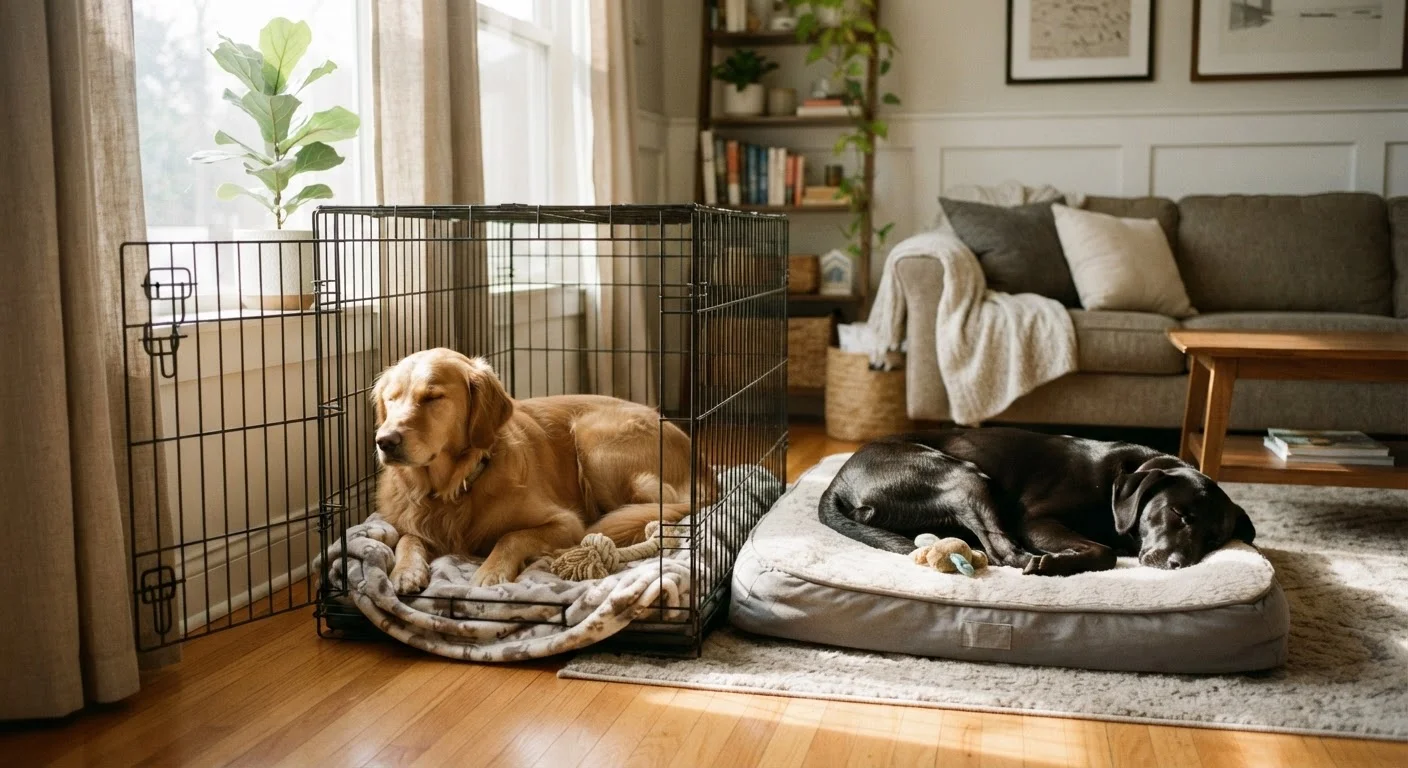
Crate training uses a dog-sized enclosure - typically wire, plastic, or fabric - to give a dog a defined, contained space during periods when direct supervision isn't possible. When introduced gradually and positively, most dogs come to treat the crate as a resting den rather than a confinement. The goal is never long-term restriction but short-term safety while the dog builds reliability.
Free roaming means the dog has unsupervised access to part or all of the home. This can range from a single room with a baby gate to full run of the house. It's not a default starting point - it's a stage reached after a dog consistently demonstrates that it won't chew, soil, or injure itself when left alone.
Most trainers and veterinary behaviorists view these not as opposing philosophies but as different phases of the same process. The real question is: where is your specific dog in that progression?
| Criterion | Crate Training | Free Roaming |
|---|---|---|
| Best suited for | Puppies, new dogs, anxious dogs | Trained adult dogs with proven reliability |
| Supports house training | Yes - strongly | Only if already house-trained |
| Physical freedom | Limited during absences | Full or partial access |
| Risk of destructive behavior | Low - space is controlled | Higher if trust isn't yet established |
| Stress risk if misused | High if overused or rushed | Low for behaviorally ready dogs |
| Suitable for seniors | May be uncomfortable physically | Generally preferred for mobility |
| Transition required | Gradual positive introduction | Incremental freedom expansion |
The Case for Crate Training
Crates serve several legitimate purposes beyond simply keeping a dog out of trouble. They support house training - dogs instinctively avoid soiling their sleeping area - and they provide a predictable, calm space for rest. For dogs who find open, busy homes overwhelming, a crate can function as a genuine retreat.
During a dog's first weeks in a new home, crating prevents the formation of bad habits before they become entrenched. A puppy who learns early that chewing furniture or eliminating indoors is not an option is considerably easier to transition to free roaming than one who spends months reinforcing those behaviors. See how to structure your new dog's first week for a practical framework.
The most important caveat: crating must never be excessive. Puppies under six months generally shouldn't be crated for more than three to four hours at a stretch during the day. Adult dogs confined for eight or more hours consistently may experience stress and frustration, which can worsen anxiety rather than resolve it.
Crating and Separation Anxiety Are Not the Same Thing
A dog who is anxious about being left alone may show distress whether crated or free roaming - the issue is the separation, not the enclosure. For these dogs, simply switching from crate to free roam (or vice versa) rarely resolves the underlying anxiety. A veterinarian or certified behaviorist can help distinguish normal settling behavior from clinical separation anxiety and recommend an appropriate approach.
The Case for Free Roaming
Dogs who have earned household freedom typically show lower stress indicators - they sleep more calmly, vocalize less when alone, and tend not to develop the repetitive behaviors sometimes associated with prolonged confinement. Physical freedom also allows dogs to self-regulate: moving to a cooler spot, finding a comfortable position, or simply pacing briefly before settling.
Free roaming works best when it's introduced incrementally. Many owners start by leaving a dog loose in a single room, then expand access as reliability is confirmed. This graduated approach lets you catch problems early - a chewed baseboard tells you the dog isn't ready for full freedom yet - without turning it into a behavioral crisis.
Senior dogs in particular often benefit from free access to the home. Mobility challenges can make entering and exiting a crate uncomfortable, and a dog who has spent years being trustworthy at home typically doesn't need confinement. For more on adjusting routines as dogs age, see how care needs shift after age seven.
How to Decide - and When to Reassess
The right approach depends on three core factors: your dog's age and developmental stage, their behavioral history, and the physical setup of your home. A nine-week-old puppy and a well-socialized five-year-old rescue are at very different starting points, even if they're the same breed.
Start by asking whether your dog has ever been left unsupervised without incident. If the answer is no - or unknown - crating during absences is the lower-risk default. If your dog has a consistent record of calm, non-destructive behavior when alone, progressive free roaming is a reasonable next step.
Dogs showing signs of distress in either scenario - excessive panting, drooling, vocalization, or self-injury - should be evaluated by a veterinarian or a certified applied animal behaviorist. These can be signs of separation anxiety, which requires a structured treatment plan rather than a simple management switch. Behavioral development also connects closely to broader socialization history; dogs with limited early exposure sometimes struggle more with transitions. Socializing a dog at any age covers how to build that foundation at any life stage.
This article is for general informational purposes only and is not a substitute for professional veterinary or behavioral advice. If your dog is showing distress or behavioral concerns, consult a licensed veterinarian or certified animal behaviorist.