How Dog Food Labels Are Regulated
Dog food sold in the United States is regulated at two levels: federally by the FDA, and at the state level through standards set by the AAFCO. AAFCO does not directly approve individual products, but it publishes ingredient definitions and nutrient profiles that most states adopt into law. This means any bag or can claiming to be "complete and balanced" must meet AAFCO standards - a concrete, enforceable benchmark rather than a marketing phrase.
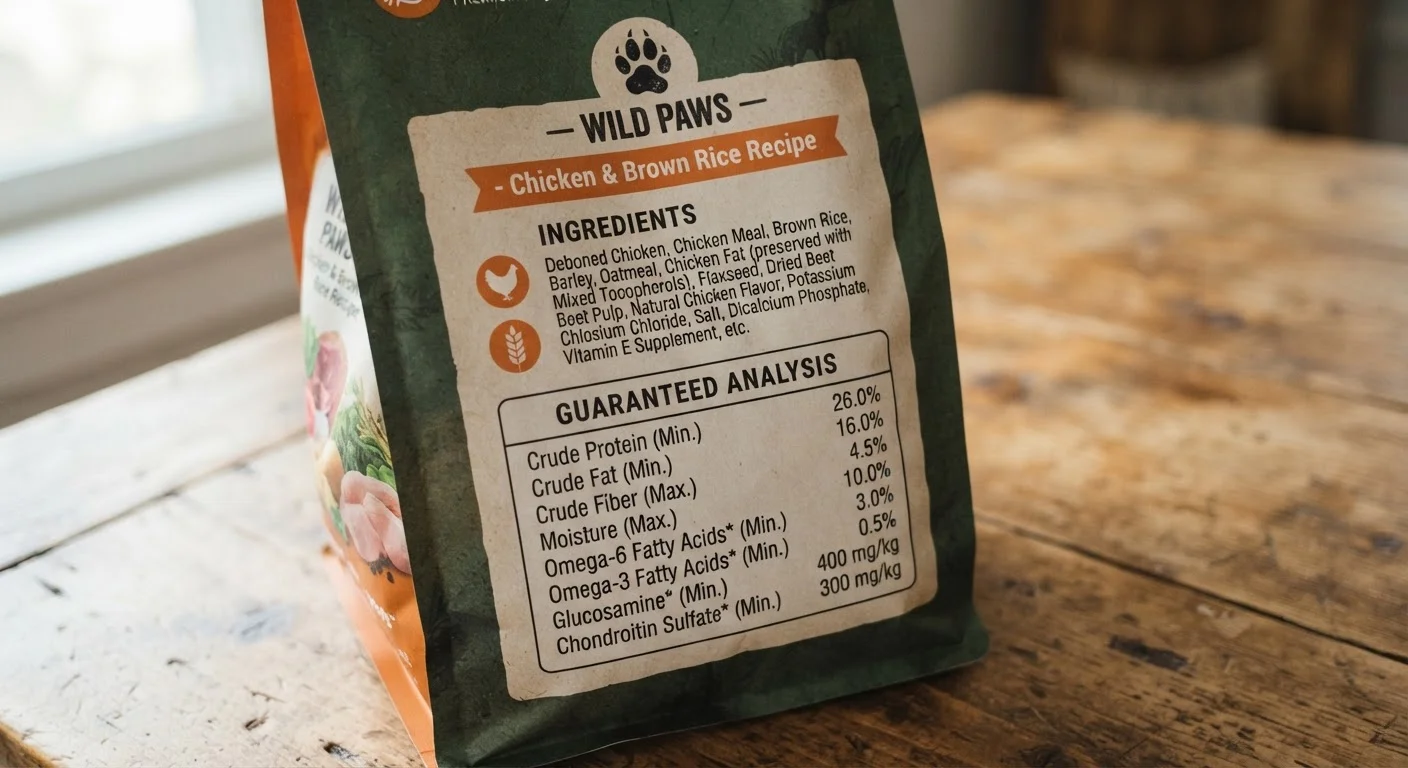
Every compliant dog food label must display six core elements: the product name, the net quantity, the manufacturer's name and address, a guaranteed analysis, an ingredient list, and a nutritional adequacy statement. Each section communicates something specific, and reading them together gives you a much clearer picture than any front-of-bag claim. For comparison, human food labels follow a similar multi-section logic.
Decoding the Ingredient List
Ingredients are listed by weight before processing, in descending order - the same rule that governs human food labels. A named meat like "chicken" or "beef" appearing first sounds reassuring, but raw meat contains a high proportion of water. After cooking, that ingredient may represent far less of the final product by weight than it appears. Conversely, "chicken meal" - which is already rendered and has water removed - delivers more concentrated protein per pound.
Ingredient splitting is a practice worth knowing. If a manufacturer lists "ground corn," "corn gluten meal," and "corn bran" separately, each falls lower on the list than if they were combined, potentially placing a single animal protein higher by comparison. This is not inherently deceptive, but it does reward careful reading rather than a quick scan of the first ingredient.
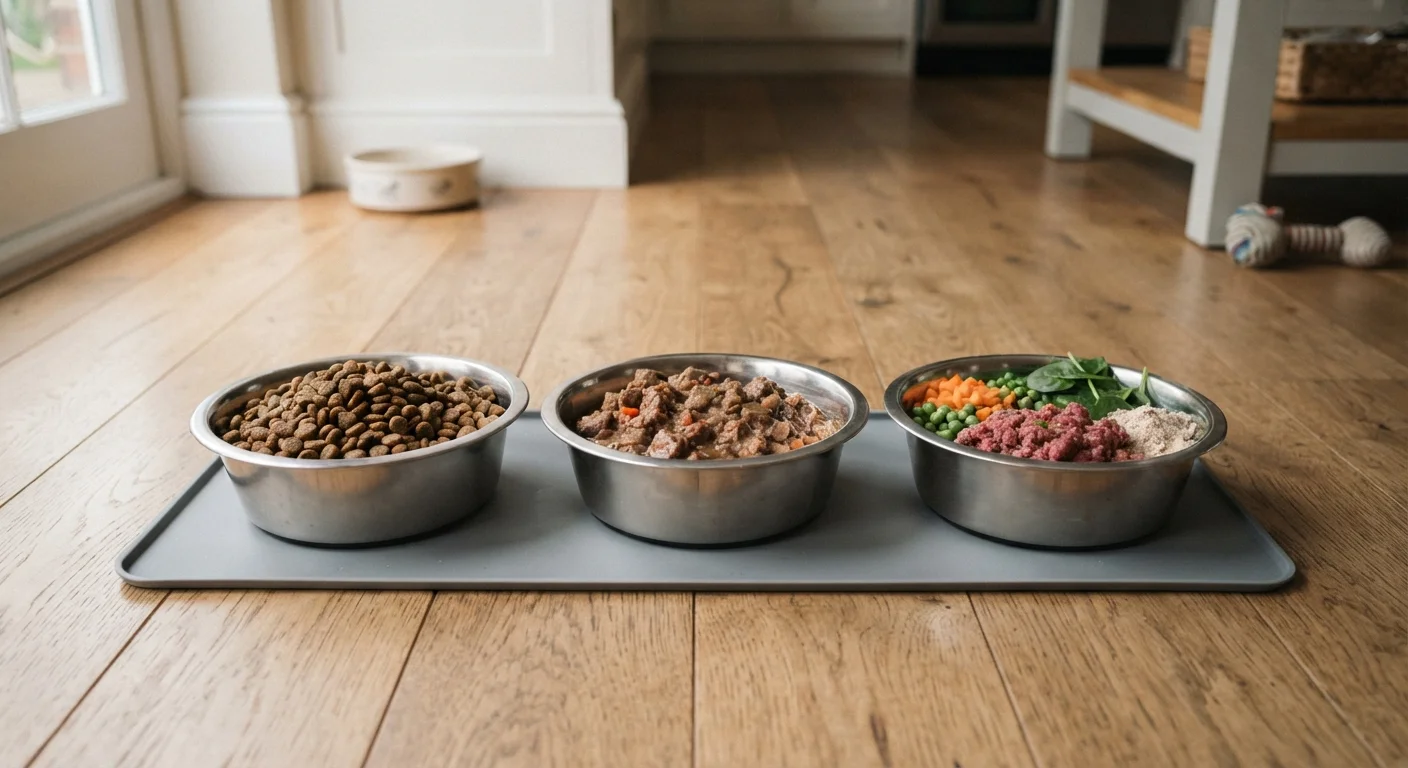
Specific named ingredients are generally more informative than vague ones. "Salmon" or "deboned turkey" tells you more than "poultry by-product meal," which can vary in composition batch to batch. By-products are not automatically inferior - they include organ meats that can be nutritionally dense - but specificity gives you a better baseline for consistency. Diet format also shapes how these ingredients are processed and delivered, which is worth understanding alongside label reading.
Crude protein
A lab measurement of total nitrogen in a food, used to estimate protein content. It reflects quantity but not protein quality or digestibility.
Chicken meal
Rendered chicken from which most moisture has been removed. Because it is pre-dried, it delivers more concentrated protein by weight than raw chicken on an ingredient list.
Ingredient splitting
The practice of listing multiple forms of the same ingredient separately, which causes each to appear lower on the list and can make other ingredients appear relatively more prominent.
Dry matter basis
A calculation method that removes moisture from the nutrient percentages, allowing meaningful comparison between wet and dry dog foods that differ widely in water content.
Nutritional adequacy statement
The AAFCO-required label statement confirming whether a food is complete and balanced, for which life stage, and by which validation method (formulation or feeding trial).
By-product meal
Rendered animal parts other than muscle meat - such as organs, bone, and blood - from a named or unnamed species. Nutritional content can vary depending on the specific ingredients included.
The Guaranteed Analysis Panel
The guaranteed analysis lists minimum percentages of crude protein and crude fat, and maximum percentages of crude fiber and moisture. The word "crude" refers to the laboratory measurement method, not the quality of the nutrient. These are guarantees of nutrient floor and ceiling values, not precise averages - actual content may vary.
To compare a wet food with a dry food using this panel, you need to convert both to a dry matter basis. Wet foods typically contain 75-82% moisture; kibble usually runs 10-12%. Stripping out moisture allows an apples-to-apples comparison of actual nutrient density. The calculation: divide the nutrient percentage by (100 minus the moisture percentage), then multiply by 100.
The panel does not tell you about nutrient quality, digestibility, or the source of a given protein. Two foods can show identical crude protein percentages while differing significantly in how much of that protein a dog can actually absorb and use. That distinction is not captured anywhere on the mandatory label, which is why the guaranteed analysis is a starting point - not a complete nutritional assessment.
AAFCO Statements and Life-Stage Claims
The nutritional adequacy statement - often called the AAFCO statement - is one of the most informative lines on any dog food package. It tells you two things: whether the food meets AAFCO nutrient profiles, and for which life stage it has been validated. A food formulated for "all life stages" meets the most demanding profile (puppy/reproduction), so it is not necessarily more nutritious for an adult dog - it may simply contain higher minimums that an adult does not need.
AAFCO recognizes two methods for substantiating adequacy: formulation (calculated to meet nutrient profiles on paper) and feeding trials (tested in live animals). Feeding trial language on the label, such as "animal feeding tests using AAFCO procedures substantiate that this food provides complete and balanced nutrition," represents a higher bar of real-world validation. Formulation-based statements are more common and still meaningful - but the distinction is worth knowing when you're comparing options.
Front-of-bag language like "natural," "holistic," or "human-grade" is largely unregulated in pet food. AAFCO defines "natural" narrowly for pet food use, but terms like "holistic" carry no regulatory definition at all. Similar labeling ambiguity applies to human food packaging, where marketing terms frequently outpace regulation. When in doubt, focus on the guaranteed analysis and AAFCO statement - these are the sections that carry legal weight.
This article is for general informational and educational purposes only. Always consult a licensed veterinarian or board-certified veterinary nutritionist for guidance specific to your dog's health needs, life stage, or medical conditions.