
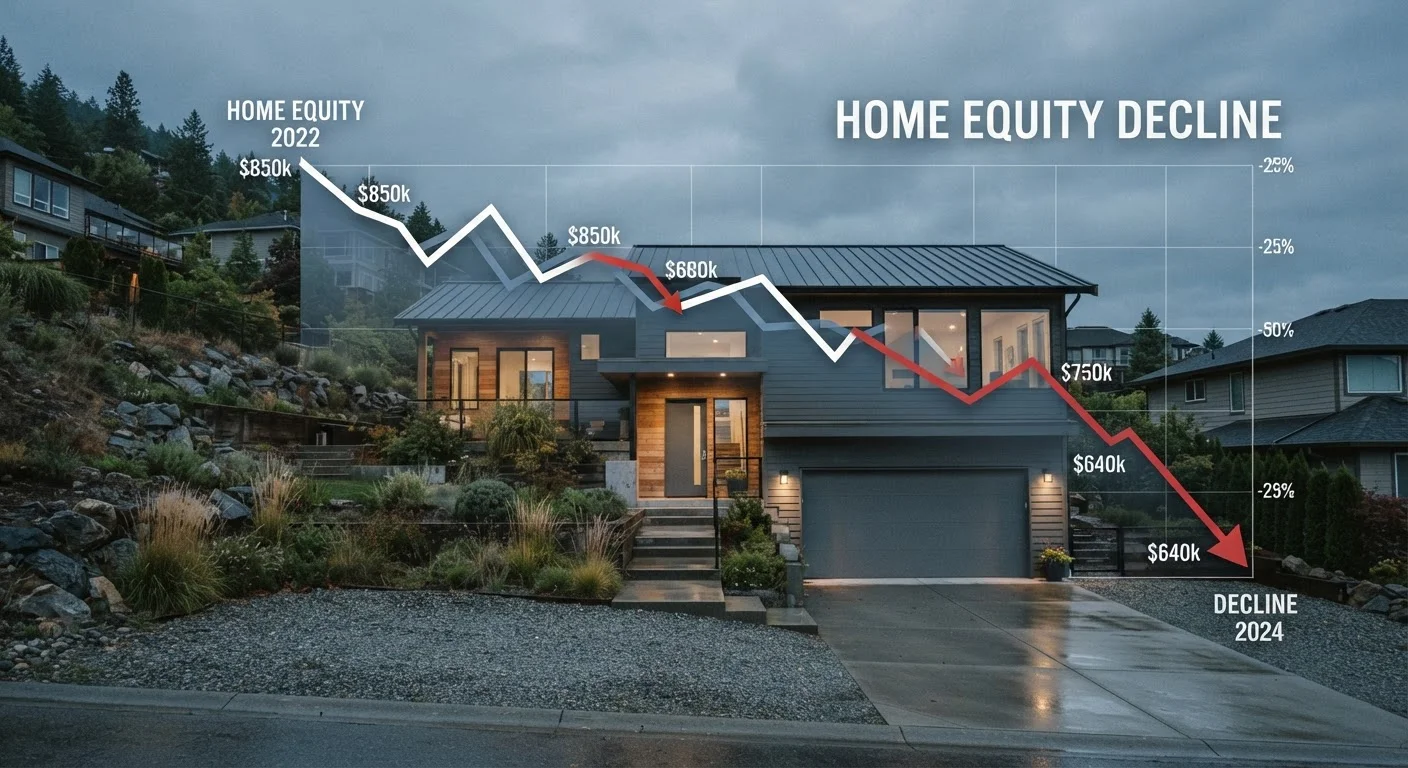
Equity Is a Moving Target, Not a Guarantee
Many homeowners assume that equity only grows - that every mortgage payment and every passing year adds to a steadily building asset. That's often true in rising markets, but it's not guaranteed. Home equity is simply the difference between what your home is worth and what you owe on it. When either side of that equation moves in the wrong direction, equity shrinks.
For a fuller grounding in what equity is and how it builds, see our Home Equity Explained guide. This article focuses specifically on the risks that can erode it.
~26%
Average US home value decline during 2008-2012 housing crisis
Federal Housing Finance Agency data shows national home prices fell substantially during the last major US housing downturn, wiping out equity for millions of homeowners.
2%-5%
Typical mortgage refinance closing costs as share of loan
According to the Consumer Financial Protection Bureau, closing costs on a refinance commonly run between 2% and 5% of the loan amount, directly reducing net equity.
$17,000
Median cost of deferred maintenance per home sale
Research by home services platforms has estimated that visibly deferred maintenance reduces sale prices by tens of thousands of dollars on average, depending on property and market.
Market Declines: The Biggest Factor Outside Your Control
Real estate markets are cyclical. Home values that rise steadily for years can plateau or fall when economic conditions shift - rising interest rates, local job losses, oversupply of housing stock, or broad recessions have all driven property value declines in parts of the US at various points in history.
When your home's appraised or market value drops, your equity drops with it - even if your mortgage balance hasn't changed. A homeowner with a $400,000 home and a $280,000 mortgage has $120,000 in equity. If that home's value falls to $320,000, equity drops to $40,000. No missed payments. No new borrowing. Just a market shift.
This is why equity should be thought of as an asset with inherent risk, not a savings account with a guaranteed balance.
“Home equity is not a savings account - it is an illiquid, market-sensitive asset that can and does lose value. Homeowners who treat it as guaranteed wealth are often the most surprised when conditions shift.”
— Housing Finance Research Community, General consensus view among US housing economists and financial educators
Borrowing Against the Home: A Direct Reduction
Home equity loans, HELOCs (home equity lines of credit), and cash-out refinancing all allow homeowners to convert equity into cash - but each one increases your debt load, which reduces your ownership stake dollar for dollar.
The risk compounds when borrowing coincides with a market softening. A homeowner who draws heavily on a HELOC during a period of high values and then sees prices decline can find themselves owing more than the home is worth. Our article on common uses of home equity covers the trade-offs of each borrowing approach in detail.
It's also worth understanding that interest costs on these products add up over time, further widening the gap between what you owe and what you own.
Fees, Costs, and the Quiet Drain on Equity
Every time you refinance or open a home equity product, transaction costs follow. Origination fees, appraisal fees, title insurance, and closing costs are real expenses - typically between 2% and 5% of the loan amount for a refinance - and they reduce your net equity at the moment you sign.
Serial refinancing, where homeowners repeatedly reset their loan to access cash or chase lower rates, can be particularly damaging if closing costs are rolled into the loan balance each time. You may be extending your payoff timeline and paying interest on fees you forgot you ever incurred.
Some homeowners are also unaware that certain loan structures - particularly some older adjustable-rate mortgages - can result in negative amortization, where the loan balance actually grows over time if minimum payments don't cover the full interest charge. This is a less common scenario today, but it illustrates how debt structure matters.
Property Condition and Deferred Maintenance
Your home's market value doesn't exist in isolation from its physical condition. A roof in disrepair, outdated systems, or visible neglect all reduce what a buyer would pay - and what an appraiser will value the property at. For homeowners carrying a mortgage or a home equity product, a lower appraisal directly means less equity on paper.
This connection between upkeep and equity is something many homeowners underestimate. The decisions that quietly erode home equity article explores how maintenance gaps accumulate into real financial losses.
The bottom line: protecting equity isn't just about financial decisions - it also involves keeping the asset itself in good condition.
What Informed Homeowners Do Differently
Understanding that equity can shrink changes how you approach homeownership decisions. It means evaluating borrowing carefully - not just asking whether you qualify for a HELOC, but whether drawing on equity now is worth the reduction in your financial cushion. It means factoring in local market conditions before assuming your home's value will recover quickly after a dip. And it means treating refinancing costs as real money spent, not just numbers rolled into a new loan.
For a broader look at misconceptions that lead homeowners into trouble, see our piece on home equity myths that mislead homeowners. The complete homeowner's guide to home equity also covers both the upside and the downside of equity as a financial resource.
This article is for general informational and educational purposes only and does not constitute personalized financial, legal, or tax advice. Consult a qualified financial professional before making decisions about your home equity or mortgage.