
Why Your Gas Budget Keeps Coming Up Short
Every family has been there: you mapped the route, punched in the MPG from your owner's manual, divided by distance, and felt confident about the fuel budget - only to stop at the pump far more often than planned. Gas costs have a way of outpacing expectations, and it's rarely one big mistake. It's a collection of small, predictable ones that stack up fast on a long drive.
Understanding why estimates go wrong is the first step to building a road trip fuel budget you can actually trust. Here are the most common missteps - and how to sidestep each one.
Relying solely on the EPA's window-sticker MPG rating for trip calculations.
Why it happens: The EPA rating is prominent, official-looking, and easy to find - so it feels like the right number to use. Most families don't realize it's derived from controlled laboratory tests, not real driving conditions.
Ignoring the fuel penalty of a fully loaded vehicle.
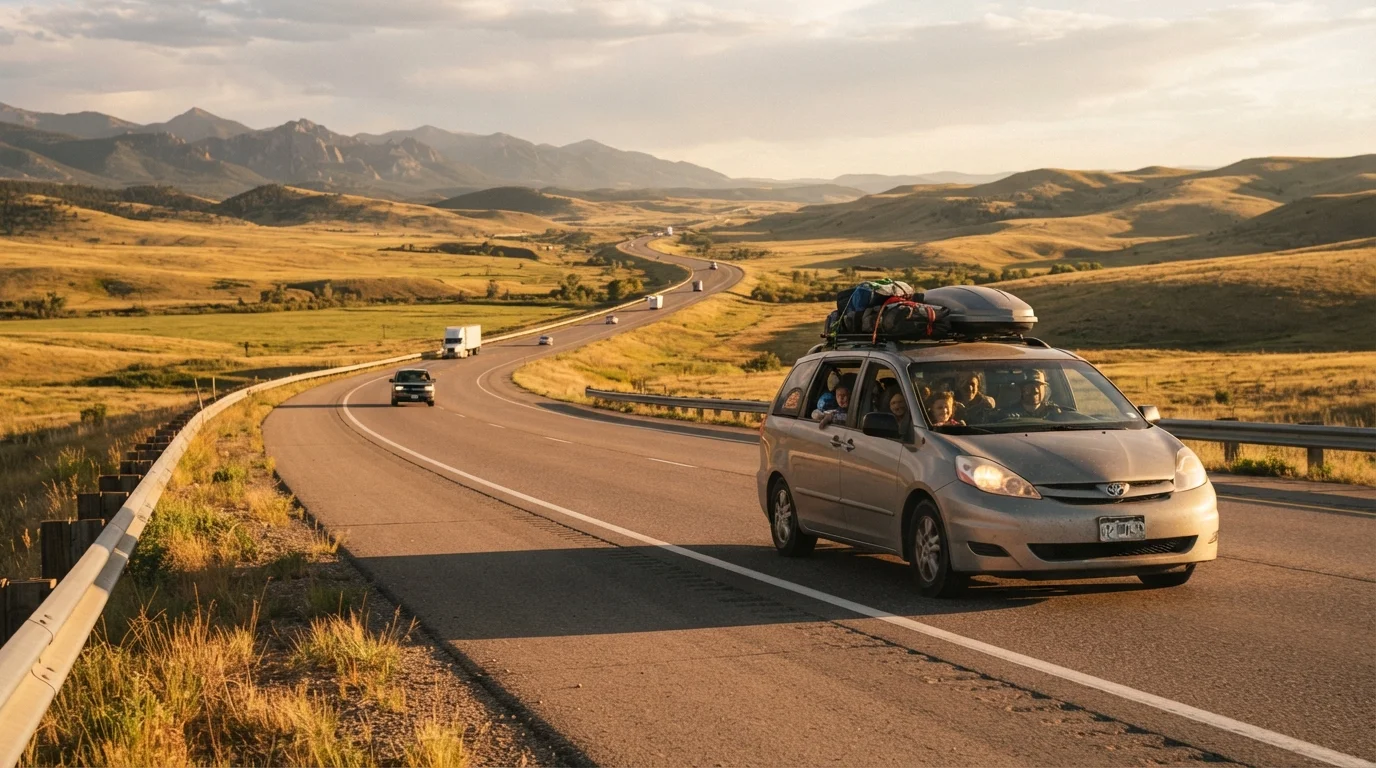
Why it happens: Families test their MPG on everyday commutes when the car is mostly empty. They assume the same efficiency applies on a road trip, not accounting for the weight of luggage, passengers, and a full roof rack.
Underestimating how much sustained highway speed reduces fuel efficiency.
Why it happens: Highway driving feels efficient because you're moving fast without stop-and-go traffic. In reality, aerodynamic drag increases significantly above 50 mph, and fuel consumption rises sharply.
Forgetting to account for air conditioning use on summer trips.
Why it happens: AC feels like a passive comfort feature rather than a fuel cost. Families plan around distance and speed but rarely think of climate control as a variable in their MPG calculation.
Using a single flat gas price for the entire trip regardless of route.
Why it happens: Families often grab a price they saw locally or recall from the last fill-up and apply it uniformly. Gas prices can vary by 30-50 cents per gallon across different states and regions.
How to Build a More Accurate Fuel Estimate
Once you know where estimates fall apart, correcting them is straightforward. Start with your vehicle's real-world MPG rather than its EPA rating. The U.S. Department of Energy's fueleconomy.gov database includes user-reported MPG figures for thousands of vehicle models - a much more honest baseline than the window sticker.
Next, apply a simple load-and-conditions adjustment. For a fully packed family vehicle traveling a hilly interstate in summer heat with the air conditioning running, many drivers find it useful to subtract 15-20% from their baseline figure. That adjusted number is what you should use in your per-mile calculation.
Up to 25%
MPG reduction from air conditioning use
The U.S. Department of Energy notes AC can cut fuel economy by as much as 25% under hot conditions.
~1-2%
Efficiency loss per 100 lbs of added weight
The DOE estimates each extra 100 pounds reduces fuel economy by roughly 1-2% in most passenger vehicles.
7-14%
Fuel economy drop at 65 vs. 55 mph
According to DOE data, driving at 65 mph rather than 55 mph typically reduces fuel efficiency by 7-14%.
Finally, look up gas prices along your specific route before you leave. State-by-state average prices are published weekly by the U.S. Energy Information Administration (EIA), giving you a reasonable regional estimate. Multiplying your adjusted per-mile fuel cost by total trip miles - and then padding by 10% for buffer - gives families a budget that holds up in the real world.
Mountain Routes Demand a Bigger Buffer
Extended climbs through mountainous terrain - like crossing the Rockies or the Appalachians - can significantly increase fuel consumption beyond flat-road estimates. If your route includes sustained elevation gain, consider adding an additional 10-15% to your fuel budget on top of your standard adjustment. Always verify current road and weather conditions through official state DOT resources before heading into high-elevation passes.
Planning a road trip through the mountain west or deep south? Terrain and seasonal demand can swing prices and consumption more than most families anticipate. The extra few minutes of research before departure almost always pays off at the pump.