Why Dogs Pull - and Why It's So Hard to Stop
Leash pulling is one of the most commonly reported frustrations among dog owners, and it is also one of the most misunderstood. Dogs do not pull to dominate or disobey - they pull because pulling has worked. Every time a dog lunges toward a smell and actually reaches it, the pulling behavior is reinforced. From the dog's perspective, it is a highly effective strategy.
This is why punishment alone - yanking back on the leash, using aversive collars - tends to suppress the behavior temporarily without teaching an alternative. The dog has not learned what to do; it has only learned that pulling sometimes creates discomfort. Positive reinforcement training, by contrast, teaches the dog that walking with a loose leash is the behavior that reliably predicts good things.
Understanding this distinction will help you stay patient when progress feels slow. You are not correcting a misbehavior; you are building a new habit, and habits take time. For additional context on how mental stimulation intersects with behavior, see our guide to environmental enrichment.
What you will need
Equipment, Setup, and the Training Steps
Before you begin, it is worth spending a few minutes on equipment. A standard flat collar works for many dogs, but if your dog has a history of strong pulling, a front-clip harness can make early training more manageable by gently redirecting their momentum. Avoid head halters unless you have guidance from a certified trainer - improper use can cause neck strain.
Front-clip harness
Redirects pulling pressure to the dog's chest and turns them back toward you, reducing forward momentum without causing discomfort.
Training treat pouch
Keeps high-value rewards accessible so you can mark and reward correct behavior within one to two seconds.
Clicker or verbal marker
Precisely marks the exact moment your dog performs the desired behavior, making rewards more informative.
4-6 foot flat leash
Provides consistent length and feel; retractable leashes teach dogs that pulling extends their range, which works against training.
Establish a marker and load your reinforcer
Before heading outdoors, teach your dog that a specific sound - a click or the word "yes" - means a treat is coming. Say your marker word and immediately deliver a treat. Repeat 10-15 times in a low-distraction room. This is called "charging" the marker and takes only a few minutes. Once your dog is orienting toward you after each marker, the association is in place.
Practice in the lowest-distraction environment first
Start indoors or in a quiet, fenced yard. Attach the leash, hold it loosely in one hand, and begin walking. The moment your dog is beside you with a loose leash, mark and reward. You are teaching your dog that staying near you - rather than forging ahead - is what earns the good stuff. Keep these early sessions to 5-10 minutes.
Apply the "stop moving" rule the moment tension appears
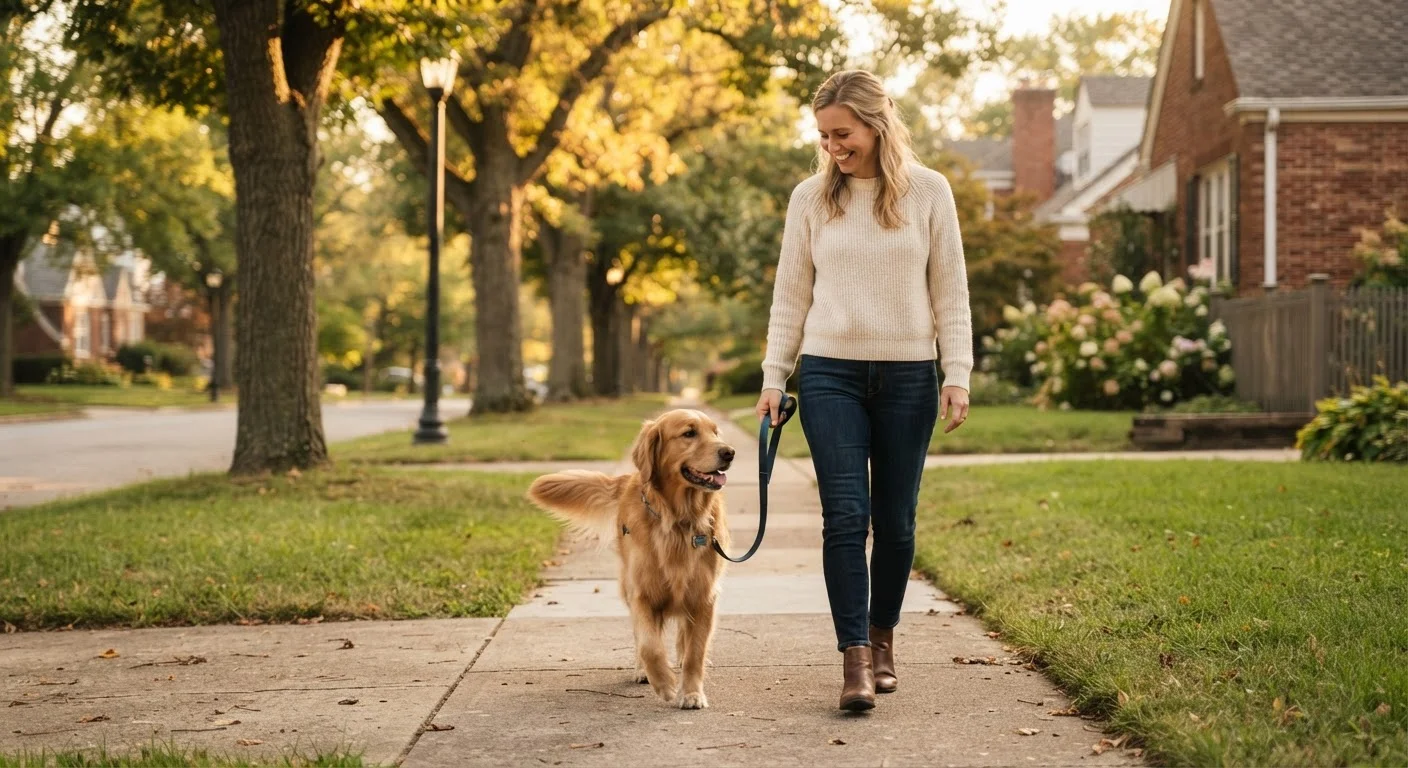
The instant the leash becomes taut, stop walking completely. Do not yank back, shout, or drag your dog. Simply plant your feet and wait. When your dog turns to check on you or the leash slackens, mark that moment and begin walking again. Every time pulling causes forward movement to stop, you are removing the reward that was reinforcing the pulling behavior. This technique - sometimes called leash pressure extinction - is the foundation of most certified trainer protocols.
Use directional changes to build attention
As your dog begins to understand loose-leash rules, add frequent, unpredictable direction changes. When your dog is paying attention and keeping up, the leash stays loose and treats flow. When they forge ahead and hit the end of the leash, you calmly pivot and walk the other way - they follow, the leash loosens, and you mark and reward. This keeps your dog oriented to your position rather than fixated on what's ahead.
Gradually add distractions and distance from home
Once your dog is walking reliably in low-distraction settings, begin practicing on quiet sidewalks, then gradually move to busier environments. Use a "distraction hierarchy" - a mental scale from easy (empty parking lot) to hard (busy park). At each new level, increase your rate of reinforcement so your dog finds staying with you more rewarding than the environment. Do not progress to the next level until your dog succeeds consistently at the current one.
Build duration and fade treat frequency over time
As your dog's loose-leash walking becomes reliable, gradually shift from rewarding every correct step to rewarding every few steps, then on a variable schedule (unpredictable intervals), which research in animal learning shows produces the most durable behavior. Continue using praise and occasional treats indefinitely - behavior maintained by reward tends to stay stronger than behavior that is simply stopped being practiced.
Sniff Breaks Are Not the Enemy
Many owners try to keep walks moving at a brisk pace, but allowing your dog to stop and sniff is genuinely enriching - scent processing is mentally tiring in the best way. Build designated "sniff time" into your walks by releasing your dog with a cue like "go sniff." This reduces the pressure your dog feels to explore everything at once, which can actually decrease pulling.
Retractable Leashes Reinforce Pulling
Retractable leashes teach dogs that pulling extends their range of movement - the exact opposite of what you want to reinforce during training. Reserve retractable leashes for open, low-traffic areas where you are not working on leash manners. Use a standard 4-6 foot leash for all training sessions.
Managing Setbacks and Common Challenges
Even with consistent practice, most dogs will have days when they pull more than usual - new environments, high excitement levels, or the presence of other dogs can temporarily override trained behavior. This is normal and does not mean your training has failed. Return to an easier distraction level, increase your reward rate, and give your dog a chance to succeed before raising the challenge again.
If your dog is highly reactive on leash - lunging, barking, or fixating on other dogs or people - standard loose-leash training may need to be paired with a behavior modification protocol designed for reactivity. In those cases, working with a certified professional dog trainer or a veterinary behaviorist is strongly recommended before progressing. Reactivity can escalate without appropriate intervention.
Consistency Across All Handlers Matters
Leash training breaks down quickly when different household members apply different rules. If one person stops when the dog pulls but another allows pulling, the dog learns that pulling sometimes works - which is actually harder to extinguish than a behavior that always works. Agree on a single approach and communicate it clearly to everyone who walks the dog, including dog walkers or family visitors.
Leash manners also benefit from a broader foundation of socialization and confidence-building. If your dog is anxious or under-socialized, see our guide to socialization at any age for approaches that reduce fear without overwhelming your dog.
This article is for general informational and educational purposes only. For guidance specific to your dog's health or behavioral needs, consult a licensed veterinarian or certified professional dog trainer.