Why Enrichment Matters for Indoor Rabbits
Rabbits are often underestimated as pets. In the wild, they spend a significant portion of their day foraging, digging, exploring, and evading predators - a behaviorally rich life that bears little resemblance to sitting in a cage or pen with a bowl of pellets. Indoor rabbits who lack adequate stimulation frequently develop stereotypies (repetitive, purposeless behaviors such as bar-chewing or circling), overgrooming, or lethargy, all of which can signal stress or boredom.
Unlike dogs, whose enrichment needs are increasingly well understood, rabbits are often overlooked - even by well-meaning owners. For more on how environmental variety shapes small-pet wellbeing, our guide on managing multiple small pets covers how different species, including rabbits, can coexist when their individual needs are met.
The good news: effective rabbit enrichment doesn't require expensive equipment. The strategies below are practical, home-friendly, and grounded in what we know about rabbit cognition and natural behavior.
Create foraging opportunities with hidden food
In the wild, rabbits spend hours searching for food. Replicating this behavior indoors is one of the most effective enrichment strategies available. Instead of placing all food in a bowl, scatter leafy greens or small amounts of rabbit-safe herbs across their space, or hide pieces inside paper bags, egg cartons, or loosely folded hay piles.
The mental effort of locating food keeps rabbits engaged and provides a meaningful daily activity. Start simple and gradually increase the complexity of hiding spots as your rabbit grows more confident.
Scattering food instead of bowl-feeding transforms mealtime into a mentally stimulating hunt.
Provide a variety of safe chewing materials
Chewing is a biological necessity for rabbits, not a destructive quirk. Their teeth grow continuously throughout their lives and require regular wear. Providing appropriate chew outlets protects both your rabbit's dental health and your furniture.
Safe options include untreated willow branches, apple wood sticks (ensure they are pesticide-free), dried pinecones, seagrass mats, and plain cardboard. Rotate materials regularly to maintain interest. Avoid painted, varnished, or chemically treated wood, and always verify that any plant material is non-toxic before offering it.
Chewing is a biological necessity - offering varied, safe materials protects teeth and prevents destructive behavior.
Build a digging station
Digging is an instinctive rabbit behavior tied to burrow construction. Indoors, a digging box gives rabbits a sanctioned outlet for this drive. A shallow plastic storage bin filled with shredded paper, hay, or child-safe kinetic sand works well for most rabbits.
Bury treats or small pieces of fresh herbs within the material to layer foraging and digging into a single activity. Place the box in a corner or partially enclosed area, as rabbits often prefer to dig where they feel protected.
A simple digging box filled with hay or shredded paper satisfies a powerful instinct many indoor rabbits never get to express.
Offer tunnel and hideout structures
Rabbits are prey animals, and their behavior reflects a constant awareness of vulnerability. Access to tunnels, hideouts, and covered spaces isn't just a preference - it's a welfare need. Rabbits who lack retreat options can become chronically stressed.
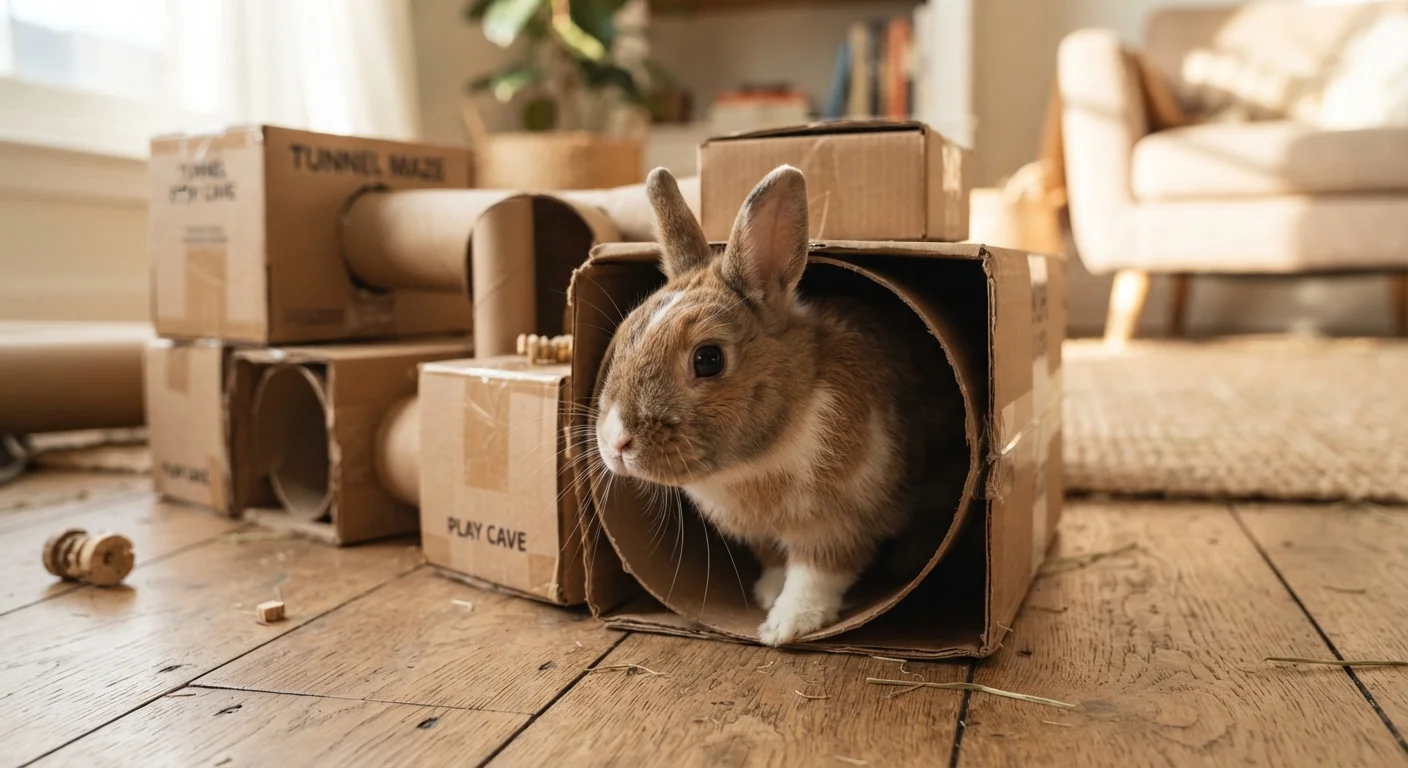
Cardboard boxes with multiple entry points, paper bag tunnels, and commercially available fabric or wicker hide boxes all serve this purpose. Arrange them so your rabbit has a connected environment to navigate rather than a single isolated shelter. This mimics the tunnel network structure of natural warrens.
Hideouts and tunnels aren't optional extras - they address a prey animal's fundamental need for perceived safety.
Schedule regular supervised free-roam time
No enclosure, however well-appointed, replaces the stimulation of a larger, varied environment. Daily free-roam time in a rabbit-proofed room or area allows rabbits to exercise, explore novel scents, and engage with their environment in ways a pen cannot replicate.
Rabbit-proofing is essential before allowing unsupervised access: cover or conceal electrical cords, block access to toxic houseplants, and secure spaces behind appliances. Even 30-60 minutes of supervised free-roam per day can measurably improve a rabbit's activity levels and mood over time.
Daily free-roam time in a rabbit-proofed space offers stimulation that no enclosure alone can replicate.
Engage with puzzle feeders and enrichment toys
Puzzle feeders designed for small animals challenge rabbits to manipulate objects to access food rewards. While rabbits are not as immediately puzzle-oriented as dogs or cats - whose enrichment needs are explored in depth in our environmental enrichment guide for dogs - many rabbits can learn to nudge, lift, or roll simple feeders given time and encouragement.
Start with low-difficulty options such as a ball that dispenses hay pellets when rolled, or a flat board with shallow compartments. Reward any interaction with the toy, even exploratory sniffing, to build positive associations before expecting the rabbit to solve it.
Puzzle feeders reward curiosity and problem-solving - start simple and let the rabbit set the pace.
Provide social interaction and gentle handling
Rabbits are social animals that benefit from companionship - whether with a bonded rabbit partner or through regular, positive interaction with their human caretakers. Isolation is a known welfare concern for rabbits kept singly. If keeping a bonded pair isn't possible, daily handling, floor-level interaction (sitting beside rather than looming over), and gentle grooming sessions can partially offset the absence of a companion.
Approach interaction on the rabbit's terms: allow them to come to you, avoid picking them up unless necessary, and keep sessions calm. For comparison, solo cats face similar social stimulation challenges - keeping a single cat mentally stimulated covers parallel strategies that may offer additional perspective for multi-species households.
Social contact - with a bonded companion or a calm, attentive owner - is enrichment in its own right for rabbits.
Building a Richer Indoor Life for Your Rabbit
Introducing enrichment doesn't need to happen all at once. Rotate activities to maintain novelty - rabbits can habituate quickly to a familiar object and lose interest within days. Pair enrichment with a solid nutritional foundation; a rabbit's diet underpins everything, and understanding why hay is non-negotiable explains the digestive logic behind that priority.
Rotate enrichment items weekly
Rabbits can lose interest in familiar objects within a few days. Swapping out chew items, rearranging tunnels, or introducing a new foraging setup weekly maintains novelty without requiring a constant supply of new materials. A small collection of items rotated on a schedule is more effective than many items offered all at once.
Observe your rabbit's individual preferences. Some are bold explorers; others are cautious and may need gradual introduction to new items. Patience and observation are your best tools for tailoring enrichment that actually gets used.
This article is for general educational purposes only. For concerns about your rabbit's health or behavior, consult a veterinarian with experience in small exotic animals.