
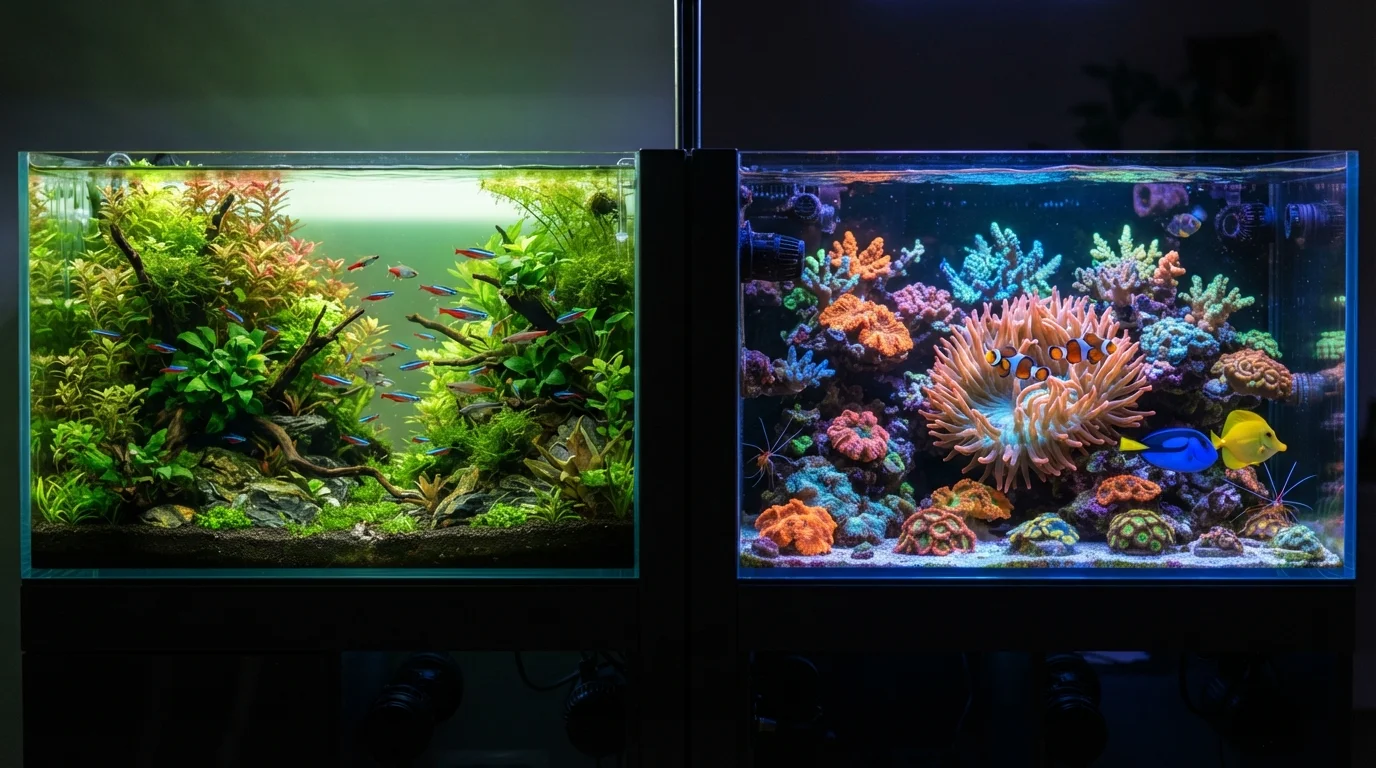
Cost and Equipment Differences
Setup cost is often the first factor that shapes a decision. A basic freshwater tank - including a filter, heater, lighting, and substrate - can be assembled for a few hundred dollars. A comparable saltwater system typically costs two to three times more, largely because marine tanks require additional equipment: a protein skimmer to remove organic waste, live rock for biological filtration, and often a separate sump compartment beneath the tank.
Ongoing expenses follow the same pattern. Marine fish and invertebrates, particularly corals, are generally more expensive than freshwater species. Saltwater also calls for purpose-mixed or purchased reef salt, and test kits must cover additional parameters like calcium, alkalinity, and magnesium - none of which freshwater keepers need to track regularly.
| Freshwater | Saltwater | |
|---|---|---|
| Initial setup cost | Lower ($150-$400 typical) | Higher ($400-$1,000+) |
| Equipment complexity | Filter, heater, lighting | Adds skimmer, sump, wavemaker |
| Water parameter difficulty | Moderate tolerance for variation | Narrow margins, more parameters |
| Fish hardiness | Generally more resilient | More sensitive to imbalance |
| Species availability | Widely available, affordable | More specialized, often costlier |
| Weekly maintenance time | 1-2 hours per week | 2-4+ hours per week |
| Beginner-friendliness | High | Low to moderate |
Neither tank type is cheap to run well, but the financial gap between them widens considerably as ambition grows - especially if a reef system with live coral is the goal.
Complexity and Water Chemistry
Freshwater aquariums tolerate more variation in water parameters. Most tropical freshwater fish thrive within a pH range of 6.5-7.5, and while temperature and ammonia levels must be monitored, the chemistry stays relatively stable once established.
Saltwater tanks operate within a much narrower margin. Specific gravity (the measure of salt concentration) must be kept between 1.023 and 1.026. pH needs to remain near 8.1-8.3. Calcium and alkalinity levels become critical if corals are present, and swings in any of these values can stress or kill livestock quickly. Water changes are more involved because new saltwater must be pre-mixed, aerated, and temperature-matched before use.
Understanding the nitrogen cycle is essential in both cases. Ammonia from fish waste converts through bacterial processes into less harmful compounds - and this biological foundation must be fully established before any fish are introduced. See our guide to the aquarium nitrogen cycle for a plain-language breakdown of how this process works and how long it takes.
Start Simple, Then Scale Up
If saltwater is your long-term goal, many experienced aquarists recommend starting with a freshwater tank first. Running a freshwater system for six to twelve months builds essential skills - reading water tests, managing livestock, troubleshooting equipment - that transfer directly to marine keeping. Jumping straight into a reef system without that foundation is one of the most common causes of early frustration and expensive livestock losses.
Fish Selection and Compatibility
Freshwater aquariums offer an enormous range of species suitable for beginners: community fish like tetras, rasboras, and corydoras catfish are widely available, relatively inexpensive, and tolerant of minor keeper errors. Planted freshwater tanks can rival the visual complexity of reef setups when well-designed, supporting fish, snails, shrimp, and aquatic plants in a single ecosystem.
Saltwater fish - clownfish, royal grammas, firefish, and dartfish among them - can be equally approachable if the tank is mature and stable. The challenge is that even hardy marine species are less forgiving of water-quality lapses than their freshwater counterparts. Invertebrates like shrimp, crabs, and corals further restrict compatible fish choices, since many species will eat what they're housed with.
If you're ready to start planning a setup, our first-time fish tank setup guide walks through species selection, cycling, and stocking in practical detail.
Time Commitment and Maintenance Realities
Both tank types need regular maintenance - water changes, glass cleaning, filter upkeep, and parameter testing - but saltwater systems demand more of each. Partial water changes of 10-20% every one to two weeks are standard for most tanks. In a marine setup, that means mixing and conditioning saltwater in advance, then carefully acclimating it before adding it to the tank.
Protein skimmers need to be cleaned regularly. Calcium reactors or dosing systems (if used for reef tanks) require calibration. Powerheads and wavemakers that simulate ocean currents add another layer of equipment to monitor. Coral growth may also require periodic trimming or repositioning under specific lighting spectra.
Freshwater maintenance is comparably straightforward. A gravel vacuum during water changes, a sponge wipe on the glass, and a filter rinse in tank water (never tap water, to preserve beneficial bacteria) covers most of what's needed week to week. This lower time burden makes freshwater a realistic long-term commitment for busy households.
This article is for general informational purposes. For guidance specific to your fish species or aquarium setup, consult an experienced aquatic retailer or aquaculture specialist.