Why the Line Isn't as Obvious as It Seems
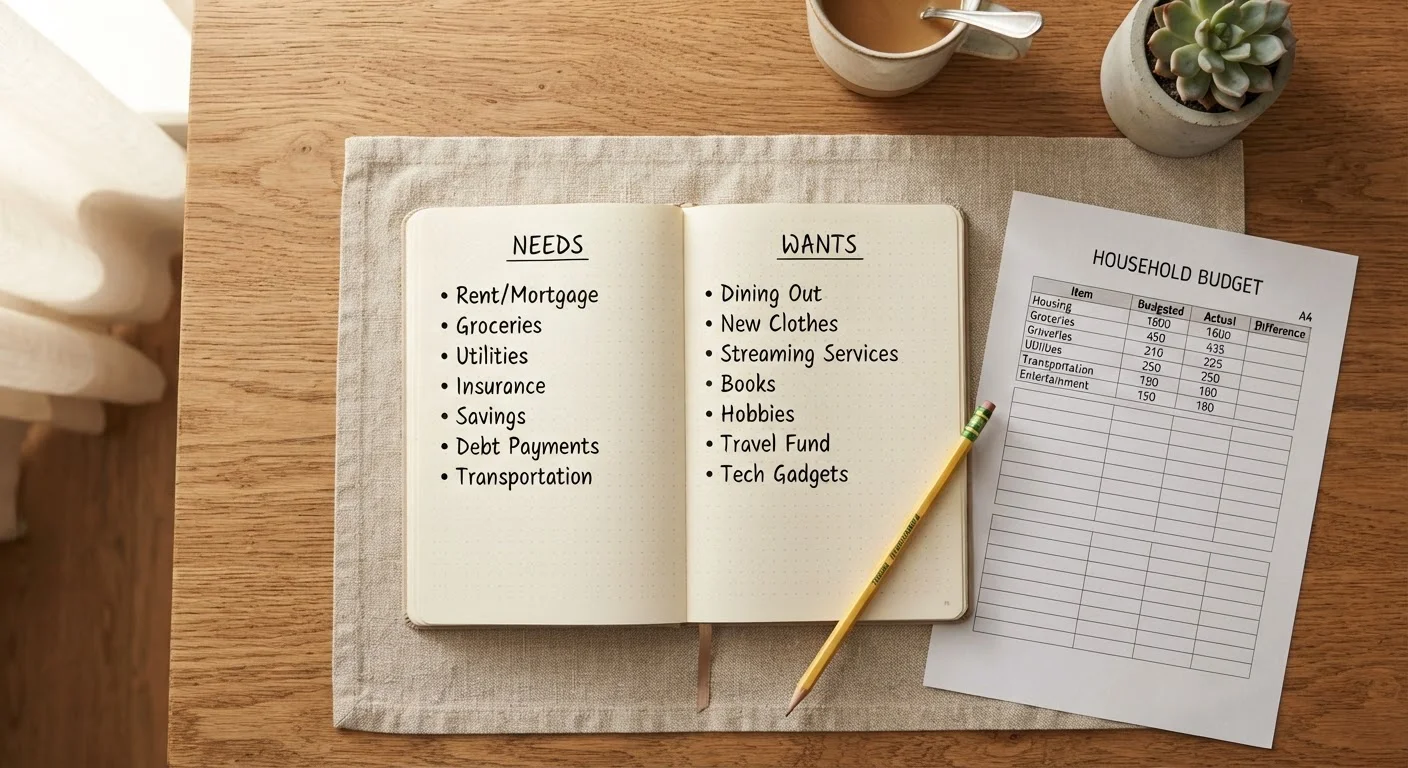
Most personal finance frameworks start with a clean split: needs on one side, wants on the other. Pay for the needs, budget the wants, done. In practice, very few spending decisions land that cleanly.
A smartphone is a need - until you're comparing the two newest flagship models and calling the upgrade a need. Groceries are a need - until the cart includes $14 artisan cheese and pre-marinated salmon. The category is right, but the specific choice has quietly crossed into want territory.
This blurring happens because needs are functional thresholds, not product categories. You need shelter; you may want a specific neighborhood. You need transportation; you may want heated seats. Understanding that distinction is the core skill that separates reactive spending from deliberate budgeting. For a broader look at how to build that mindset, see Building a Smarter Purchasing Mindset.
| Criterion | Needs | Wants |
|---|---|---|
| Definition | Functional threshold for safety or basic operation | Preference that improves comfort or experience |
| Budget priority | Funded first, non-negotiable | Funded from remaining discretionary income |
| Examples | Housing, utilities, basic food, medication | Streaming services, upgraded appliances, dining out |
| Common confusion point | Specific product chosen to meet the need | Framed as necessary by habit or social norms |
| Decision test | Would skipping it cause genuine harm or hardship? | Would a cheaper substitute serve the core function? |
| Emotional weight | Often stress-driven when unmet | Often desire-driven; urgency fades with time |
How Marketing and Social Norms Warp Perception
Two forces routinely push wants across the line into perceived needs: advertising framing and social comparison.
Advertising works by making features feel indispensable. Language like "essential," "must-have," or "you deserve" is designed to convert preference into urgency. When evaluating any purchase, it helps to strip away that framing and ask what core function you're actually trying to fulfill - the same habit that applies when reading product specifications without getting lost in the numbers.
Social comparison adds another layer. When everyone in your peer group has a particular product or service, opting out can feel like deprivation rather than a free choice. But "everyone has one" is a description of a social norm, not evidence of functional necessity.
70%
Shoppers who report impulse purchases they later regret
Surveys on consumer behavior consistently find that a large majority of shoppers report making impulsive purchases they later considered unnecessary, according to research cited by behavioral economists.
24 hrs
Pause period that reduces unplanned purchases
Behavioral finance research suggests that introducing a brief waiting period before non-essential purchases significantly reduces the rate of impulse buying.
Neither influence is inherently sinister - but both are worth noticing in real time. The moment you catch yourself thinking "I need this because everyone has it" or "I need this because the ad said so," you've found a want dressed in need's clothing.
Practical Tools for Drawing the Line
A few straightforward tests help cut through the noise:
- The substitution test: Could a significantly less expensive option fulfill the same core function? If yes, the difference between the two is a want, not a need.
- The 24-hour pause: For non-essential purchases, wait a day before buying. Genuine needs persist; impulse wants frequently fade.
- The function-vs-feature split: Identify the function you need (e.g., reliable internet for remote work), then ask which features beyond that baseline are actually driving the purchase (e.g., gigabit speed when your work requires a fraction of that).
- The budget-reverse check: If funding this purchase required skipping a bill, delaying savings, or carrying a balance, it's almost certainly a want - regardless of how it feels.
Once needs are reliably funded, wants become a legitimate part of a healthy budget, not an afterthought. The issue isn't spending on wants - it's funding them before needs are secure. The Spending Hierarchy offers a practical framework for ranking purchases when dollars are limited.
It's also worth keeping price and value distinct throughout this process. A need met by an overpriced product still leaves money on the table. Understanding the real difference between price and value can sharpen every category of spending decision you make.
Context Changes the Calculation
What qualifies as a need can shift based on life circumstances. A car is optional for someone in a walkable city with strong transit but is genuinely necessary for someone in a rural area with no alternatives. Similarly, a particular medication or assistive device may be an absolute need for one household and entirely irrelevant for another. These judgments are personal - the goal is honest self-assessment, not a rigid universal list.