Your Home Is Already a Gym
Setting up a home fitness routine doesn't require a rack of dumbbells or a dedicated room. For many homeowners, the challenge isn't motivation - it's working around budget constraints, limited square footage, and a packed schedule. The good news is that your home is already stocked with objects that can meaningfully support strength, mobility, and endurance work.
This isn't about improvising half-heartedly. Research on resistance training consistently shows that progressive overload - gradually increasing demand on muscles - is what drives adaptation, and that principle applies whether you're using a barbell or a filled backpack. What matters is consistent effort, good form, and an honest assessment of what each object can safely handle.
If you're curious about structuring workouts around compact living spaces, our guide on training in small spaces covers which formats genuinely suit tight quarters. And for a fuller picture of bodyweight-only options, The Floor Is Your Gym walks through room-by-room approaches with no equipment at all.
Below, we've identified seven household items that have legitimate, well-established exercise applications - along with practical notes on how to use each one safely.
A Sturdy Chair
A solid, non-wheeled dining or kitchen chair is one of the most versatile objects in any home. Placed against a wall for stability, it supports tricep dips - hands gripping the seat edge, feet extended forward, lowering and raising the body using arm strength. It also works as an elevation platform for incline or decline push-up variations, or as a balance aid for single-leg squats and calf raises.
Before using any chair for dips or step-ups, test it under static load first. Chairs with upholstered seats or lightweight frames are not appropriate for this purpose.
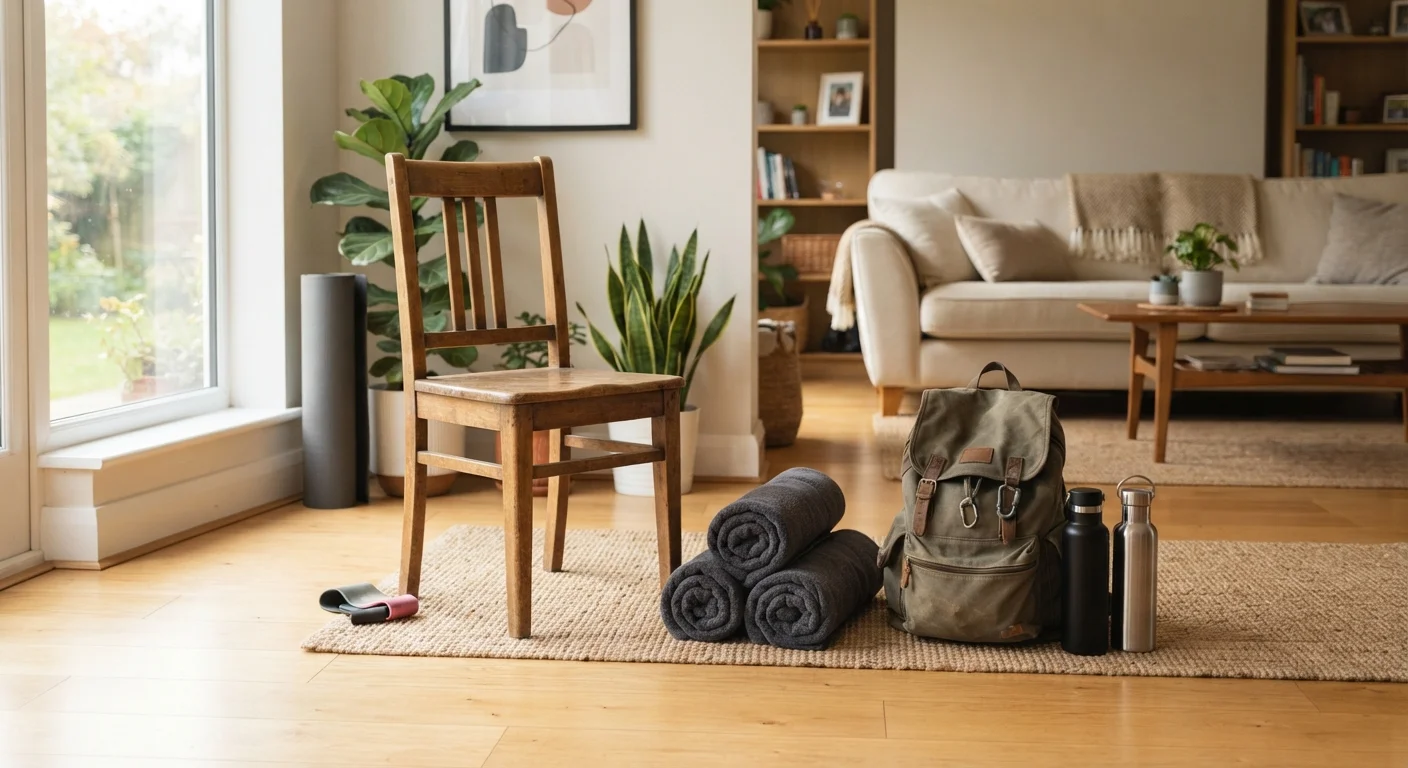
A sturdy dining chair can replace a bench for dips, push-up variations, and balance work.
A Filled Backpack
A backpack packed with books, water bottles, or canned goods functions as an adjustable weighted vest. Worn during bodyweight squats, lunges, or push-ups, it adds meaningful resistance without any equipment purchase. You can increase or decrease load simply by adding or removing contents.
Keep the load centered and snug - a loose, swinging pack throws off balance and form. Start conservatively and increase weight only when the movement feels controlled throughout its full range.
A book-filled backpack makes a surprisingly effective adjustable weight for squats and push-ups.
Towels
On a smooth floor, a folded towel under each hand or foot creates a low-friction slider surface. This enables towel mountain climbers, hamstring curls (lying on your back, heels on the towels, curling legs inward), and lateral lunge slides - all of which challenge stability muscles often underworked by standard exercises.
This only works on hard flooring. Carpet reduces the glide effect too much to be useful and can increase joint stress from uneven resistance.
Folded towels on hard floors create sliders that unlock challenging core and hamstring exercises.
A Wall
Walls provide resistance through isometric holds - positions where muscles contract without movement. The classic example is the wall sit: back flat against the wall, knees at roughly ninety degrees, held for time. This is a well-documented lower-body endurance exercise with no impact on joints.
Walls also enable wall push-ups for beginners building upper-body strength, and serve as a foot-placement surface for elevated glute bridges. They're also useful for balance reference during single-leg exercises.
Isometric wall sits are a joint-friendly lower-body endurance staple that require nothing but a wall.
Water Jugs or Filled Bottles
A standard one-gallon water jug weighs approximately 8.3 pounds when full - comparable to a light dumbbell. Held in each hand, jugs support bicep curls, shoulder presses, lateral raises, and bent-over rows. Smaller filled bottles work well for higher-repetition, lower-resistance movements like front raises or wrist curls.
Grip matters here. Jugs with handles are easier to control; smooth bottles are less stable. Use slow, controlled motion rather than momentum to keep the exercise effective and reduce the risk of strain.
A full gallon jug weighs over eight pounds - a ready-made light dumbbell for arm and shoulder work.
Stairs
If your home has a staircase, you have one of the most effective cardiovascular and lower-body tools available. Stair climbing at a brisk pace elevates heart rate quickly and engages glutes, hamstrings, and calves. A single bottom step also serves as a platform for step-ups, calf raises, and incline push-ups.
Use the handrail when needed, wear shoes with grip, and avoid socks-only footing on bare wood or tile stairs. This applies especially during any plyometric or faster-paced stair work.
Stair climbing is one of the most accessible cardiovascular exercises available in any multi-floor home.
A Countertop or Desk Edge
A stable, fixed countertop at roughly hip height provides support for standing oblique crunches, balance holds during single-leg exercises, and assisted pistol squats. It also serves as an incline surface for countertop push-ups - a good entry point for those building toward floor-level push-up strength.
Only use countertops that are wall-anchored and solidly constructed. Freestanding or lightly fastened surfaces are not appropriate for load-bearing or balance assistance. Kitchen islands with locking casters are borderline - test stability thoroughly before relying on them.
A fixed countertop supports standing balance work and incline push-ups for building upper-body strength gradually.
Building Consistency With What You Have
The real advantage of household-object workouts isn't novelty - it's removing the friction between you and exercise. When your tools are already in the room, the barrier to starting drops significantly. That matters for long-term adherence more than any piece of equipment.
Start With Form, Not Load
Whether you're using a backpack or a water jug, prioritize controlled movement over adding weight. Sloppy form with a heavier improvised load increases injury risk more than it increases benefit. Master the movement pattern with minimal resistance first, then increase load gradually over days or weeks.
That said, improvised tools do have limits. A sturdy dining chair is not the same as a purpose-built plyometric box. Always check that objects are stable, on non-slip surfaces, and rated (explicitly or obviously) to hold your weight before using them for support or elevation. If an object shifts, wobbles, or shows signs of wear, choose a different option.
For homeowners juggling family, work, and household responsibilities, short, effective workouts are often more sustainable than ambitious routines that don't fit a realistic schedule. Once you've built momentum with household-object exercises, you might explore sustainable habits for long-term home fitness to keep that progress going. And if you're ready to formalize your setup a little more, setting up a workout corner offers practical space-planning guidance.
This article is for general informational and educational purposes only and does not constitute medical or fitness advice. Consult a qualified healthcare or fitness professional before starting any new exercise program, particularly if you have existing health conditions, injuries, or concerns about physical activity.