Why Bodyweight Training Works Without a Dedicated Space
The assumption that effective exercise requires a gym, a spare room, or rows of equipment is one of the most persistent barriers to consistent fitness. Research consistently shows that resistance training using your own bodyweight can build strength, support cardiovascular health, and improve flexibility - all without a single piece of hardware.
The real requirement is simpler than most people expect: a clear floor space roughly the length of your body. That space exists in almost every room of a typical home. The key is knowing which movements suit which environment, so exercise becomes something you slot into the home you already have rather than a setup you need to build from scratch.
If you're working on fitting movement into a busy schedule, our guide to short workouts for busy homeowners covers the principles behind making brief sessions genuinely effective.
~6 ft²
Minimum floor space for a full bodyweight session
A body-length clear area is all that's typically needed to perform squats, push-ups, planks, and core work.
150 min
Weekly moderate activity recommended for adults
According to the U.S. Department of Health and Human Services Physical Activity Guidelines for Americans, adults benefit from at least 150 minutes of moderate-intensity activity weekly.
3-5 min
Effective length of an exercise snack
Short movement breaks of a few minutes, repeated across the day, are associated with health benefits in multiple observational studies.
Living Room: Your Largest Training Floor
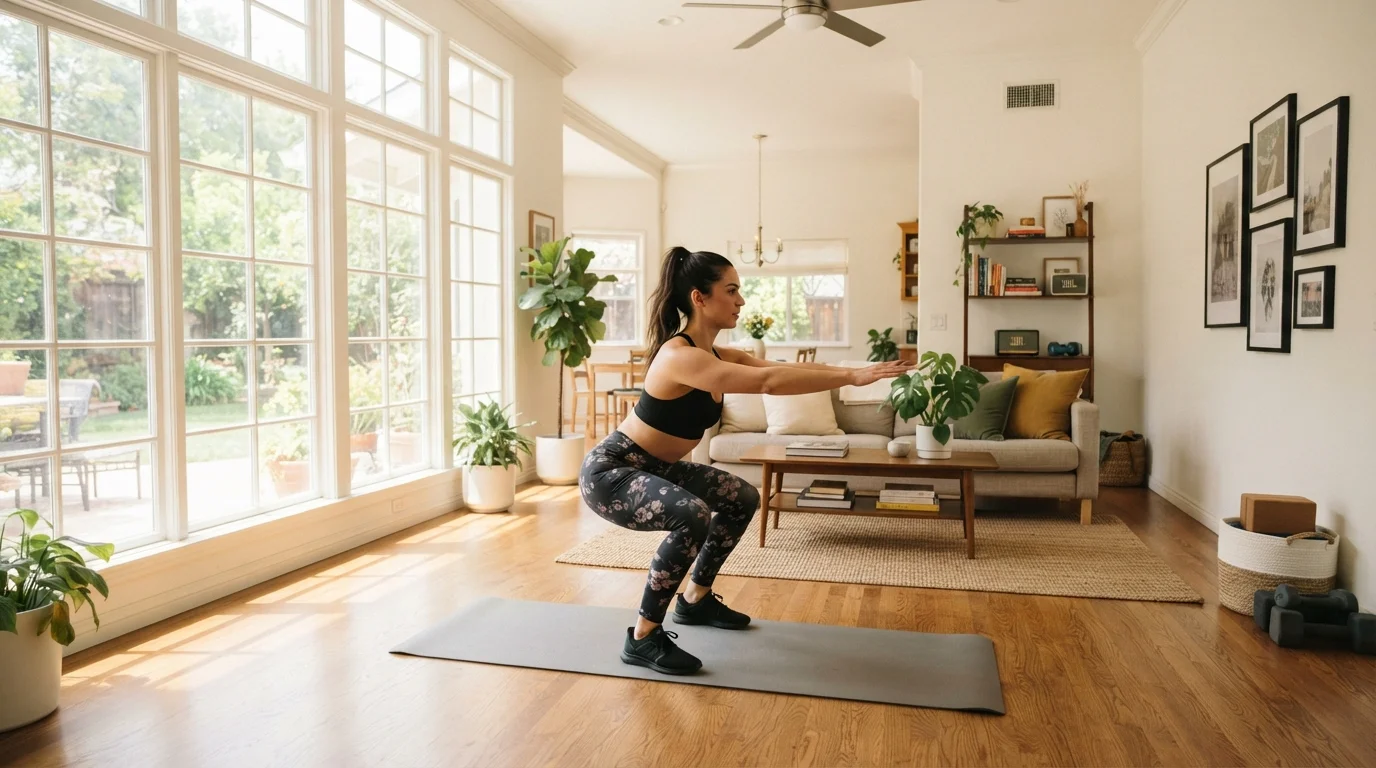
The living room is usually the most spacious open-floor area in a home, making it the natural anchor for longer or more dynamic movement sessions. Pushing back the coffee table - or simply using the area in front of the sofa - typically yields enough room for a complete circuit.
Movements that work well here
- Squats and variations (sumo, pulse, single-leg): Use the sofa edge for balance assistance when learning single-leg versions.
- Push-up progressions: From incline (hands on the sofa) to standard to feet-elevated - the furniture becomes a progression tool.
- Plank variations: Standard, side, and forearm planks require nothing but the floor and about two square feet.
- Glute bridges and hip thrusts: The sofa or a low ottoman provides an ideal surface for shoulder elevation.
- Inchworms and bear crawls: These full-body movement patterns need a clear runway - the living room delivers.
For ideas on using furniture and everyday objects as workout tools, see our article on household objects that double as workout tools.
Use the sofa's cushion firmness as an instability cue: placing your hands on a softer surface during push-ups engages stabilizing muscles more than a firm floor, providing a natural progression tool.
Unstable surfaces increase demand on smaller stabilizing muscles, which can help intermediate exercisers add challenge without additional equipment.
Set a visible marker - a small mat, a folded towel - in each room where you plan to exercise. The physical cue reduces decision fatigue and increases the likelihood you'll actually start moving.
Behavioral research on habit formation consistently shows that environmental cues significantly lower the activation energy needed to begin a desired behavior.
Bedroom: Morning and Evening Movement
The bedroom floor - especially the space beside or at the foot of the bed - lends itself to lower-intensity, controlled movements. The proximity to the bed makes it a natural setting for morning activation routines and evening wind-down mobility work.
Morning activation (5-10 minutes)
- Hip circles and leg swings standing beside the bed for joint mobility.
- Cat-cow stretches on the floor to ease the spine after sleep.
- Bodyweight squats to activate the lower body before the day begins.
Evening wind-down
- Child's pose and supine twists to release tension accumulated during the day.
- Slow, controlled glute bridges to counteract prolonged sitting.
- Diaphragmatic breathing exercises - lying flat on the floor - to transition the nervous system toward rest.
The bedroom is also ideal for consistency: the visual cue of your floor is the first thing you see each morning, reducing the mental barrier to starting.
Kitchen and Hallway: Micro-Workouts Between Tasks
These transitional spaces are underused fitness environments. While waiting for water to boil or laundry to finish, short movement breaks - often called exercise snacks - can meaningfully contribute to daily activity. Emerging research suggests that multiple short bouts of physical activity spread throughout the day may support metabolic health comparably to a single continuous session.
Kitchen opportunities
- Counter push-ups: Hands on the counter edge at a comfortable incline - accessible for those building upper-body strength gradually.
- Standing calf raises: Done during food prep with no space requirement at all.
- Wall sits: The hallway or kitchen wall provides steady support for an isometric lower-body hold.
Hallway opportunities
- Walking lunges: A narrow hallway is exactly the right width; length determines how many reps you can string together.
- High knees or step-touches in place for a brief cardio pulse.
If your spaces are genuinely compact, our guide to training in small spaces discusses which formats truly suit tight quarters.
Putting It All Together: A Room-by-Room Weekly Plan
Rather than treating each room's movements as isolated ideas, combining them into a loose weekly structure helps ensure balanced training across muscle groups and energy systems.
| Day | Room | Focus |
|---|---|---|
| Monday | Living room | Lower body (squats, bridges, lunges) |
| Tuesday | Bedroom | Morning mobility + evening stretching |
| Wednesday | Living room | Upper body & core (push-ups, planks, inchworms) |
| Thursday | Kitchen/hallway | Micro-workout day - movement snacks only |
| Friday | Living room | Full-body circuit combining movements from the week |
| Weekend | Any room | Active recovery - gentle mobility, stretching |
This structure is a starting point, not a prescription. Adjust based on your schedule, energy levels, and any guidance from a healthcare provider. For building a habit that holds up long-term, our article on sustainable habits for long-term home fitness covers evidence-informed strategies for consistency.
Safety, Progression, and When to Seek Guidance
Bodyweight training is broadly accessible, but a few consistent principles help keep it safe and effective over time.
Form before volume
Prioritize controlled, full-range movement over the number of repetitions. Sloppy form under fatigue is where minor strains tend to happen. If a movement feels unstable or painful - not simply effortful - stop and assess before continuing.
Progress gradually
Bodyweight exercises have natural progressions: a standard squat becomes a slow-tempo squat, then a single-leg variation. Push-ups move from incline to standard to feet-elevated. These progressions keep training challenging without adding external load. If you'd prefer a structured physical space for more intense sessions, our guide to setting up a workout corner offers practical layout advice.
Surface and environment checks
Ensure floors are clear of obstacles and that rugs or mats don't slide underfoot. Bare hardwood or tile may require a non-slip mat for floor-based exercises.
Watch for Pain vs. Effort
Muscle fatigue and a general sense of effort are normal during exercise. Sharp, joint-specific, or persistent pain is a different signal - stop the movement if you experience it. Do not push through pain, and consult a healthcare or physical therapy professional if discomfort recurs.
This article provides general health and fitness information for educational purposes only. It is not a substitute for personalized advice from a qualified healthcare professional. Consult your doctor or a certified fitness professional before beginning any new exercise program, particularly if you have an existing health condition, injury, or are pregnant.