
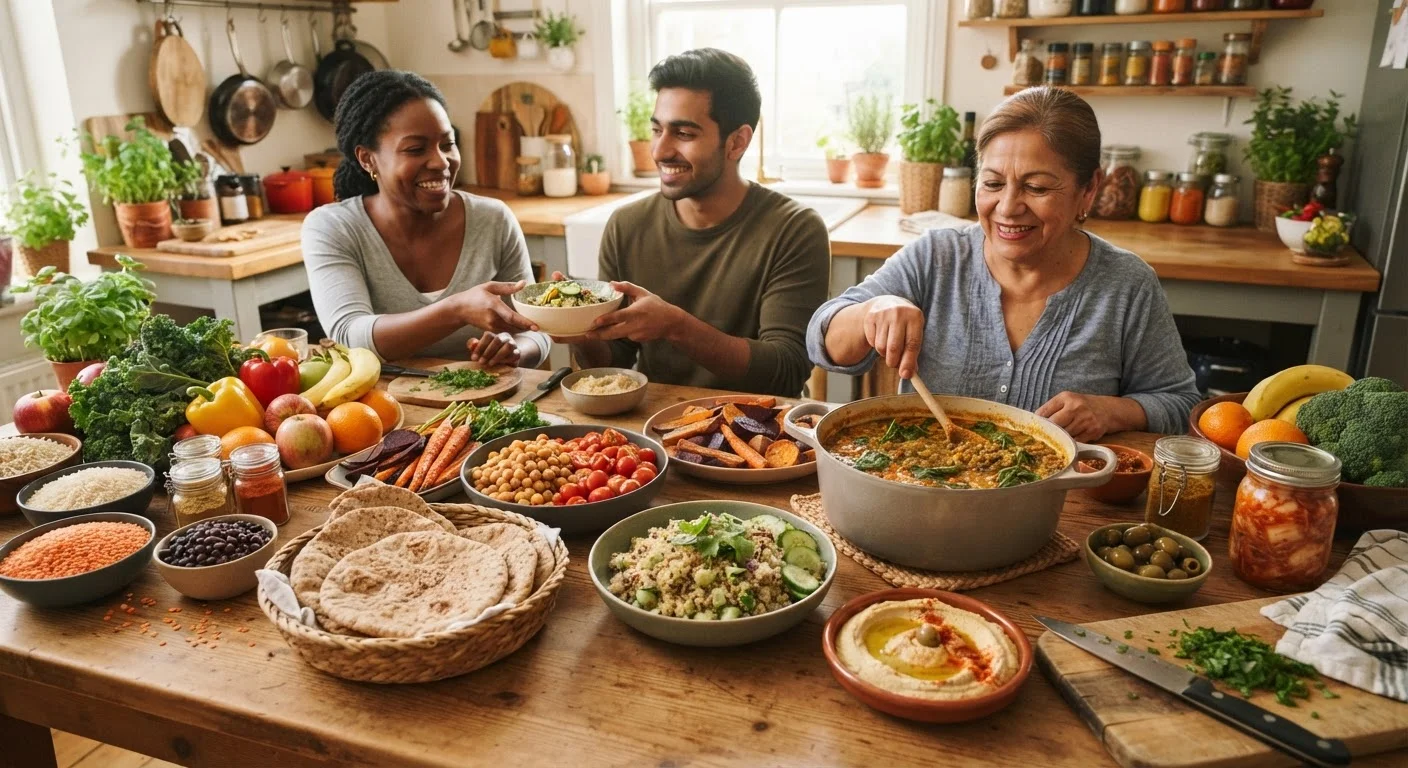
There Is No Single 'Healthy Diet'
Walk into any bookstore or scroll through any health feed and you'll find dozens of competing nutrition frameworks - each presented as the answer. The reality, supported by decades of research across global populations, is considerably less tidy: many different eating patterns can support good health, and no single one has a monopoly on nutritional adequacy.
What nutrition science does point to with consistency is a set of principles rather than a single prescription: eating a variety of whole or minimally processed foods, including plenty of vegetables, legumes, and fiber-rich grains, while limiting foods with very high amounts of added sugar, sodium, and saturated fat. How those principles get expressed on your table depends on who lives in your household, what you can afford, where you live, and what foods your family actually enjoys eating.
Understanding what 'balanced diet' actually means in practical terms is a useful starting point - because it quickly reveals that the concept is far broader than any specific meal plan suggests.
When evaluating any new eating approach, ask whether you could sustain it for a year - not just a month. If the answer is no, it's worth finding a version that fits your real life before committing.
Research on dietary adherence consistently shows that long-term sustainability, not short-term restriction, is the strongest predictor of lasting nutritional benefit.
Don't discard a traditional family recipe just because it doesn't appear in mainstream health media. Look at its ingredients against broad nutritional principles - you may find it's already well-aligned, or needs only a small adjustment.
Many traditional food preparations from around the world are built around legumes, vegetables, and whole grains - staples that align well with evidence-based dietary guidance.
How Budget Shapes Nutritional Choices
Household income is one of the most significant real-world factors in how families eat, yet nutrition guidance rarely accounts for it honestly. The assumption that healthy eating is expensive persists - and while some premium health foods carry high price tags, nutritious eating on a modest budget is genuinely achievable with the right framing.
Dried legumes (lentils, chickpeas, black beans), whole grains like oats and brown rice, eggs, canned fish, and frozen vegetables are among the most nutrient-dense, affordable foods available in most U.S. grocery stores. These aren't compromise options - they form the backbone of well-regarded dietary patterns around the world. For households managing tighter grocery budgets, stretching a grocery budget without eating worse is worth exploring in depth.
~13%
U.S. households experiencing food insecurity
According to USDA Economic Research Service data, roughly 13% of U.S. households experience food insecurity at some point in a given year, underscoring that access shapes nutrition realities.
$0.74/serving
Average cost of a serving of canned or dried legumes
Studies from the Harvard T.H. Chan School of Public Health have noted legumes as among the most cost-effective sources of protein and fiber available in U.S. grocery stores.
The interaction between money and food choices is also covered usefully in the context of how a typical household budget breaks down, which can help families see where food spending fits relative to other priorities.
Culture, Tradition, and Food Identity
Food is never purely nutritional. It carries cultural meaning, family memory, and social identity. Traditional food patterns from around the world - West African, South Asian, Latin American, East Asian, Mediterranean, and many others - all contain nutritionally sound foundations built over generations. The assumption that 'eating healthy' means adopting a particular Western template often leads households to unnecessarily abandon foods that are both culturally meaningful and nutritionally valuable.
Dietitians and public health researchers increasingly recognize that culturally congruent dietary guidance - advice that works within a household's existing food traditions rather than replacing them - tends to be better accepted and more sustainable. A family that has eaten dal and roti for generations doesn't need to switch to quinoa salads to eat well. A household that regularly prepares stir-fried vegetables and tofu is not nutritionally behind.
The goal is to look at the foods your household already enjoys and identify patterns that align with broad nutritional principles, then make modest shifts where genuinely useful - rather than treating culturally familiar foods as obstacles to overcome.
Access, Geography, and Practical Constraints
Food access varies significantly across U.S. communities. Households in areas with limited full-service grocery stores - sometimes called food deserts - face a genuinely different set of choices than those within easy reach of well-stocked markets. Transportation, physical mobility, time constraints, cooking equipment, and storage space all factor into what eating well can realistically look like for a given household.
These are structural realities, not personal failures. Acknowledging them matters because nutrition advice that ignores access tends to create guilt without offering solutions. Some practical approaches that hold up across access constraints include relying on shelf-stable staples (canned tomatoes, dried beans, oats), making the most of frozen produce (which retains much of its nutritional value), and building a repeatable weekly structure. Our nutrition-minded grocery planning checklist offers a practical framework that can be adapted to different store types and budgets.
Nutrition Advice Doesn't Always Account for Reality
Generic dietary guidance is typically developed for idealized conditions - good access, stable income, and no special health requirements. If standard advice feels unworkable for your household, that's a signal to look for adapted approaches rather than to blame yourself. A registered dietitian, particularly one familiar with your cultural background or budget constraints, can offer far more useful guidance than a one-size-fits-all framework.
For households with children navigating food variety challenges, evidence-informed strategies for picky eaters addresses a common layer of complexity that shapes what families can realistically serve.
Finding What Healthy Eating Means for Your Household
Rather than trying to match an idealized external standard, a more useful approach is to identify what nutritional principles apply broadly and then ask how your household can meet them in ways that are practical, affordable, and enjoyable. Some guiding questions worth working through:
- Are vegetables and legumes present in most meals, in some form? Frozen, canned, or fresh - all count.
- Is most food in its whole or lightly processed form? This doesn't require perfection, just a general pattern.
- Are culturally important foods included, not excluded? Restriction-heavy approaches are rarely sustainable.
- Does the approach work with your actual grocery budget? Nutrition that requires spending beyond your means isn't a real solution.
For households wanting to structure meals without obsessive tracking, building a balanced plate without counting every calorie offers accessible frameworks like the plate method that work across different food traditions.
Sustainable healthy habits rarely come from a single dramatic change. They tend to accumulate gradually - a pattern explored in principles that hold across life stages. The households that eat well over time are usually those that have found an approach flexible enough to adapt as circumstances change.
This article is for general informational and educational purposes only and is not a substitute for professional medical or dietary advice. Individual nutrition needs vary. Consult a registered dietitian or qualified healthcare provider for guidance specific to your household's health circumstances.