What Each Approach Actually Does to Your Fuel Economy
Cruise control holds a fixed speed by managing throttle electronically, eliminating the minor speed creep most drivers don't notice but their fuel gauge does. Studies by the U.S. Department of Energy have noted that maintaining steady speeds on highways can meaningfully reduce fuel consumption compared to inconsistent acceleration patterns. The mechanism is straightforward: engines operate most efficiently at stable load, and cruise control delivers exactly that - on the right road.
Manual throttle, by contrast, is as good as the driver using it. An inattentive driver who unconsciously surges and coasts on the highway will burn more fuel than cruise control would. But a driver who actively anticipates the road - lifting off before a descent, coasting toward a known stop - can actually beat cruise control's efficiency. That's the variable the comparison hinges on.
For a broader look at where fuel actually goes under different driving conditions, see our comparison of city and highway fuel use.
| Criterion | Cruise Control | Manual Throttle |
|---|---|---|
| Flat highway efficiency | Strong - steady load, no drift | Varies with driver attentiveness |
| Hilly terrain efficiency | Weaker - reactive throttle on grades | Better with proactive drivers |
| Heavy or variable traffic | Poor fit - frequent disengagement | More adaptable |
| Driver fatigue on long hauls | Reduces physical fatigue | More physically demanding |
| Situational awareness | Risk of mental disengagement | Keeps driver more engaged |
| Speed consistency | Precise and automatic | Subject to unintentional drift |
Where Cruise Control Wins - and Where It Doesn't
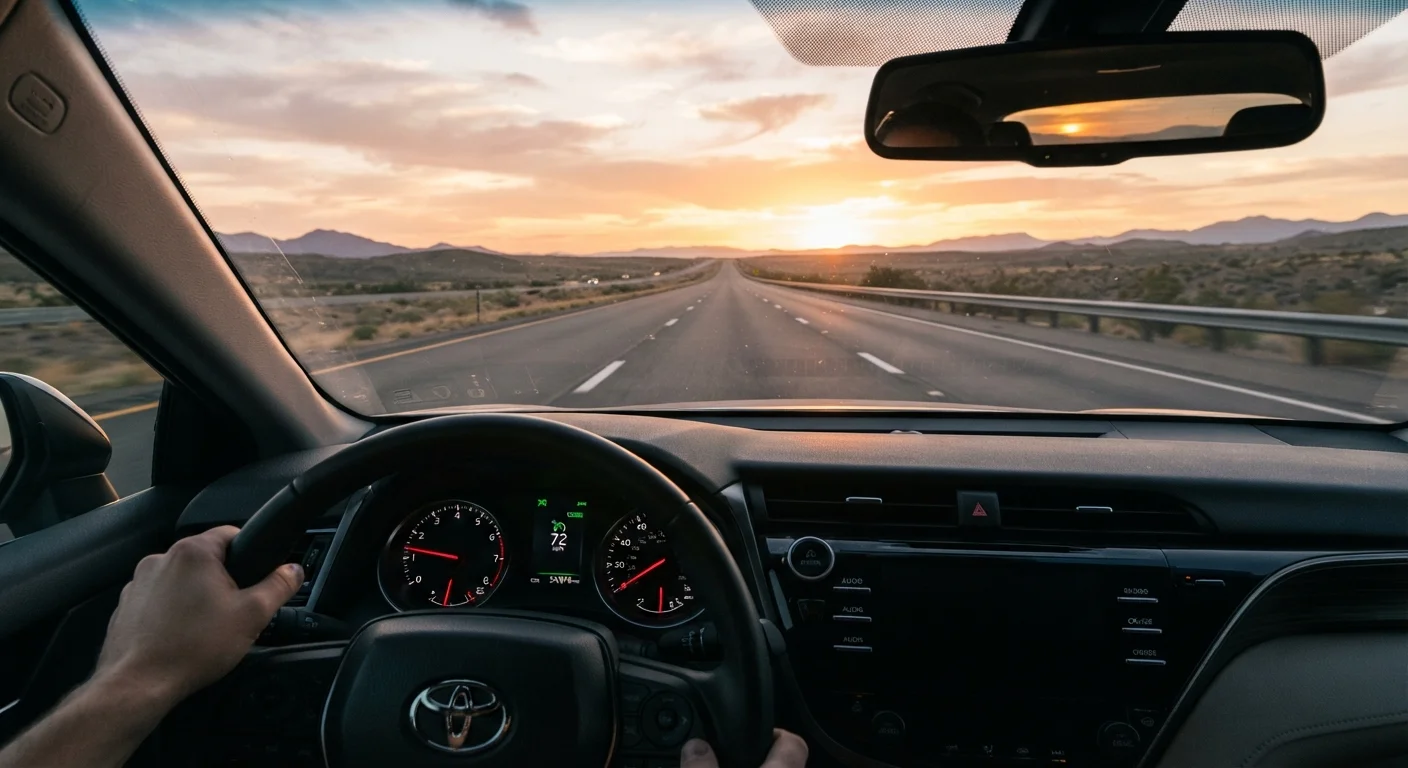
On a flat interstate with light traffic, cruise control is the pragmatic choice. It keeps you honest on speed, prevents the slow drift above your target mph, and reduces the mental overhead of constant throttle management. Over a 300-mile interstate run, those benefits compound.
The picture changes on hilly roads. Cruise control is reactive - it detects lost speed and opens the throttle to recover it, often applying more power than a driver who spotted the grade a quarter-mile ahead would have used. On rolling terrain, this reactive behavior can actually hurt fuel economy relative to a switched-on driver managing speed manually. Some newer adaptive cruise systems handle grades better, but the fundamental reactive limitation applies broadly.
Heavy traffic is where cruise control's efficiency case collapses entirely. Constant engagement and disengagement creates its own inefficiency, and the system offers no fuel benefit when average speed is dropping every few minutes.
7-14%
Potential fuel savings on flat highways
The U.S. Department of Energy estimates that maintaining steady highway speeds can reduce fuel consumption by roughly this range compared to inconsistent throttle use.
~1 MPG
Efficiency loss per 5 mph over 50 mph
According to the EPA, fuel economy generally decreases significantly above 50 mph, making speed control - by any method - consequential at highway speeds.
For techniques professionals use to stretch fuel on variable roads, the smooth driving techniques used by experienced drivers are worth understanding before any long haul.
Safety and Fatigue: The Other Half of the Decision
Fuel economy doesn't exist in isolation from safety. Cruise control reduces physical fatigue on long drives, which is a genuine benefit - but it can also encourage mental disengagement. Drivers who rely on cruise control sometimes report reduced situational awareness, particularly on monotonous stretches. The system handles speed; it does not handle lane position, hazard detection, or reaction time.
Manual throttle keeps drivers more physically engaged but adds cognitive load on extended trips. Neither is a shortcut to alertness. The practical takeaway: use cruise control on predictable roads where your full attention stays on traffic and hazards, not on the pedal. Use manual throttle where conditions require active anticipation.
Route selection also plays into this - knowing what's ahead lets you choose the right approach before you're in it. Our guide to route planning as a fuel-saving strategy covers how terrain and traffic patterns should factor into your planning. And if you're preparing for a longer family trip, what road trip-friendly actually means for different vehicles offers useful context on vehicle-specific efficiency trade-offs.
This article is for general informational purposes only. Always drive in accordance with local traffic laws and road conditions. For vehicle-specific guidance, consult your owner's manual or a qualified mechanic.