Why City and Highway Driving Are Fundamentally Different for Your Engine
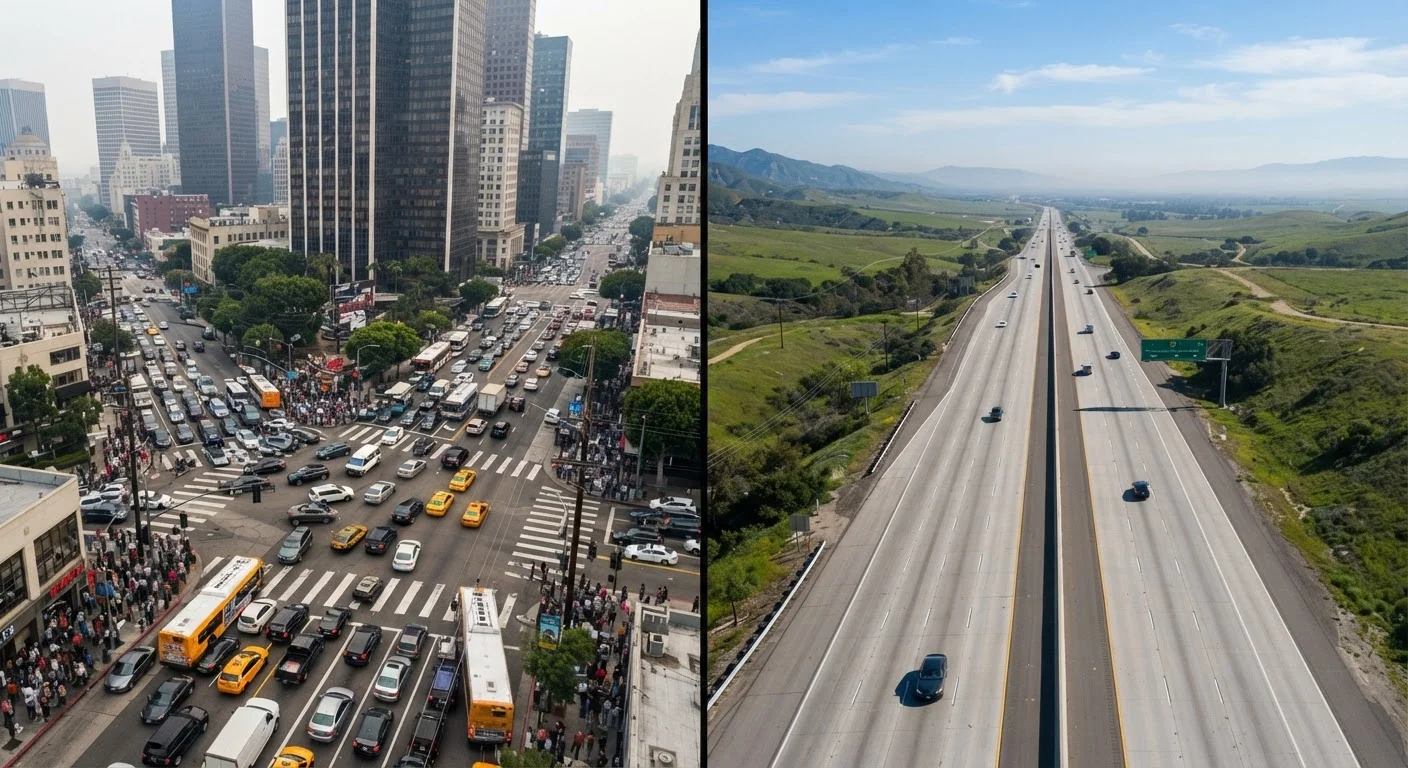
Your engine doesn't simply burn fuel at a fixed rate - it responds to demand. In a city environment, that demand is chaotic: traffic signals, pedestrians, sudden slowdowns, and tight turns mean your throttle is constantly opening and closing. On the highway, demand stabilizes into a narrow, predictable band that allows your engine and transmission to operate more efficiently.
The US Environmental Protection Agency (EPA) rates vehicles separately for city and highway fuel economy precisely because the difference is significant and consistent across vehicle types. A typical gas-powered passenger car might achieve 25-30 mpg on the highway but only 18-22 mpg in city conditions - a gap of roughly 25-35%.
Understanding where fuel actually goes in each environment is the first step toward spending less of it. For a broader look at the factors behind that gap, see everything that quietly drains your fuel economy.
| Criterion | City Driving | Highway Driving |
|---|---|---|
| Typical fuel economy | Lower (18-22 mpg average) | Higher (25-30 mpg average) |
| Primary fuel drain | Repeated acceleration from stops | Aerodynamic drag at speed |
| Idling impact | High - frequent lights and traffic | Minimal to none |
| Braking energy loss | Significant - frequent braking | Low - little braking needed |
| Optimal driving behavior | Smooth acceleration, anticipate stops | Steady speed, avoid over-driving limit |
| Hybrid/EV advantage | High - regen braking recaptures energy | Lower - fewer regen opportunities |
| Engine operating efficiency | Poor - frequent off-peak demands | Good - steady cruising RPM |
The City Driving Fuel Penalty: Stop-and-Go Physics
Every time you accelerate from a stop, your engine must overcome inertia - the energy needed to get a stationary vehicle moving again. In city driving, you repeat this cycle dozens of times per trip. Each acceleration event demands a significant burst of fuel, and much of the kinetic energy you build up is then lost as heat through the brakes when you slow down again.
Idling compounds the problem. Sitting in a running vehicle at a red light or in a traffic jam burns roughly 0.1 to 0.3 gallons of fuel per hour depending on engine size - with zero miles traveled to show for it. The real fuel cost of idling your engine breaks down exactly how those minutes add up at the pump.
Frequent gear changes in automatic transmissions also reduce efficiency. The transmission is constantly hunting for the right gear, preventing the engine from settling into its optimal torque range. Drivers who avoid aggressive braking and accelerating can noticeably reduce city fuel consumption - anticipating stops and coasting where safe rather than driving up to each light at full speed.
25-35%
City vs. highway MPG gap for typical gas cars
EPA separate city and highway ratings consistently reflect this range across most conventional passenger vehicles.
~0.2 gal/hr
Fuel burned while idling (average)
The US Department of Energy estimates idling uses roughly 0.1-0.3 gallons per hour depending on engine displacement.
≈1-2% per 5 mph
Fuel economy loss above 50 mph
The US Department of Energy notes fuel economy generally drops with each incremental speed increase above 50 mph due to aerodynamic drag.
Why Highway Driving Is More Efficient - Up to a Point
At steady highway speeds, typically between 50 and 65 mph, most gasoline engines reach their best fuel-efficiency operating zone. The transmission locks into a high gear, engine RPM drops, and the fuel-per-mile rate falls. There are no repeated acceleration events, minimal braking, and no idling losses.
The key qualifier is speed. Aerodynamic drag increases with the square of velocity - meaning the faster you go above around 50 mph, the more fuel you burn fighting air resistance. The US Department of Energy has noted that fuel economy can drop noticeably for every 5 mph above 50 mph, though the precise figure varies by vehicle shape and size.
This is where throttle discipline matters. Cruise control vs. manual throttle on the highway explores how maintaining consistent speed - rather than allowing it to drift up and down - keeps fuel consumption in check. Unnecessary speed variation on the highway creates mini versions of the city acceleration-braking cycle, eroding the inherent efficiency advantage.
Route choices also matter more than drivers often realize. Route planning as a fuel-saving strategy outlines how elevation changes and traffic patterns affect highway fuel use beyond just distance.
Where Hybrids and EVs Change the Equation
Conventional gasoline vehicles waste braking energy as heat - it simply disappears. Hybrid and electric vehicles recover a portion of that energy through regenerative braking, converting it back into stored electricity. This fundamentally changes the city-highway efficiency relationship.
For many hybrid models, city fuel economy ratings are actually close to - or even exceed - their highway figures. The stop-and-go cycling that penalizes conventional engines becomes partially productive for hybrids. On the highway, hybrids lose some of this advantage because there are fewer braking events to recover from, and the gasoline engine carries more of the load at sustained speeds.
Hybrid City Ratings: A Common Surprise
Many drivers expect hybrids to shine most on the highway, but the opposite is often true. Because regenerative braking recaptures energy at every slowdown, hybrids are designed to extract value from the very stop-and-go patterns that punish conventional engines. Check the EPA's separate city and highway ratings for any hybrid you're considering - the city figure is frequently the stronger number.
If you're evaluating ownership costs across different driving patterns, fuel costs over a car's lifetime provides a structured way to think about how your specific mix of city and highway miles compounds over years.