Why Sentimental Clutter Is Uniquely Hard to Tackle
Ordinary clutter - expired coupons, duplicate kitchen tools, outdated cables - is relatively easy to discard because it carries no emotional weight. Sentimental clutter is different. Objects tied to people we love, milestones we've passed, or lives we once lived can feel like physical extensions of memory itself. Letting go of them, even when they serve no practical purpose, can trigger genuine grief.
That emotional friction is not irrational. It is a normal human response, and understanding it is the first step toward working through it productively. The goal of this guide is not to convince you to own less - it is to help you make intentional decisions so the objects you keep are genuinely meaningful, not just retained out of guilt or inertia.
For a deeper understanding of how professional organizers approach categorization before you dive into the steps below, Zones, Categories, and Containers offers useful foundational thinking you can apply yourself.
Don't Rush Through Emotional Items
Sorting sentimental clutter in a single marathon session often leads to regret or decision fatigue. Spread this work across several shorter sessions - 60 to 90 minutes at a time - and give yourself permission to pause. If you find the process bringing up significant grief or distress, it may be worth speaking with a counselor before continuing.
What You'll Need Before Starting
Preparation matters more with sentimental items than with any other type of clutter. Showing up without a plan - or the right materials - often leads to sessions that stall or result in decisions you later regret. Review the prerequisites and tools below before your first session.
What you will need
Acid-free storage boxes
Preserve paper keepsakes, photos, and fabric items without yellowing or deterioration over time.
Smartphone or flatbed scanner
Digitalize photos, letters, and documents so memories are preserved without physical bulk.
Sticky notes and markers
Temporarily label items during sorting so you can categorize without committing to permanent decisions.
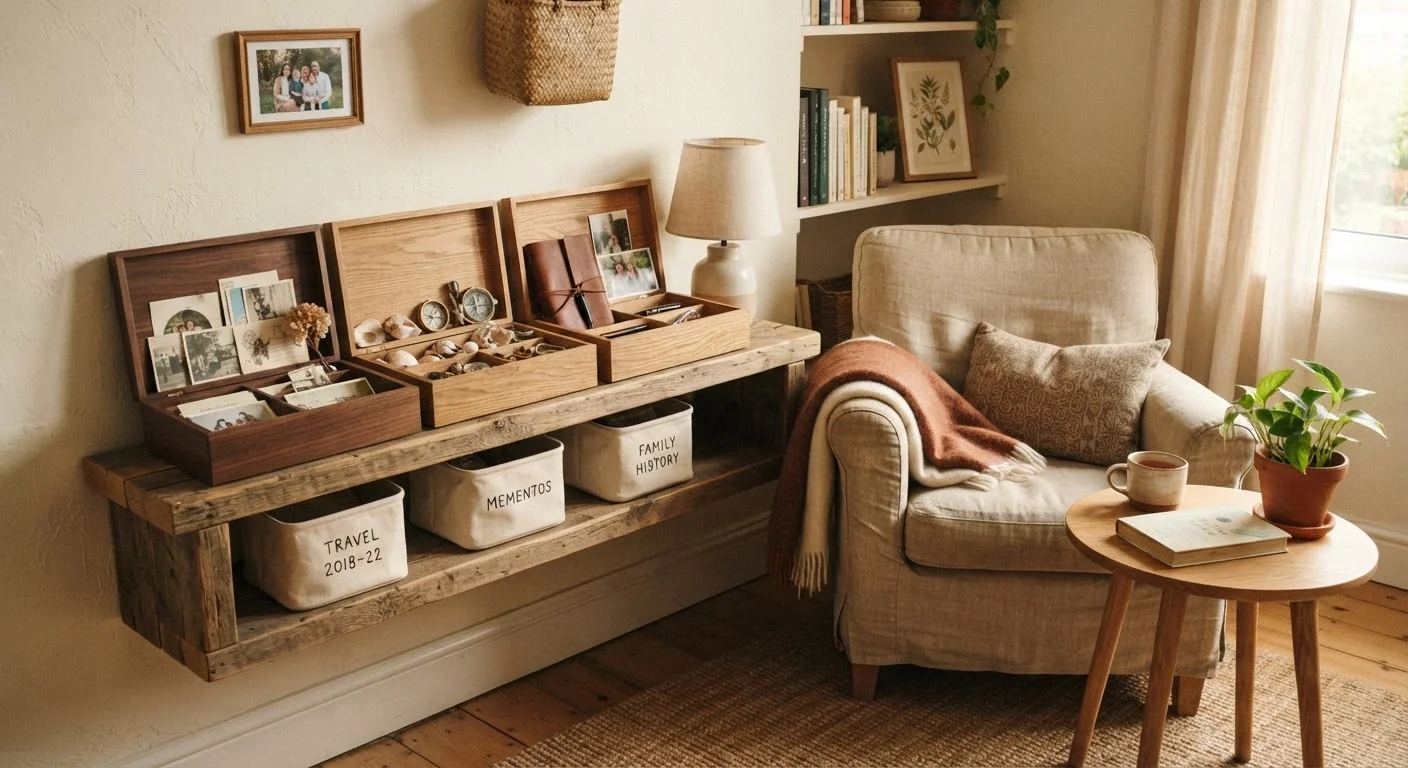
Small labeled bins or baskets
Designate a finite physical boundary for each category of kept sentimental items.
External hard drive or cloud storage subscription
Safely back up digitalized memories in a second location to prevent data loss.
Avoid Making Permanent Decisions Under Pressure
Never sort sentimental items immediately after a loss, move, or other major life stressor. Your emotional state directly affects your judgment. Box items temporarily and revisit them when you feel more settled. Donating or discarding something you later wish you'd kept is rarely reversible.
Step-by-Step: Sorting With Intention
Follow these steps in order. Each one builds on the last, and skipping ahead - particularly to the release stage before you've set your boundaries - tends to produce anxiety rather than relief.
Set a physical boundary before you begin
Decide in advance how much space sentimental items are allowed to occupy - for example, one medium box per person in the household, or one dedicated shelf in a closet. This boundary is not about minimizing what matters to you; it is about giving your memories a defined home so they don't quietly expand into every drawer and cabinet.
Write the limit down and keep it visible during sorting. If the container is full and you want to add something, something else must leave - this simple rule prevents indefinite accumulation.
Gather everything into one place before sorting
Sentimental items are almost always scattered - a box in the attic, a drawer in the bedroom, a shelf in the garage. Bring them all into one room before making any decisions. Seeing the full volume helps you make proportional choices and prevents you from discovering a forgotten batch after you've already made peace with what to keep.
Don't sort as you gather - just collect. Sorting while gathering leads to drawn-out sessions and inconsistent decisions.
Sort into three categories: Keep, Store, and Release
Work through items one at a time and assign each to exactly one of three groups:
- Keep: Items you actively display, use, or look at regularly. These earn prime real estate in your home.
- Store: Items with genuine sentimental weight that you don't use but aren't ready to part with. These go into your designated memory container.
- Release: Items you are willing to donate, gift to someone who will use them, or responsibly discard.
Resist creating an 'undecided' pile - it tends to become a permanent holding category. If an item stalls you, photograph it and move it to Release. The photo preserves the memory; the object doesn't have to.
Digitalize what you can
Photographs, letters, children's artwork, and printed documents can almost always be scanned or photographed at high resolution. Free and low-cost scanning apps make this accessible for most smartphones. Once digitalized, originals that were kept only for their visual record - not their physical texture or material - become candidates for Release.
Store digital files in at least two locations: a local drive and a cloud backup. Organize folders by person, decade, or event so files are actually retrievable later.
Handle shared and inherited items as a group
Items that belonged to a parent, grandparent, or late partner carry additional emotional complexity, especially when multiple people have a claim. Before sorting these alone, reach out to relevant family members and give each person an opportunity to claim what matters to them.
A practical method: photograph every item and share the images in a group message or shared folder. Ask each person to note what they want within a set time window - one to two weeks is reasonable. Unclaimed items can then be donated or sold without guilt, because everyone had the opportunity to weigh in.
Create a maintenance habit so clutter doesn't rebuild
Once your memory container is organized, schedule a brief annual review - 30 minutes is usually sufficient. Each year, check whether anything in storage has naturally lost its emotional pull; those items are good candidates for Release. Add new keepsakes only if something else leaves, maintaining your original boundary.
Pairing this with seasonal organization - rotating holiday items, for example - keeps the habit manageable. For a broader room-by-room approach, see The Room-by-Room Decluttering Roadmap for a complementary framework.
Use the 'Future Self' Test
When you can't decide on an item, ask: 'Will I realistically look at or use this in the next five years?' If the honest answer is no, it may be occupying space for guilt rather than genuine meaning. Photographing the object before releasing it can provide emotional closure without the physical burden.
If your household includes other adults with different organizational habits or thresholds for what counts as 'worth keeping,' Shared Spaces, Different Habits outlines practical ways to align without conflict. And once your sentimental items have a permanent home, Seasonal Organization: Rotating What You Own Without Chaos can help you keep the rest of your storage rotating smoothly year-round.