
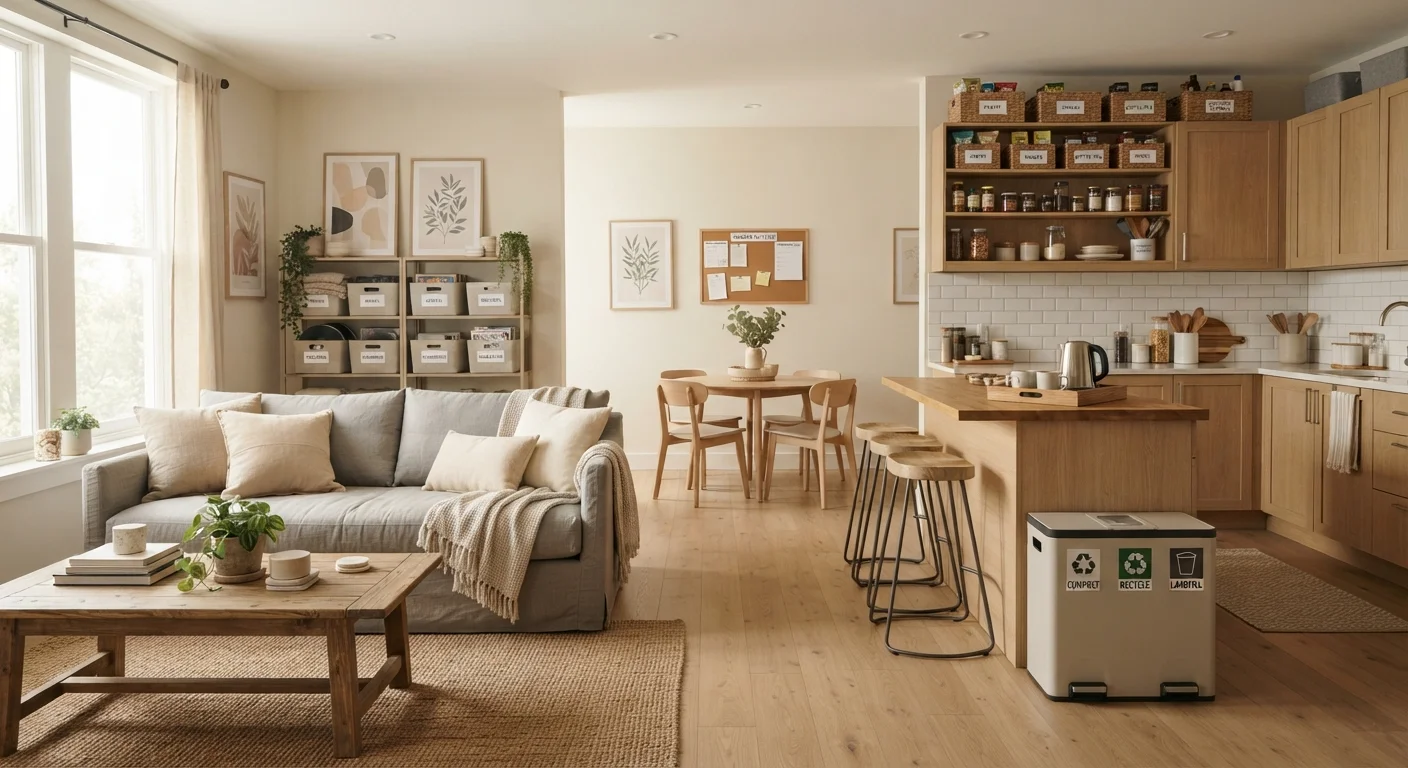
Why Standard Organization Advice Often Fails Shared Households
Most home organization guides are written with a single person - or a very like-minded couple - in mind. They assume everyone in the house shares the same tidiness threshold and will naturally maintain whatever system is put in place. In reality, most shared households include adults with genuinely different habits: one person who thrives on visible surfaces, another who needs a designated drop zone the moment they walk in the door.
The solution isn't to force everyone into one style. It's to design systems that are easy enough for the least naturally tidy person to use consistently. When you build around the path of least resistance, the whole household benefits. For a grounding framework on how professional organizers approach this kind of design thinking, see how professional organizers use zones, categories, and containers.
Core Practices for Multi-Adult Organization
The following practices are proven to reduce friction and keep shared spaces functional - without requiring anyone to completely change who they are.
Create personal landing zones for each adult near the entry.
When people arrive home, they need somewhere to deposit keys, bags, and shoes quickly. Without a designated spot, these items land wherever there's space - which is usually everywhere. Personal zones eliminate that ambiguity and give each person ownership over a small area.
Use open, visible storage for frequently shared items.
Closed containers work well for items used by one person, but shared supplies hidden behind cabinet doors get misplaced or duplicated. Open baskets and clear bins reduce the effort required to return something correctly.
Establish a 'one in, one out' agreement for high-traffic surfaces.
Kitchen counters, coffee tables, and bathroom counters are the most contested real estate in any shared home. Without explicit rules, they accumulate items from multiple people. A simple agreement to remove one item before adding another keeps surfaces manageable.
Separate 'communal' and 'personal' storage clearly in shared rooms.
When one person's belongings blur into shared space, others feel displaced and resentful. Clear physical separation - even just a labeled shelf or drawer - signals respect for each person's ownership while keeping shared items accessible.
Design systems around the lowest-effort path, not the ideal behavior.
Organization fails when it requires more steps than the habit it's replacing. If the laundry basket is across the room, clothes land on the floor. Systems that are slightly easier than the messy alternative get used; ones that require extra effort don't.
Start the Conversation Before You Start the System
No organizational system survives without buy-in. Before rearranging a single shelf, gather everyone in the household for a short, low-pressure conversation. The goal isn't to assign blame for past mess - it's to agree on a few shared expectations going forward.
Keep the Conversation Short and Specific
Household organization talks go sideways when they become general complaints about cleanliness. Keep the discussion focused: pick one or two shared spaces to address, agree on one or two specific rules, and schedule a follow-up check-in in a few weeks. Small, concrete agreements are far more durable than sweeping resolutions.
Keep the conversation focused on shared spaces: entryways, kitchens, bathrooms, and living rooms. Personal rooms are each person's domain. Once you have rough agreement on what matters most - mail handling, kitchen counter rules, bathroom supplies - you can design systems that reflect those priorities. If your household generates a lot of paperwork, a dedicated system helps; see a realistic approach to taming paper clutter for ideas you can adapt for multiple users.
Quick Wins You Can Implement Today
You don't need a full weekend overhaul to start seeing results. These targeted actions make shared spaces immediately easier to manage.
For households that are starting fresh or feel overwhelmed by where to begin, a first-timer's path to an organized home offers a practical on-ramp you can adapt for a multi-adult setting.
Maintaining Systems Over Time
Even well-designed systems drift when life gets busy. The fix isn't stricter rules - it's a light, recurring reset. A ten-minute shared tidy at the end of each week does more for long-term order than an occasional deep-clean marathon.
It also helps to revisit your system every few months. Households change: new jobs shift schedules, hobbies accumulate gear, guests become roommates. A system that worked in spring may need adjusting by fall. For practical guidance on rotating seasonal items without creating new chaos, see seasonal organization strategies that keep storage tidy year-round.
Systems Drift - That's Normal
Even households that start with great systems will see them degrade over time. This doesn't mean the system failed or that anyone is to blame. Regular, short resets - a weekly ten-minute tidy or a monthly check-in - are a normal and necessary part of maintaining any shared-space system. Build the reset into your routine from the start so it doesn't feel like a reaction to failure.
If shared spaces like the kitchen or garage are chronically difficult, consider whether the storage itself needs rethinking. Sometimes a layout problem masquerades as a habit problem. Comparing dedicated storage rooms against distributed storage can help you decide which approach suits your household size and layout.