Why First-Timers Stall (and How to Avoid It)
Most people don't struggle with organization because they're lazy - they struggle because they start too big. Standing in the middle of a cluttered living room and thinking "I need to organize the whole house" is a guaranteed path to doing nothing at all.
The other common trap is buying storage products first. Attractive bins and drawer dividers are satisfying to purchase, but without knowing what you're storing or where, they often become clutter themselves.
The solution is deceptively simple: narrow your scope ruthlessly at the start, use what you already own, and treat your first organized space as a prototype - not a finished product. Once you prove a system works in one small area, replicating it elsewhere becomes much easier.
Decluttering
The process of removing items from your home that you no longer need, use, or want. It comes before organizing - you can't build a reliable system around clutter.
Assigned home
A specific, consistent location where a particular item always lives. When everything has an assigned home, returning items after use becomes automatic.
Zone
A designated area of a room reserved for a category of activity or items - for example, a "mail zone" near the front door for incoming papers.
Contain
Using a physical boundary - a basket, drawer divider, or shelf section - to keep a group of items together and prevent them from spreading into other areas.
Daily reset
A short, consistent routine - usually five to ten minutes - for returning items to their assigned homes at the end of each day.
The One-Room Rule: Where to Begin
Choose a single room - or even a single surface - as your starting point. Good candidates are areas you interact with daily: an entryway, a kitchen counter, or a bathroom cabinet. High-traffic spots reward you with visible results fast.
Before touching anything, spend five minutes observing the space. Ask yourself: what items actually live here versus what just landed here? What do I reach for every day? What hasn't moved in months?
This observation step prevents the most common beginner mistake: reorganizing items that shouldn't be there at all. For a room-by-room breakdown of what to tackle and in what order, the room-by-room decluttering roadmap offers a practical walkthrough you can follow alongside this guide.
The Core Framework: Sort, Assign, Contain
Every effective organization system - regardless of room or budget - runs on three steps:
- Sort: Pull everything out and group similar items together. This makes the full inventory visible and forces you to make decisions about what stays.
- Assign: Give every item a specific home based on how often you use it. Daily-use items go in easy reach. Seasonal or rarely used items go higher up or further back.
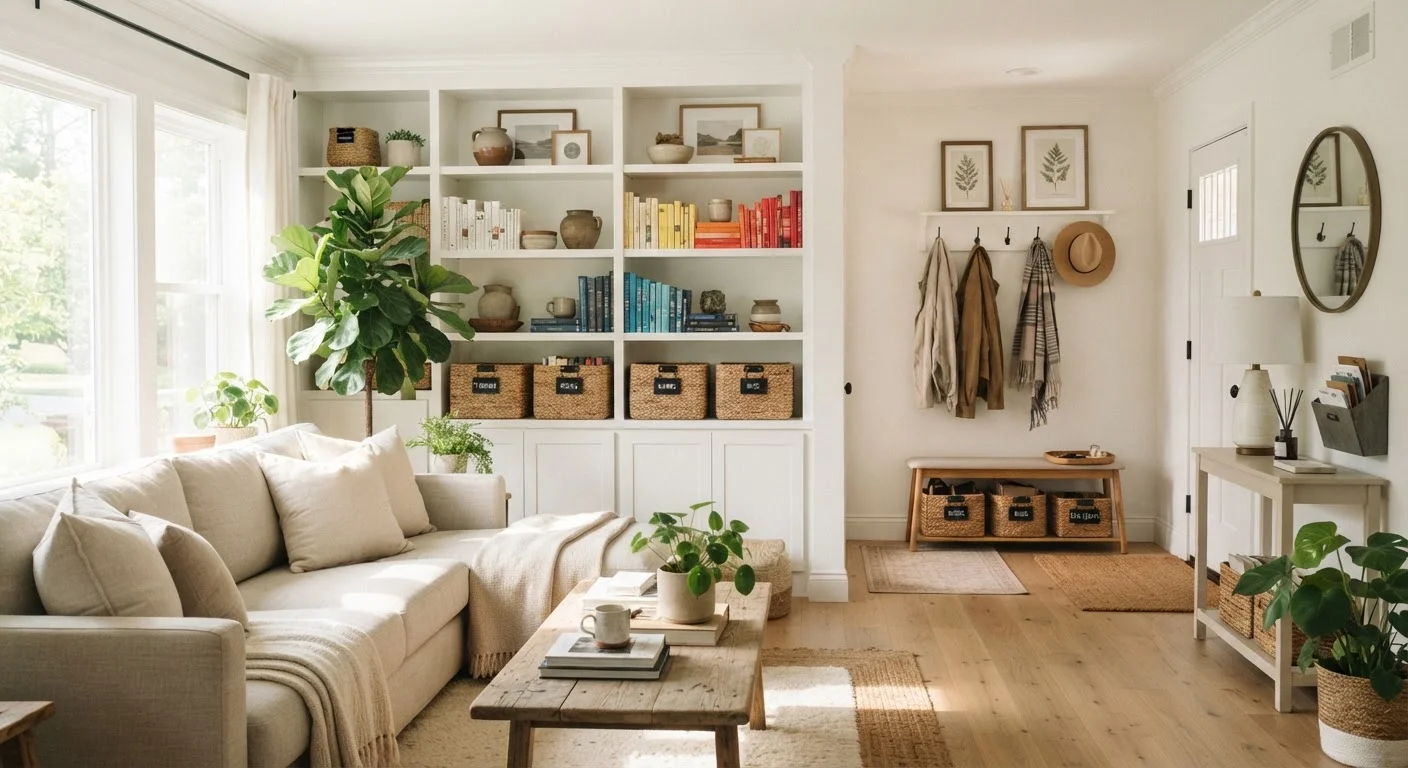
- Contain: Once items have assigned homes, add containers only where loose items would otherwise drift. Label anything that isn't obvious at a glance.
This framework is the same logic professional organizers use, just stripped of the jargon. For a deeper look at how pros apply zones and categories to whole-home planning, how professional organizers think explains the method in practical detail.
Label Before You Buy More Containers
Many organizers recommend labeling existing containers or shelf sections before purchasing anything new. Labels force you to commit to a category, which quickly reveals whether you need a container at all. If a labeled spot stays mostly empty, that space was never the problem.
Tools That Actually Help (Without Overspending)
Resist the urge to shop before you sort. Once you've completed the Sort and Assign steps in your first space, you'll have a much clearer picture of what - if anything - you actually need to buy.
In practice, most first-time organizers need very little:
- Labels or a label maker: The single highest-impact, lowest-cost tool. Clear labels eliminate the guesswork that causes systems to break down.
- A few uniform containers: Matching containers make a space look calmer and are easier to stack. Sizes matter more than aesthetics - measure your shelves first.
- Hooks and over-door organizers: These add storage without requiring a drill or permanent changes, useful in rentals or anywhere wall space is limited.
Keep organization costs in mind as part of your broader household budget. The homeowner budget guide can help you plan for these kinds of small, practical home expenses alongside larger ones.
Room-by-Room Decluttering Roadmap
A structured walkthrough for tackling clutter in every room of the home. Useful once you're ready to move beyond your first organized space.
Zones, Categories, and Containers
Explains the core logic professional organizers use - zones, categories, and containers - so you can apply the same thinking without hiring anyone.
Building a Habit That Sticks
The hardest part of home organization isn't the initial sort - it's maintaining the system two months later. The reason most organized spaces slide back into chaos is that the maintenance routine was never built in.
Two habits do most of the work:
- The daily reset: A five-to-ten minute pass at the end of each day to return items to their assigned homes. This prevents pile-up from ever getting out of hand.
- The monthly check-in: A brief review to catch items that have drifted, spots that aren't working as intended, and anything new that needs a home.
If a system consistently breaks down in the same place, that's signal, not failure. It usually means the assigned location isn't convenient enough, or that others in the household haven't bought into the logic. Systems need to reflect real behavior - not ideal behavior. For households with multiple people, organizing with different habits in mind offers targeted strategies for shared spaces.