
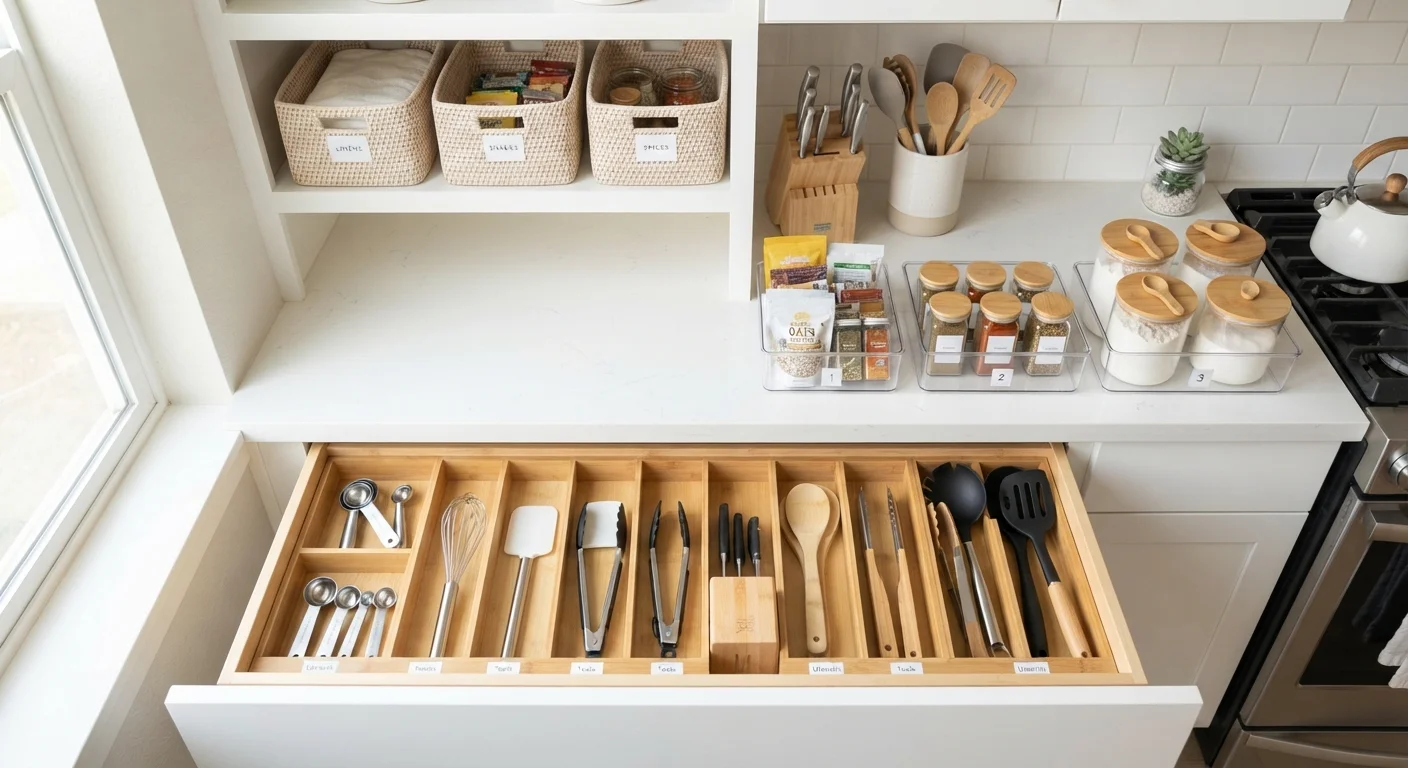
Why Container Choice Matters
Most disorganized spaces aren't short on storage - they're short on the right kind of storage. A junk drawer stuffed with twist ties and batteries isn't a container problem; it's a container-matching problem. When you pair a container to what it's actually meant to hold, things go back where they belong with almost no effort.
This guide covers the three most common household containers - drawer dividers, bins, and baskets - and maps each to the situations where it genuinely excels. Understanding these differences helps you shop thoughtfully and avoid the trap of buying a lot of containers that look good but don't function well. If you want to understand the broader logic behind this approach, see how professional organizers think about zones, categories, and containers.
| Best use for drawer dividers | Flat, same-category items in enclosed drawers |
| Best use for bins | Grouped, grab-and-go items on shelves or in cabinets |
| Best use for baskets | Soft, irregular, or visually prominent living-space items |
| Key principle | Match container size to category size, not available shelf space |
| Common mistake | Buying containers before deciding on categories |
| Longevity tip | Label bins and baskets so categories don't drift over time |
Drawer Dividers: Precision for Flat, Layered Items
Drawer dividers are rigid or semi-rigid inserts that segment the interior of a drawer into distinct compartments. They're designed for items that would otherwise drift, overlap, or disappear beneath one another.
Where they work best
- Utensil drawers: Separating spatulas, whisks, and measuring spoons prevents the tangled pile that makes cooking prep slower than it needs to be.
- Office supply drawers: Pens, paper clips, sticky notes, and scissors each get a fixed lane, so the drawer stays usable long-term.
- Clothing drawers: Adjustable dividers let you section socks, underwear, and folded shirts into columns that stay upright.
Limitations to know
Dividers add the most value when item sizes are relatively consistent. A drawer holding many oddly shaped tools (think a mix of kitchen gadgets and cords) often benefits more from a different approach. Dividers also require the drawer itself to be the main storage unit - they don't work on open shelves or in cabinets.
For kitchen-specific ideas, our small kitchen storage guide covers how to apply these principles in tight spaces.
Bins: Containment for Grouped, Grab-and-Go Items
Bins are open-top containers - usually rectangular or square - made from plastic, wire, or fabric. Their defining feature is quick access: you can see inside, reach in, and pull items out without moving anything else.
Where they work best
- Pantry shelves: Grouping snack packets, canned goods by type, or baking supplies in individual bins means you pull one bin forward rather than excavating the shelf.
- Under-sink areas: Cleaning supplies grouped by task (daily cleaning vs. deep cleaning) are easier to grab and return.
- Freezer organization: Freezer-safe bins keep proteins, vegetables, and prepared meals from becoming an icy avalanche every time you open the door.
- Kids' rooms and playrooms: Wide bins accommodate bulky toys and make cleanup fast because precision isn't required - items just go in.
Limitations to know
Bins can mask clutter if they're not sized correctly. An oversized bin tends to collect unrelated items over time. Matching bin size to category size - roughly - is the key discipline. Stackable bins also extend their usefulness vertically, a strategy explored further in our article on using vertical storage.
Drawer divider
A rigid or adjustable insert that segments a drawer into fixed compartments. Dividers prevent items from shifting and keep categories physically separated within a flat storage space.
Bin
An open-top, usually rectangular container used to group related items on a shelf or in a cabinet. Bins allow quick visual access and easy retrieval without moving surrounding items.
Basket
A woven or fabric container used for storage in living areas. Baskets are flexible in shape, visually warm, and best suited for soft, bulky, or less frequently accessed items.
Category
A defined group of items that belong together by function or use - for example, 'baking supplies' or 'charging cables.' Assigning one category per container is a core organizing principle.
Containment zone
The designated area where a specific category of items lives. A containment zone might be one drawer, one bin, or one basket - the goal is that items always return to the same zone.
Baskets: Flexible Storage with a Softer Footprint
Baskets - woven, seagrass, wire, or fabric - are the most visually forgiving of the three container types. They hold irregular or soft items comfortably, and they work in living spaces where hard plastic would feel out of place.
Where they work best
- Blankets and throws: A large basket beside a sofa keeps blankets accessible and looking intentional rather than abandoned.
- Bathroom counters and shelves: Rolled towels, extra toilet paper, and toiletry backup stock fit naturally in baskets without looking clinical.
- Entryway catch-alls: A medium basket near the door corrals scarves, hats, sunglasses, and other small items that otherwise scatter.
- Open shelving displays: On a bookshelf or floating shelf, a basket adds texture while holding items you'd rather not display openly.
Limitations to know
Baskets are generally harder to clean than plastic bins, and their irregular interior shapes can waste space if you're storing small, uniform items. They're a poor fit for anything that needs to be found quickly by sight - woven sides block visibility. Reserve baskets for broader categories where exact location within the container doesn't matter much.
Thinking about how baskets, bins, and dividers fit into a whole-home system? Compare centralized vs. distributed storage strategies to see how container choice connects to room-level planning.