
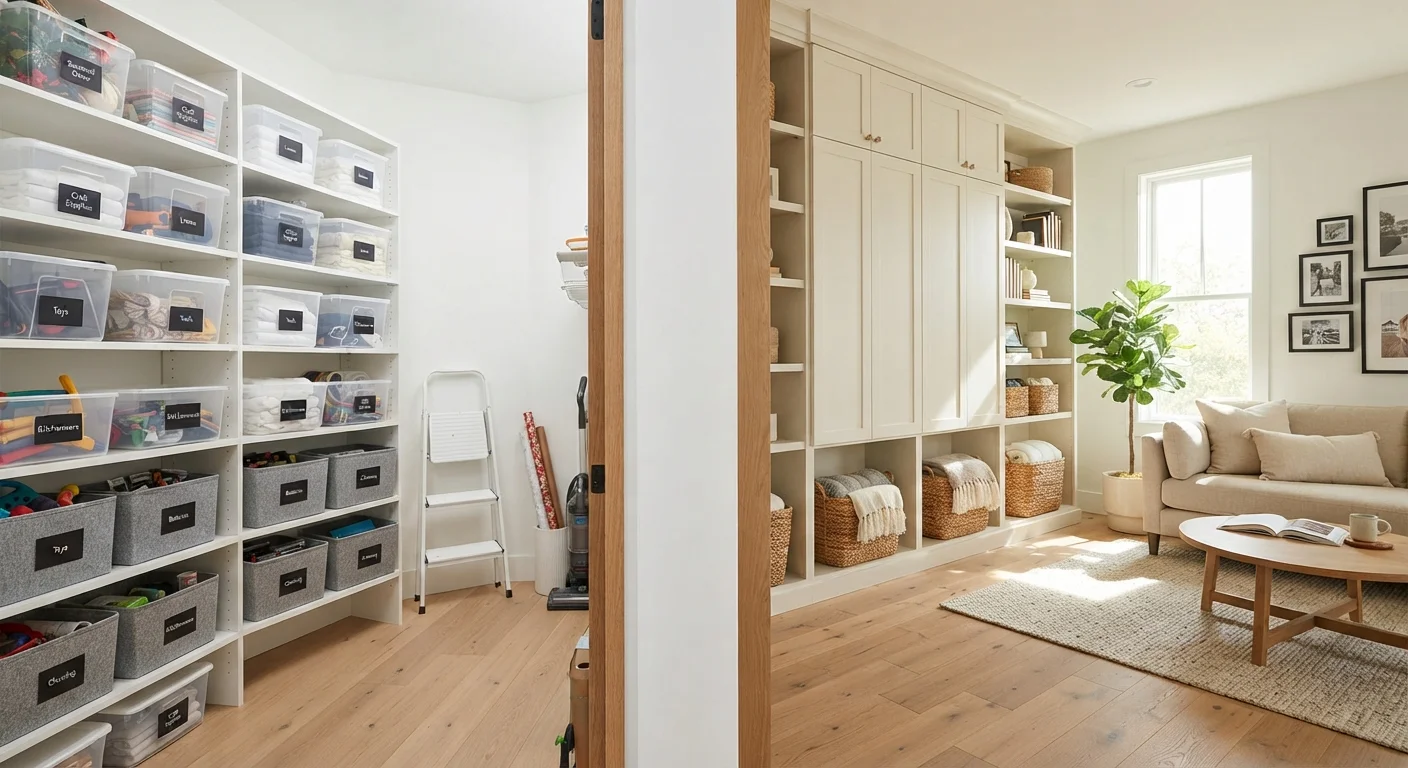
What Each Approach Actually Means
A dedicated storage room is any space - a utility room, walk-in closet, basement section, or converted spare room - where the primary purpose is holding household goods. Everything from holiday decorations to cleaning supplies lives in one centralized location.
Distributed storage means spreading storage capacity across individual rooms so that items live close to where they're actually used: medicine in the bathroom, extra linens in the hallway closet, snacks in a kitchen pantry cabinet, office supplies at the desk.
The tension between these two approaches comes down to a simple question: Is it more useful to know exactly where everything is (centralized) or to reach for something without leaving the room (distributed)? Most homes benefit from thinking carefully about both, rather than defaulting to one by accident.
The Case for a Dedicated Storage Room
A central storage room creates a single point of accountability. When everything has one home base, the rest of your living spaces stay clear. This approach particularly suits households that accumulate bulky or infrequently used items - camping gear, power tools, holiday décor - that don't belong in any single room.
- Easier inventory management: You know what you have and where it is, which helps avoid buying duplicates.
- Cleaner living areas: Common rooms don't double as storage zones, so they feel less cluttered.
- Scalable organization: You can invest in shelving, labeled bins, and systems in one contained space. See fixed vs. modular shelving options to plan the layout effectively.
The main drawback is distance. If your dedicated storage room is in a basement or far end of the house, you may find yourself making long trips to retrieve frequently used items - which can lead to items migrating back into living spaces anyway.
| Dedicated Storage Room | Distributed Storage | |
|---|---|---|
| Access to daily items | Longer trips across the home | Items near point of use |
| Clutter in living spaces | Lower - items consolidated | Higher risk if system breaks down |
| Works in small homes | Needs dedicated square footage | Fits any layout |
| Inventory visibility | Easy - everything in one place | Requires labeling per zone |
| Upfront organization cost | Moderate - one room to outfit | Spread across multiple zones |
| Best for seasonal/bulky items | Excellent fit | Awkward without central zone |
The Case for Distributed Storage
Distributed storage works with the natural flow of daily life. Items live exactly where they're needed, which means less friction retrieving them - and often, more consistent put-away habits, because returning something is just as easy as taking it out.
- Reduces clutter migration: When storage is close to the point of use, people are more likely to actually use it.
- Scales well in smaller homes: Apartments and compact layouts can't always spare a whole room. Vertical storage strategies can dramatically expand capacity without using floor space.
- Works for multi-person households: Different people can maintain their own storage zones. Organizing for multiple adults with different habits often works better with distributed systems.
The challenge with distribution is consistency. Without a clear system, items end up stored arbitrarily - which means duplicates accumulate, things get lost, and no one can find what they need. Using the right containers for each zone helps enormously; understanding what each storage container does best prevents mismatched solutions.
Label Everything at the Zone Level
Whether you use a central room or distribute storage throughout, labeling containers at the zone level - not just the item level - makes the system self-maintaining. When anyone in the household can read 'bathroom: medicines & first aid' and know exactly where that bin lives, the system survives even the busiest weeks. Simple masking tape and a marker costs almost nothing and saves significant time.
How to Decide - and How to Combine Both
Start by auditing what you actually store. Walk through your home and list items by frequency of use: daily, weekly, monthly, and seasonal. Daily-use items almost always belong in distributed storage near their point of use. Seasonal and bulky items are natural candidates for a central room.
If you have a dedicated room already, resist the urge to fill it with everyday items. Treat it as a depot for things you genuinely need less than once a week. If you don't have a dedicated room, a large hall closet, a section of the garage, or even a set of uniform bins in one location can serve the same purpose at low cost.
For rooms that need to do double duty - like a home office that also stores fitness equipment - focused thinking about zones pays off. Our guide to setting up a dedicated workout corner without wasting space shows how even small footprints can hold a functional storage zone without chaos. Similarly, smart kitchen storage strategies demonstrate how distributed storage can be highly systematic even within tight constraints.
Neither approach requires significant spending to implement well. Labeled bins, consistent shelving heights, and a commitment to putting things back where they came from matter more than expensive furniture.